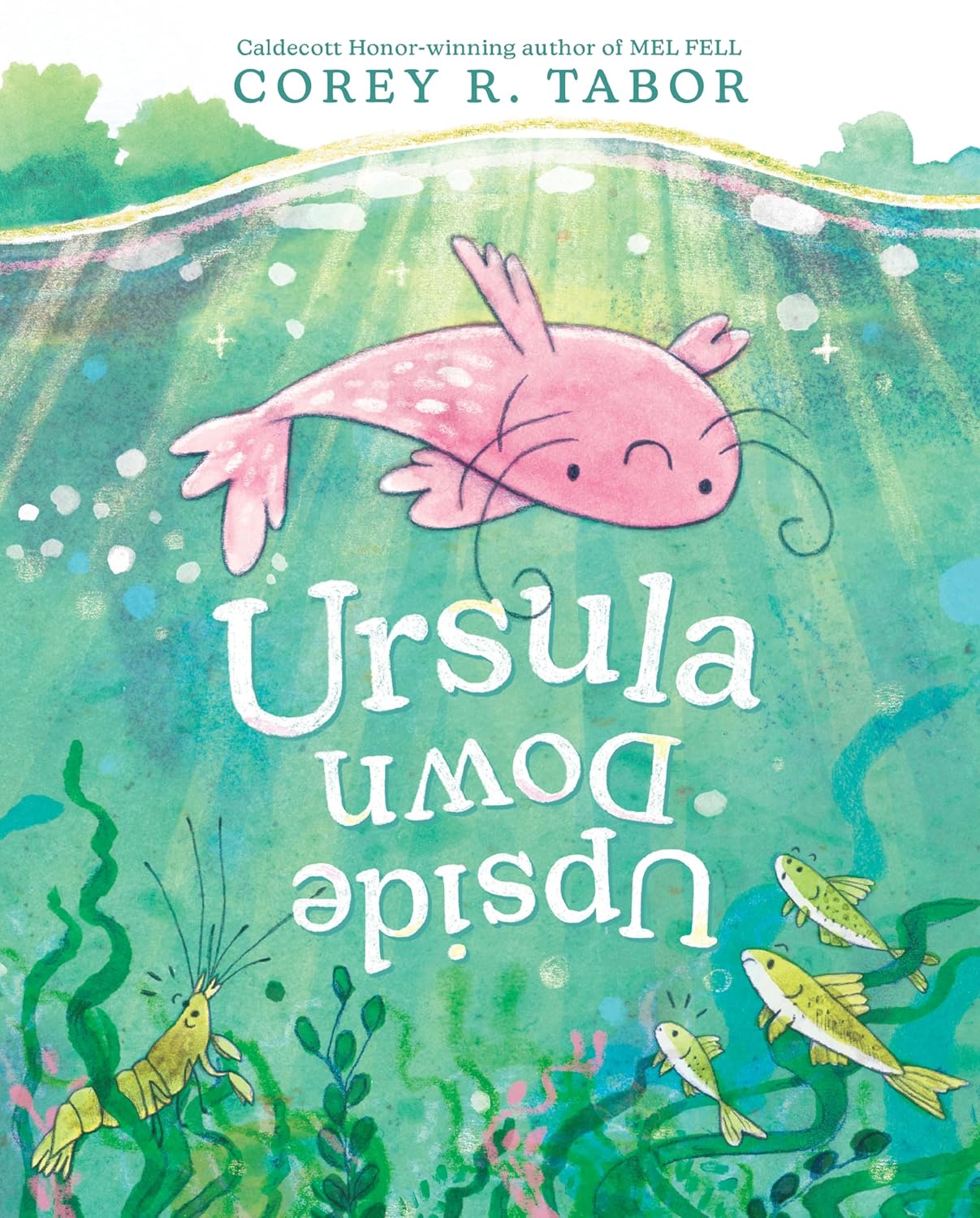
I adore Ursula Upside Down. It’s one of my favorite books of the last several years. It’s sweet, funny, gorgeously illustrated, based on a true natural phenomenon, and has a surprise ending that is so obvious and perfect that you wonder why you didn’t figure it out before it happened. In what is becoming a theme, I took it out of the library for my own research and S decided to adopt it. Let’s take a look at why.
The book introduces and humanizes its main character early.
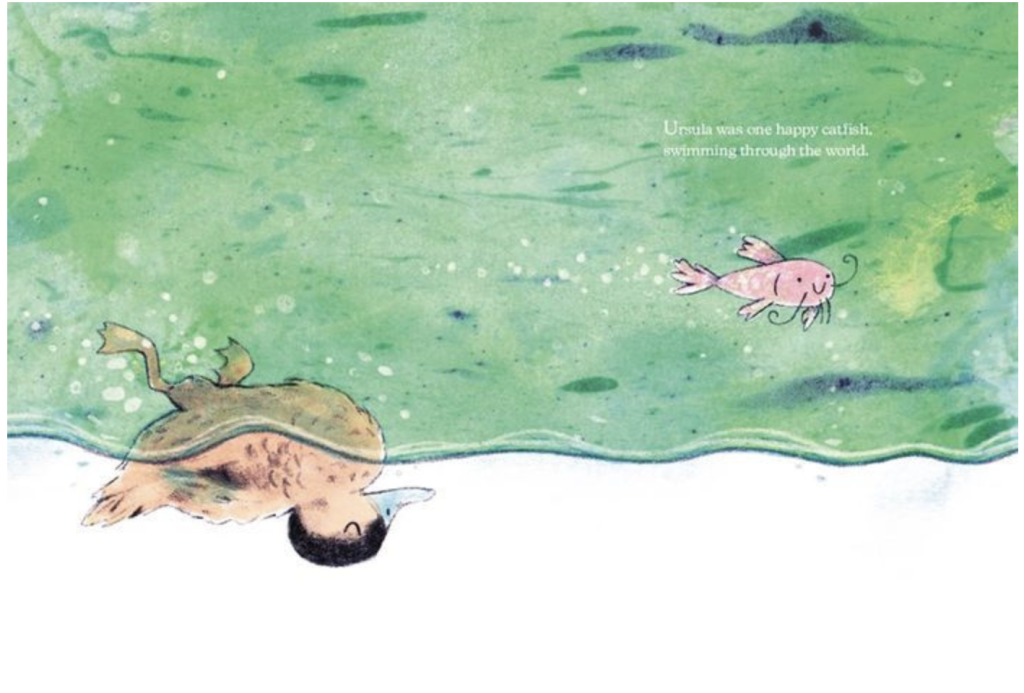
Here’s Ursula on the first page. She’s bright pink, smiley, and plainly introduced as such: “Ursula was one happy catfish, swimming through the world.” In one sentence and picture, you already feel like you know her, and she’s a delight.
S immediately took a liking to Ursula. Just like Milo in The Penguin Who Was Cold, the quick introduction to Ursula makes S like her and care about her problem. And just like Milo, Ursula’s problem is laid out quickly enough to hold a two year old’s attention.
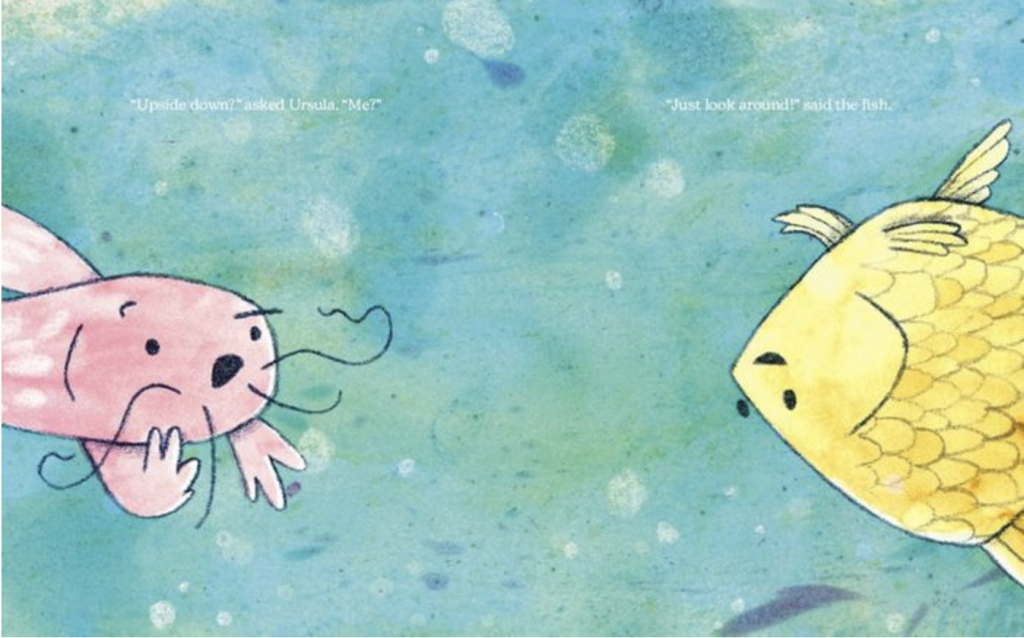
Ursula is very clearly upside down – the duck’s positioning makes that obvious to even the most fidgety of readers. And within pages, we see Ursula’s world flip when she learns that others don’t see things the way she does. Since we already care about her, we now care about her being upset too.
The book combines both obvious and unexpected toddler interests.
The obvious: animals. Ursula is an adorable fish, surrounded by other fish, ducks, etc.
The not-so-obvious: being upside down. S LOVES getting flipped upside down, and immediately identified with Ursula being upside down. This led to S continuously exclaiming “Ursula! Upside Down!” whenever S spotted or opened the book.
The book is interactive, snappy, and colorful.
Perhaps unsurprising given toddler attention spans, Ursula Upside Down gets high marks from S for its short, snappy sentences, bright pictures, and interactivity.
The fact that Ursula is upside down from the start offers built-in interactivity throughout the story — S and I can flip the book to see various animals and scenery change perspectives. Starting on the first page, it’s fun to flip the book on its head to see what we associate as “normal” (a duck swimming on top of the water) turn right-side up.
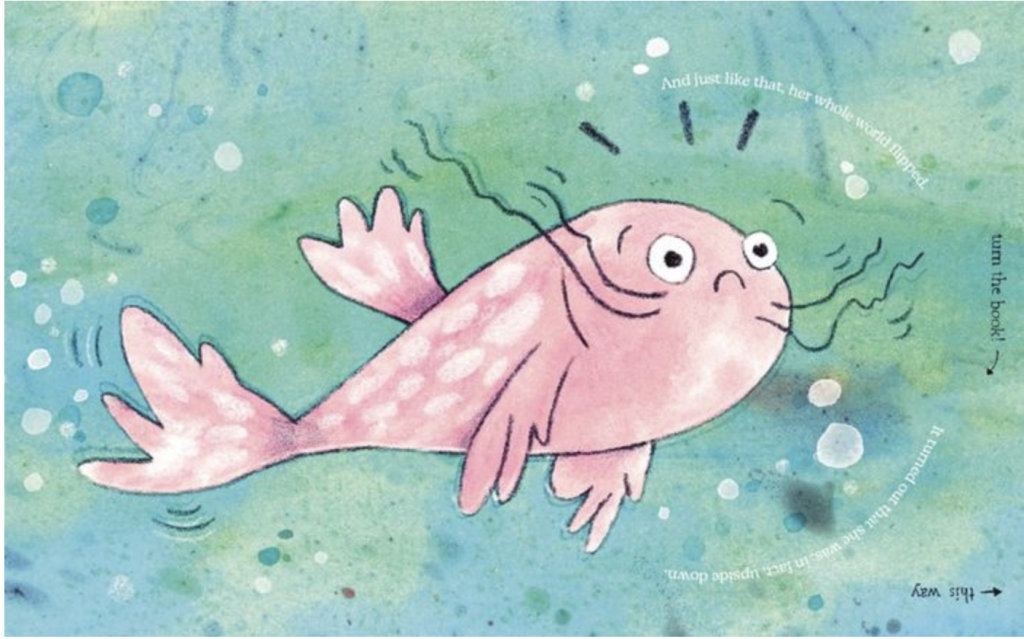
Corey R. Tabor brilliantly flips the whole book when Ursula starts to wonder if she’s been upside down the whole time. This also keeps S’s attention — it’s the only book we’ve read that uses the medium of the book like that, and it’s an interactive experience.
As with Milo’s journey in The Penguin Who Was Cold, the end of the story here goes over S’s head. (Though as noted above, it’s amazing and you should definitely check it out.) But none of that matters to S. We read the book for our cheerful pink friend, and will continue to reach for the story because of all the excellent leg-work (fin-work?) that was put in up front.
Ursula Upside Down By the Numbers:
Pages: 31 pages of what I would consider the “main” book
Word Count: 272 (282 if you add in speech bubbles in the illustrations that are hilarious but not necessary for the main story to work)
Words Per Illustration: 14.3
Words Per Sentence: 6.33
Leave a Reply