Jennifer Tarr

Writing picture books for kids and their grown ups.

Tag: Dogs

  • Toddler Teaches…TWO DOGS

    Toddler Teaches…TWO DOGS

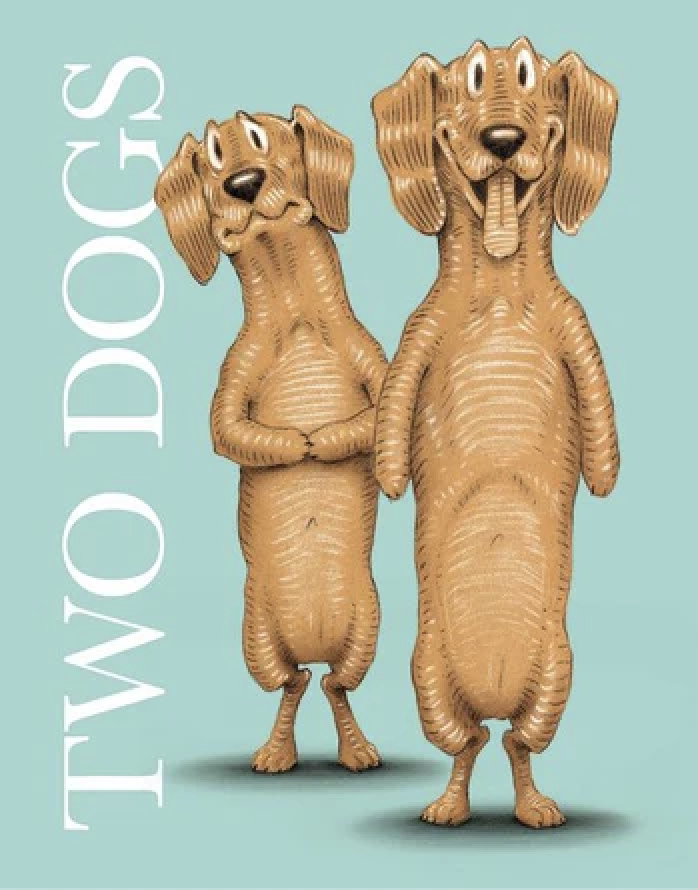
    Ian Falconer’s Two Dogs is a bit of a mystery to me. S loves it. But with the exception of having two dogs as protagonists, it defies almost everything I thought I knew about what makes books appealing to a 2-year old.

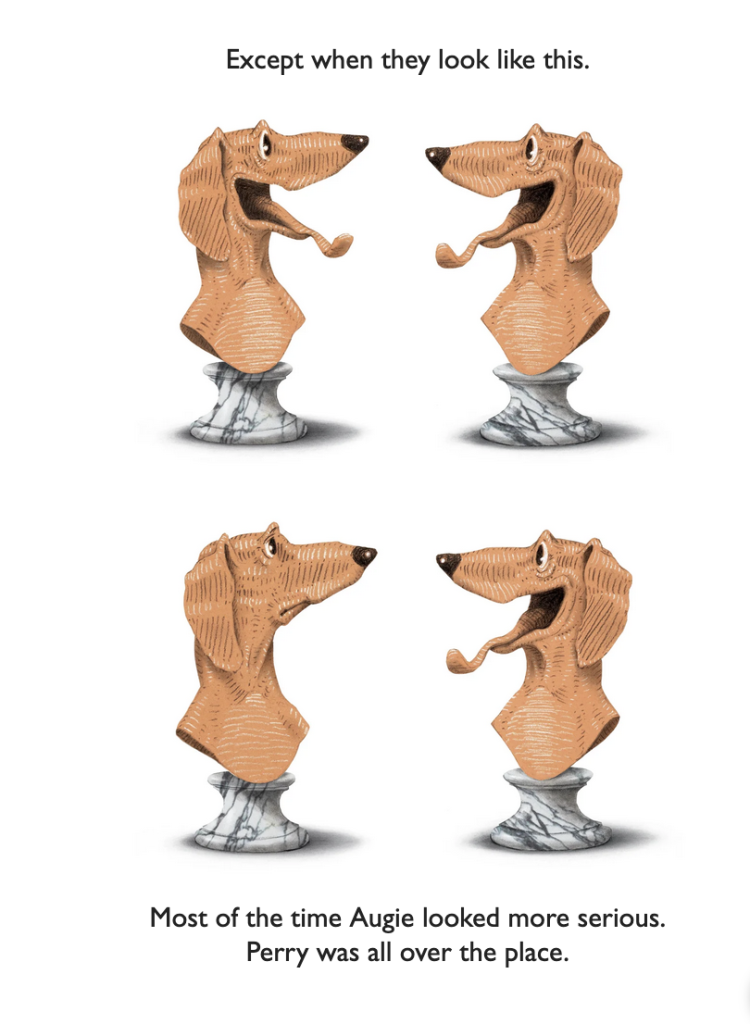
    Start with the intro. It’s unique, clever, and makes no sense to S:
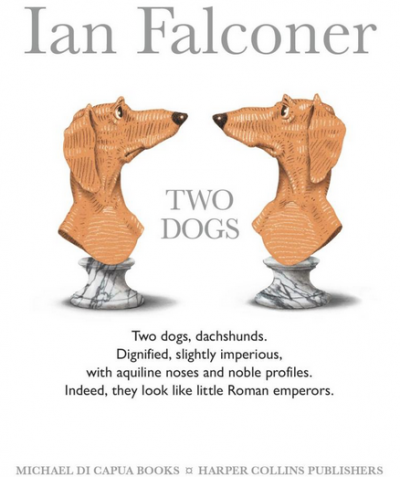
    First page of Two Dogs by Ian Falconer

    Over the next several pages, the story introduces Perry and Augie, their differing personalities, and their problem: their family played with them all the time as puppies, but now leave them alone all day. (Darn work and school!)

    These concepts go completely over S’s head. Most days, we flip past all of the intro pages without even paraphrasing them. For S, the book begins on page 7. That’s when Perry steals Augie’s ball.

    Over the next several pages, Augie asks Perry for his ball back with increasing levels of desperation.
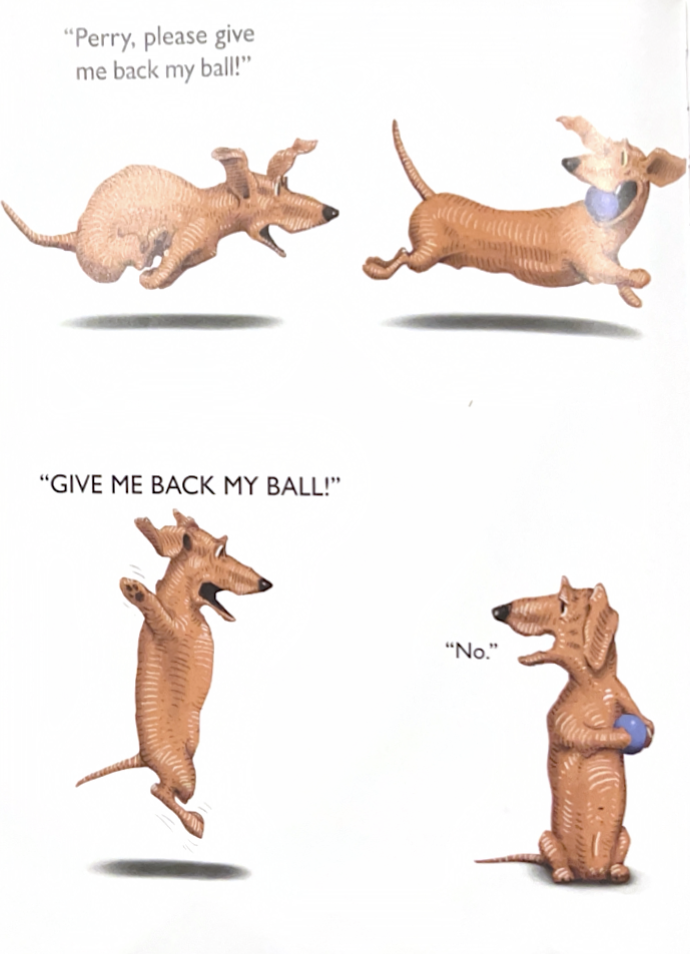
    S loves this section of the story, and will point at these pages and say “Give the ball back.” “Give it back!” S will also open the book directly to these pages and say “Read Perry book!” I think S enjoys the repetition in Augie’s requests, as well as looking at the pictures of Augie and Perry jumping around – they are very active. I also think S identifies with the song-and-dance of trying to get your toy back. It seems to be a common thing in early preschool.

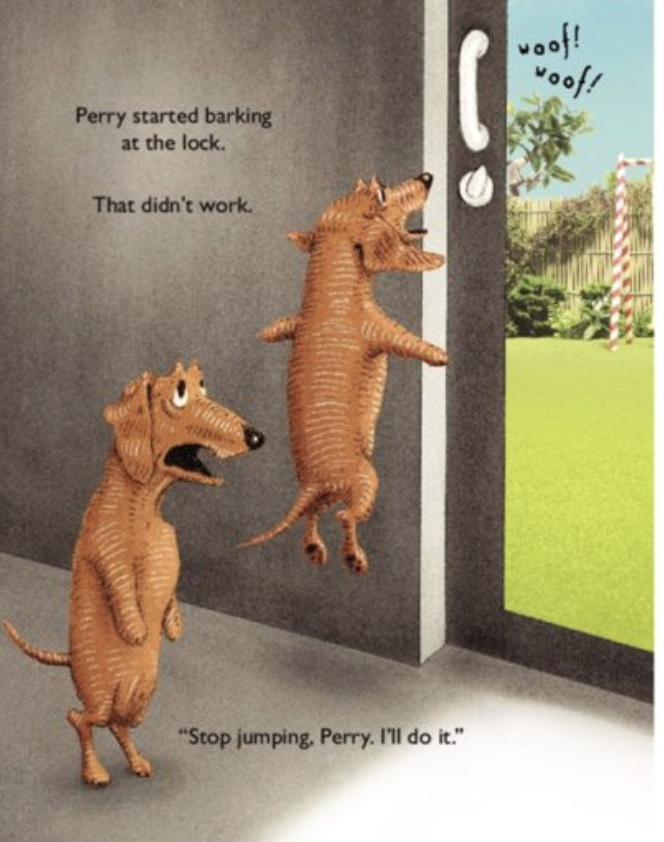
    S also loves the next section of the story, where Augie and Perry try to open the door to leave the house. Each time we read it, S informs me that the dogs are trying to “open the door.” This is a relatively new skill for S, which may be why it is of interest. The pictures are also quite colorful, which certainly doesn’t hurt.
    After that, we mostly skip pages or paraphrase. Of the dogs’ antics outside, we focus on their playing on the playground and swimming in the pool — things that S is familiar with and likes. Their other activities are funny but go over S’s head (ex: “watering” the flowers) or are written in a manner that is too advanced for a 2 year old and never caught S’s attention.

    But even though we read less than half of the book each time, S keeps asking for it.

    So what can Two Dogs teach us about appealing to toddlers despite being geared toward older readers?

    1. There is value in including topics that may be of interest to multiple age ranges. You never know what will pique a toddler’s interest or make a book suitable for siblings of different ages.
    2. Though the book starts “slowly”, I continue to think that starting your story quickly and with short, punchy sentences is the best way to appeal to a younger reader. If I had followed S’s cues rather than my own curiosity, I would have stopped reading long before we got to the part S enjoys so much.
    3. Shorter sentences and more illustrations per sentence help with complex topics. The pages we read have half the number of words per illustration of the ones we don’t. It’s been a pretty common phenomenon — S is more likely to want to read stories with shorter sentences and fewer words per picture.
    4. Dogs are always a good protagonist choice, particularly when they’re engaged in fun antics like Augie and Perry.

    Two Dogs By the Numbers:

    Page count: 40

    Word count: 423

    Average word count per illustration on pages we read aloud: 6.72

    Average word count per illustration on pages we don’t read aloud: 13.13

    Average sentence length on pages we read aloud: 4.48

    Average sentence length on pages we don’t read aloud: 6.71
  • Toddler Teaches…LITTLE RED HEN

    Toddler Teaches…LITTLE RED HEN

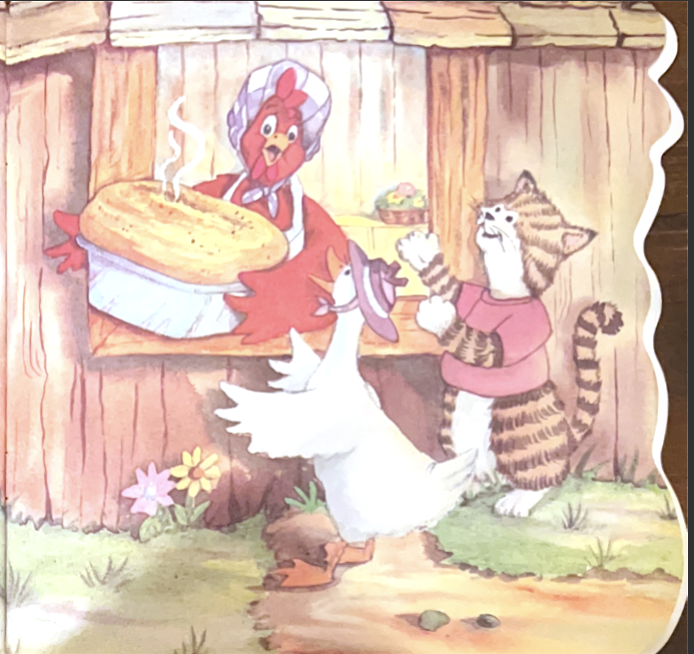
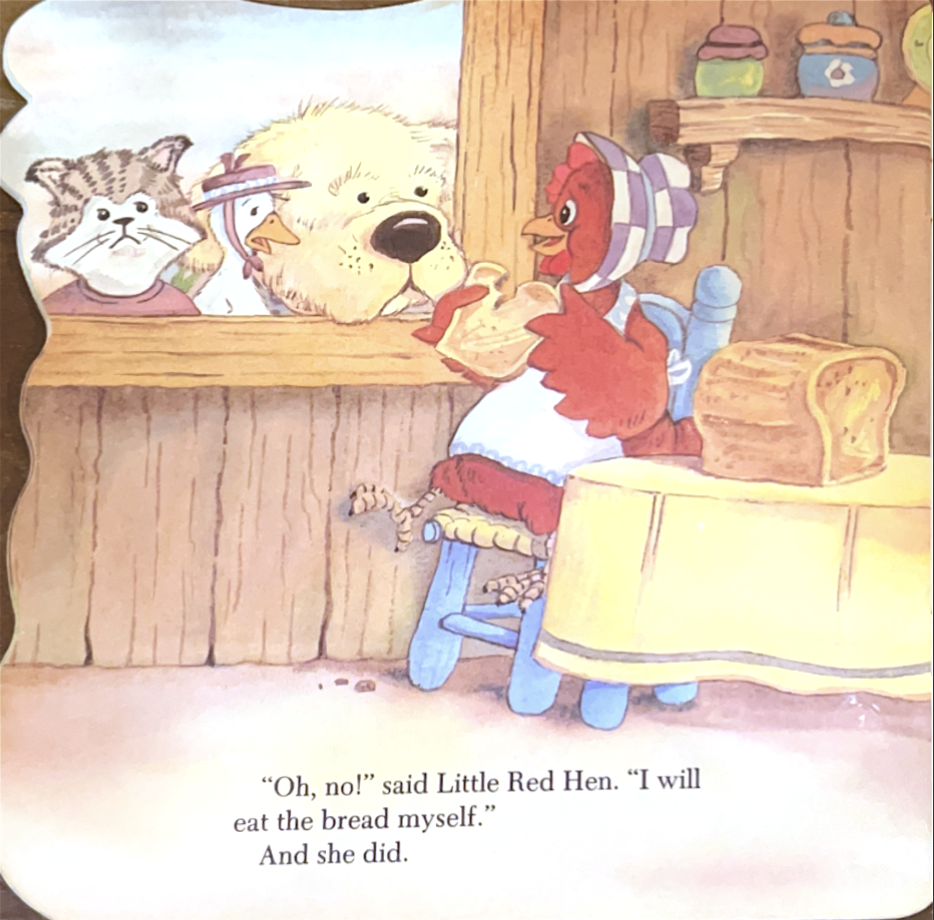
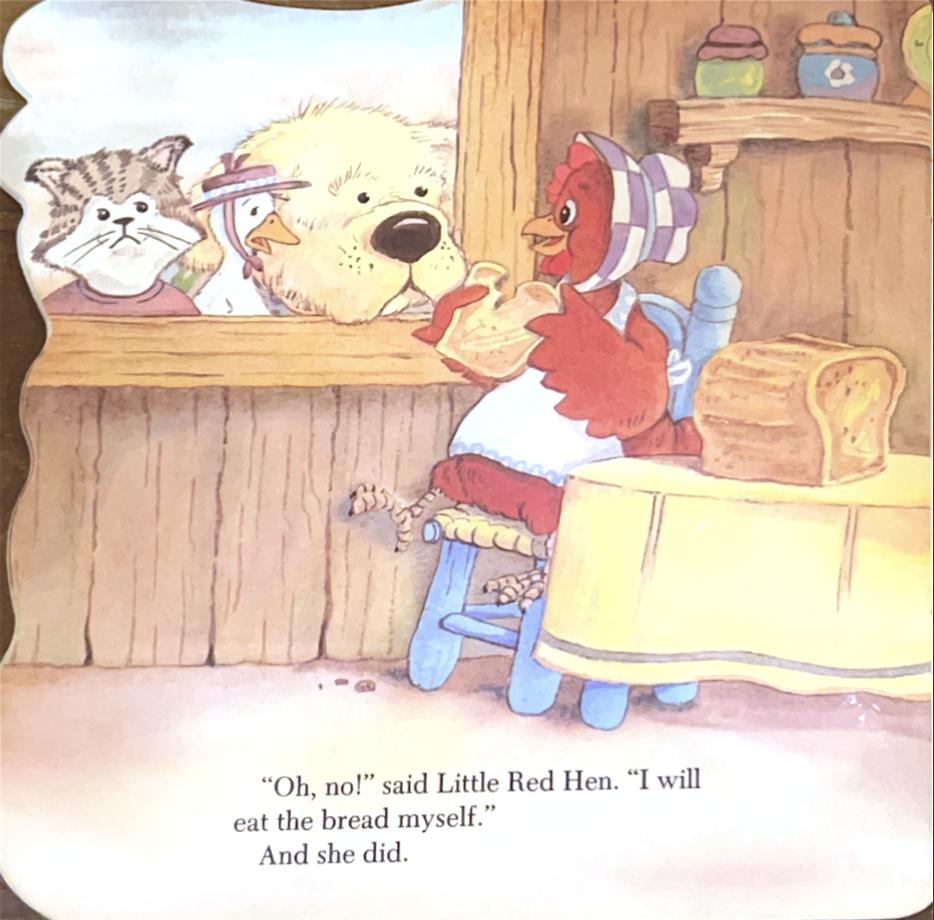
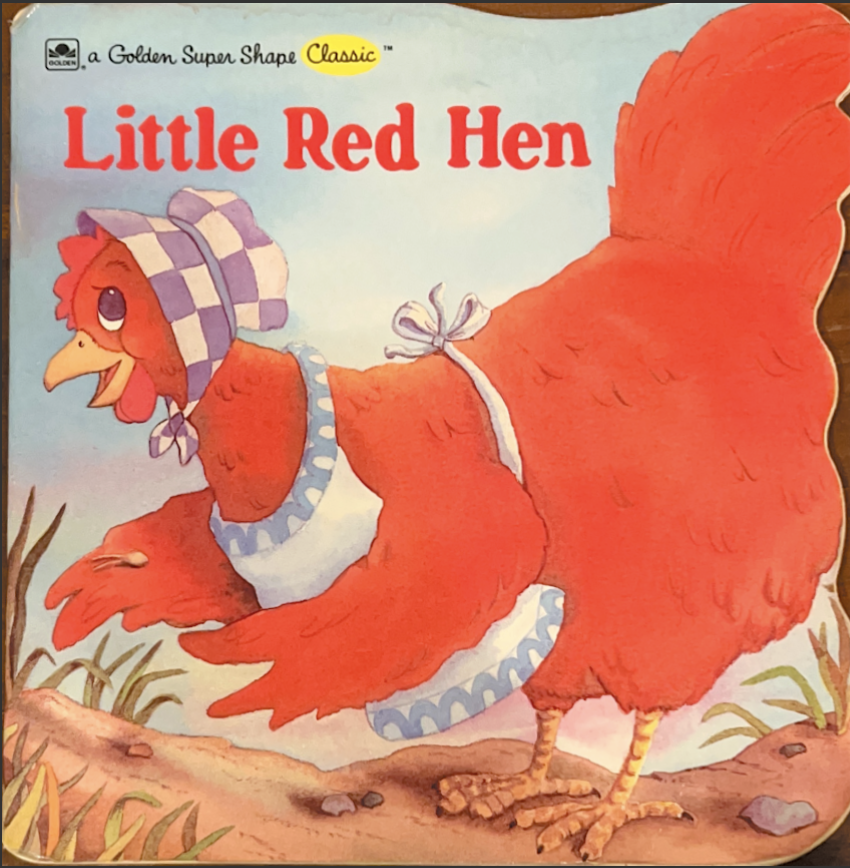
    Because they are awesome, my parents held onto my favorite childhood books. Lyn Calder and Jeffrey Severn’s Little Red Hen was high on that list. I loved the Hen’s absolutely giant loaf of bread, as well as her (suddenly smaller) slice of toast.

    Seriously, how much bread did the Little Red Hen eat between the prior page and this one? And why is it no longer the size of her torso?

    Over the summer, my parents pulled out a number of my childhood favorites to read to S. Little Red Hen was an immediate winner. It’s got all the elements needed for toddler success: animals; bright, colorful illustrations; and short, punchy refrains. Not to mention carbohydrates.

    Breaking Down Little Red Hen

    Little Red Hen follows a predictable pattern, which got S actively interacting with the story as early as 19-20 months:

    • First, the Hen asks “Who will help me [do whatever thing she needs help with to keep making the bread]?”
    • Each time, the other animals respond in the same Rule of 3 refrain: “‘Not I,’ said Duck. ‘Not I,’ said Cat. ‘Not I,’ said Dog.”
    • Hen responds in a predictable pattern that mirrors her initial ask, reinforcing the language that was already used: “Then I will [do whatever Hen’s initial request was] myself.”
    • The sequence for each of Hen’s requests concludes with: “And she did.”

    S loved the repetitions, and loved chiming in “did” at the conclusion of each section.

    The refrains and parallel language are predictable, vocabulary building, and fun. They also use simple, declarative sentences that make it easier for young readers to understand what is happening and participate in the action.

    The last few pages invert the animals’ refusals to help, continuing in a Rule of 3 pattern that ties the ending of the book to everything that came before in a satisfying “of course!” conclusion.

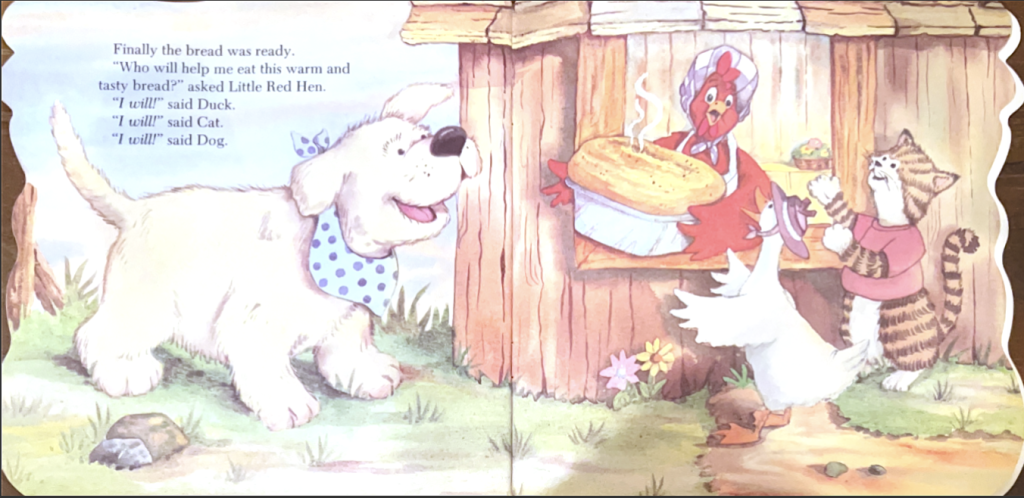
    Who will help Hen eat the (absolutely ginormous) bread? “I will!” said Duck, Cat, and Dog. But in a continuation of the previously established pattern, Hen responds that she will eat the bread herself. And in a continuation of the refrain S loves so much, the story ends with a simple, “And she did.”

    Analyzing the construction of the book, I can see why I loved Little Red Hen as a kid and why S loves it now. (Though if we’re being honest, I still really like the bread pictures, so maybe it’s more about the carbs than the exceptional construction of the story…)

    Trying a Reimagining of the Story

    Given S’s love of Little Red Hen, I thought it would be interesting to see S’s reaction to a version of the story geared for slightly older readers.

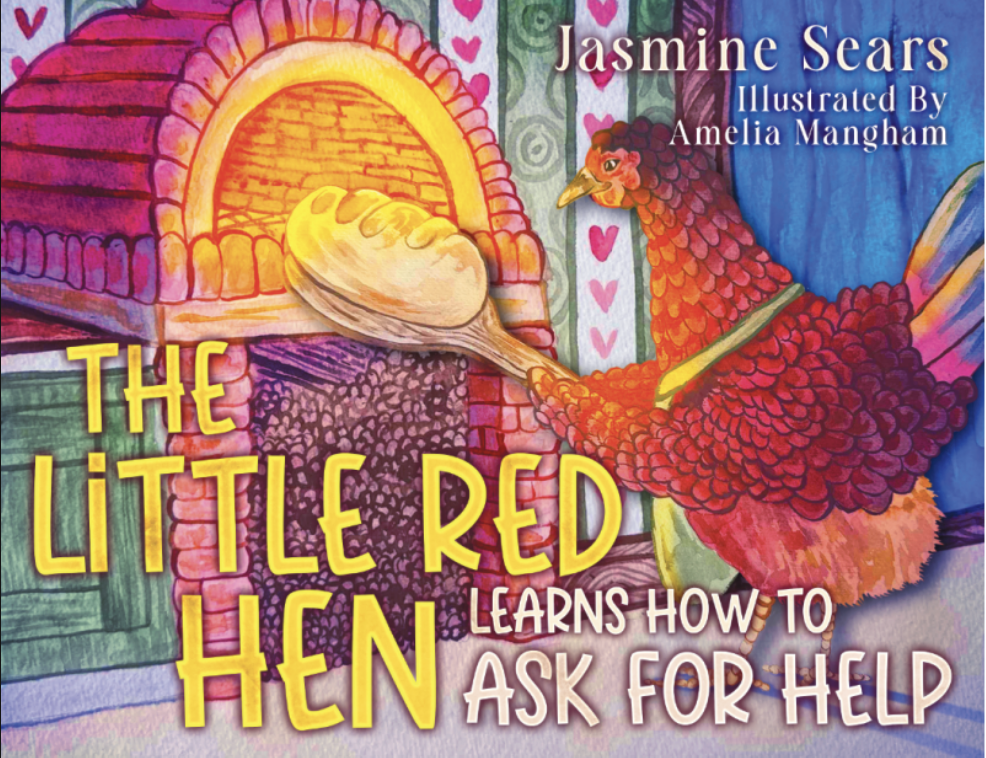
    Thanks to Jasmine Sears for the eARC!

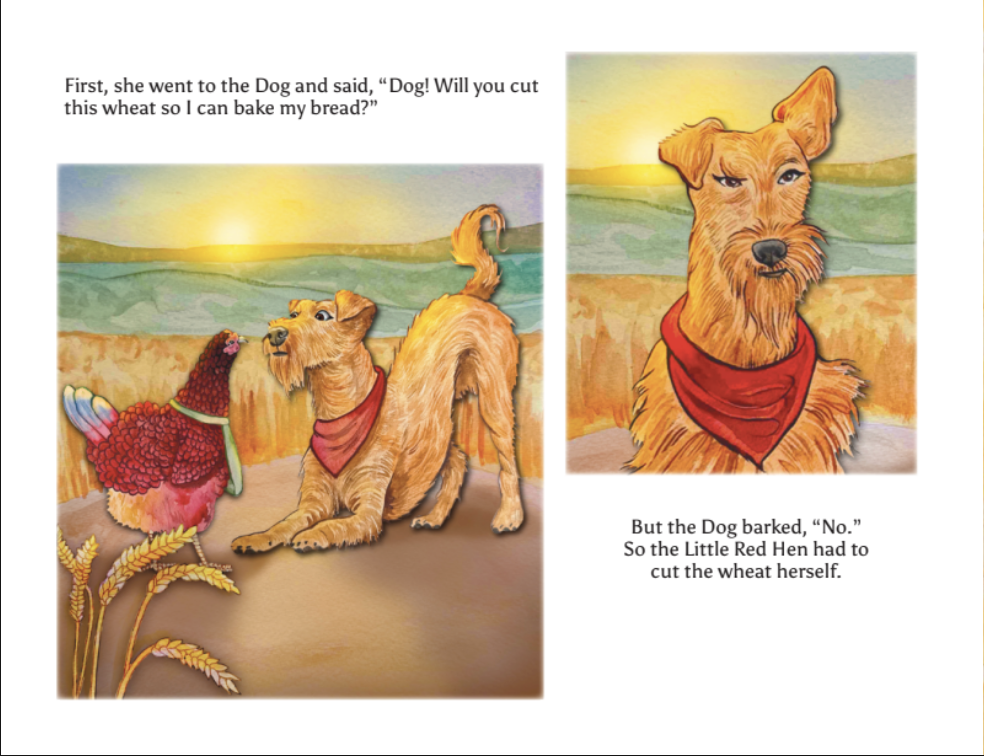
    Jasmine Sears‘s and Amelia Mangham‘s upcoming picture book The Little Red Hen Learns How to Ask for Help cleverly reimagines the story in a light more favorable to the Hen’s unhelpful friends. In their retelling, Hen has asked — nay, demanded — each of her friends help her with a task they are unsuited to do. Dog is told to cut the wheat, Cat is told to fetch the water, and so on. It is only after Hen realizes she should be asking nicely and asking her friends for help with things they know how to do (and are not afraid of doing) that they all pitch in and bake the bread together.

    S was absolutely transfixed by the illustrations in this version — they’re beautiful, bright, and almost glow from within. We made it to the end of the first half of the story (where Hen eats all the bread herself), which is the part S already knew. That was 367 words, which is on the long side for S’s attention span but doable with this many illustrations (particularly when they are brightly colored and of animals) and predictable, parallel language. The fact that S already knew the basics of the story to that point probably also helped.

    S’s interest in the retelling highlights the value of reimagining stories that are familiar to young readers — the more familiar the story, the easier it is for a young reader to understand parts of the retelling, even if generally aimed at an older age group. It’s also another mark in the plus column for animals, parallel language, and brightly colored illustrations (a.k.a. toddler gold).

    Little Red Hen By the Numbers:

    Pages: 23

    Word Count: 297

    Words Per Illustration: 24.75

    Words Per Sentence: 7.24

    The Little Red Hen Learns to Ask for Help By the Numbers:

    Pages: 36 pages of what I would consider the “main” book.

    Word Count: 785

    Words Per Illustration: 13.77

    Words Per Sentence: 10.61