Jennifer Tarr

Writing picture books for kids and their grown ups.

Tag: active illustrations

  • Toddler Teaches…HANUKKAH PAJAMMAKAHS

    Toddler Teaches…HANUKKAH PAJAMMAKAHS

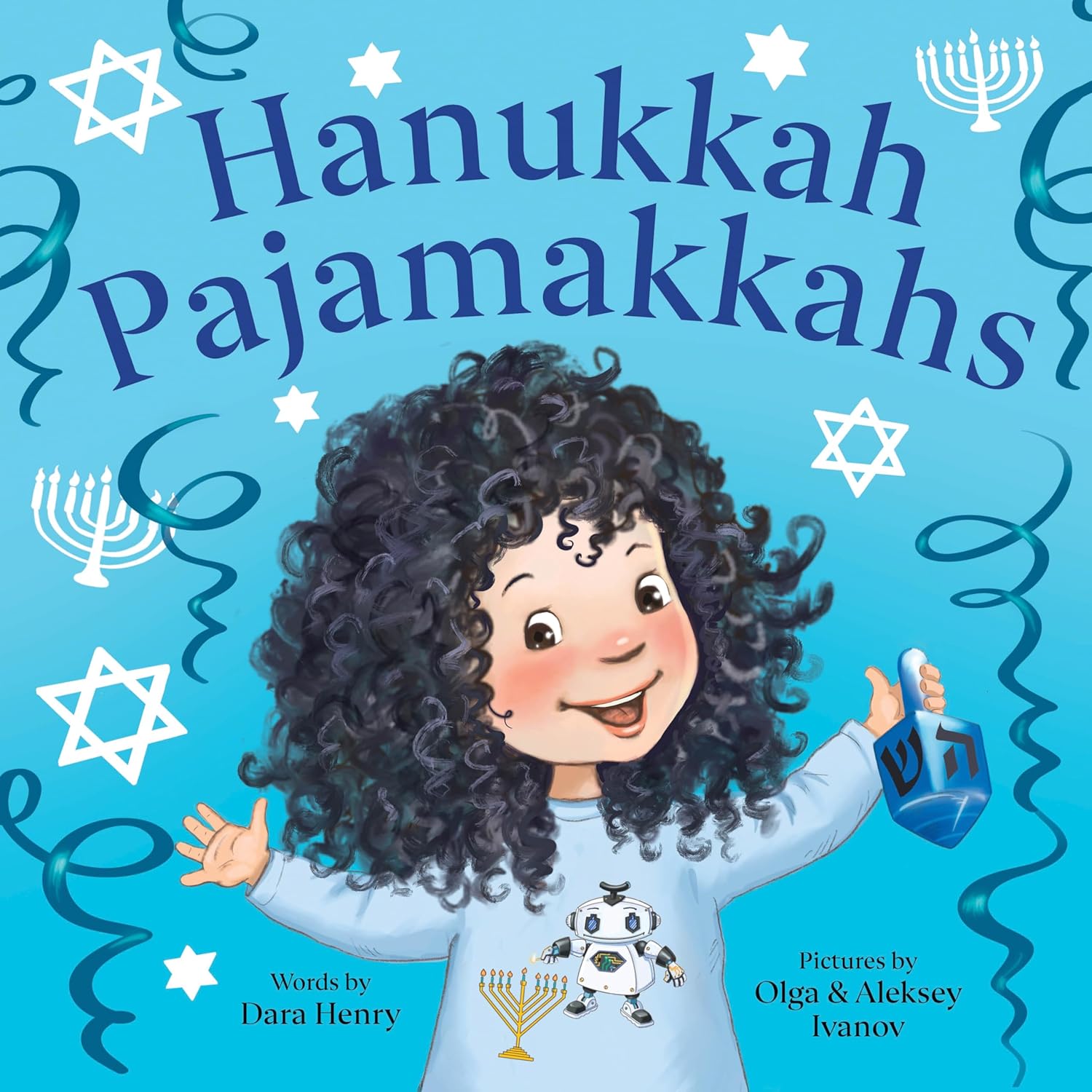
    Continuing our theme of “representation matters,” let’s take a look at Dara Henry and Olga and Aleksey Ivanov’s adorable Hanukkah Pajamakkahs.

    The story is geared for readers ages 4 and up, and its main joke/premise goes over S’s two-year old head. Ruthie wants to wear her fun new Hanukkah pajamas for all eight nights of Hanukkah and promises her parents she will keep them spotless. She naturally proceeds to get them extremely messy, but claims she’s in the clear because streaks, drips, and splotches aren’t technically spots.

    The book’s sentences are also generally too long for S’s attention span and comprehension abilities. Excluding one-word onomatopoeia sentences, the book averages 8.5 words per sentence, with nearly half of them clocking in at 9+ words per sentence. I wind up doing a fair amount of summarizing on each page, which I think makes S less likely to request an immediate re-read of the book when we finish it (there’s less repetition/consistency when I summarize, and toddlers seem to adore repetition/consistency).

    Nonetheless, S is always excited to read Hanukkah Pajamakkahs when she spots it (terrible pun intended) on the shelf. Here’s why:

    Hanukkah Pajamakkahs introduces its prime toddler hook quickly.

    The book begins with Ruthie opening her Hanukkah pajamas, which she calls “pajamakkahs.” S finds this delightful. “Pajamakkahs” is fun to say, and the book instructs the reader to say it with excitement — both the text (Ruthie “squealed in delight”) and the layout (putting “pajamakkahs” in big, colorful font) demand that “pajamakkahs” be uttered with verve. S loves to join in and shout “pajamakkahs!”
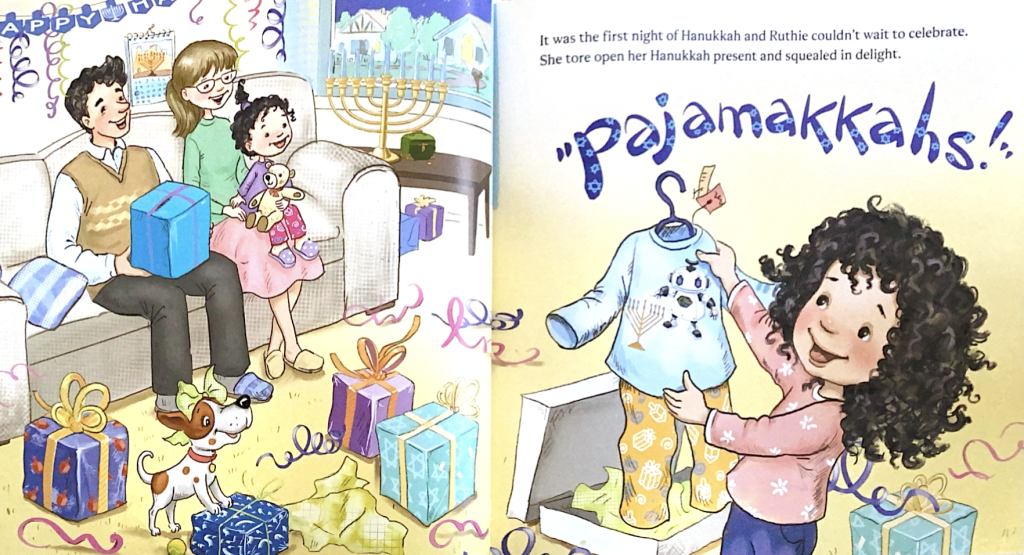
    You too would want to wear your pajamas 8 days in a row if they featured a robot lighting a menorah.

    In addition to starting the story off with excitement, the pajamakkahs are relatable — like Ruthie, S has Hanukkah pajamas and loves to wear them, regardless of the time of year. Hanukkah is exciting, and Hanukkah pajamas carry that excitement forward into something mundane (bedtime).

    Like the joyful challah-baking in Challah Day!, Ruthie’s excitement over pajamakkahs (and the existence of a book centering that excitement) is a prime example of meaning coming from something small — a slice-of-life kind of representation.

    The book features lots of relatable Hanukkah items and activities.

    S also identifies with and enjoys pointing out the other Hanukkah items in the story. Ruthie lights a menorah, makes latkes, and plays dreidel, and many of these items can be found in the background of multiple spreads. These items are exciting, and keep S turning the pages to find more of them.
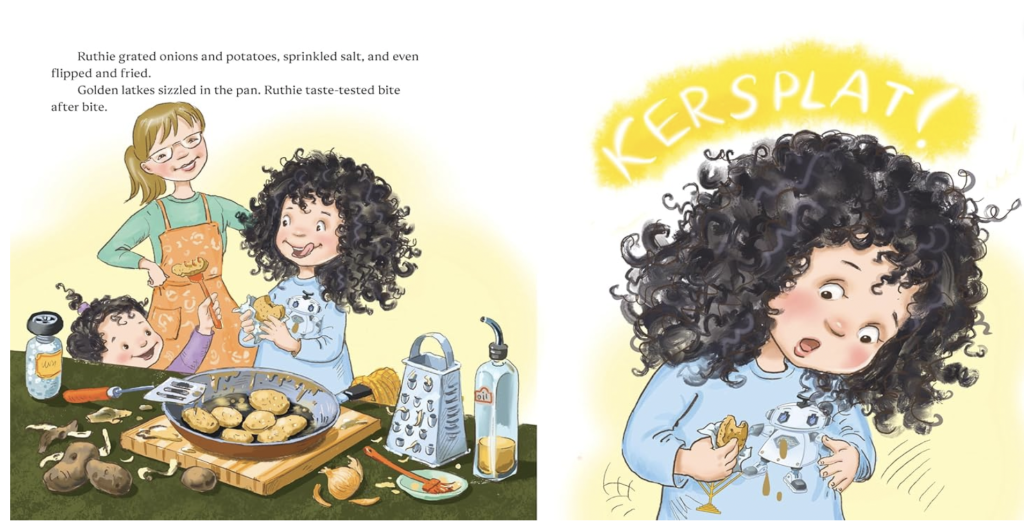
    Ruthie’s first stain is definitely a drip, not a spot, so I give her credit for her rules lawyering.

    There is a ton going on in the illustrations, Hanukkah-related and otherwise.

    As noted above, S loves to point out Hanukkah-related items in the book, and Hanukkah Pajammakahs‘ illustrations have no shortage of them to look at. They also have a ton of other things going on, which keep S engaged and interacting with the book.

    The below spread is probably S’s favorite spread in the whole story. It takes place outdoors (always a favorite) and features kids playing soccer, a dog running around, flying food, and lots of ancillary items to take note of — hats, scarves, a picnic, etc. There is a lot of action and joy in this spread, which S picks up on.
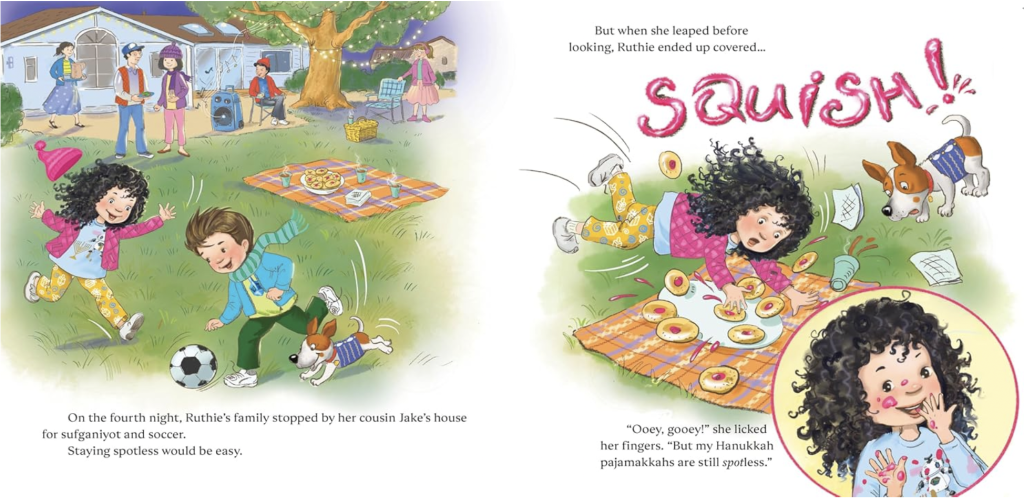
    By Day 4, I’m pretty convinced that Ruthie’s already got true spots on her PJs. I’m also kind of shocked the puppy isn’t trying to eat her shirt…

    The book makes fun use of onomatopoeia.

    Each time Ruthie gets her pajamas messy, the book uses fun onomatopoeia to describe what is happening. Latke drippings go “kersplat!,” jelly donuts go “squish!,” glitter goes “floof!,” and so on.

    Like the initial use of “pajamakkahs!,” the onomatopoeia acts as a cheerleader in the middle of the story, raising our enthusiasm level as we read.

    Potentially of note for anyone trying to use onomatopoeia as an element to bring in younger readers: S tends to get more excited by certain kinds of onomatopoeia than others. At age 2, words that make sense in context like “squish,” “crash,” or “whoops” tend to get a better reaction than words that convey a sound that S may not understand.

    TL;DR: If you or your kids like Hanukkah, fun sounds, giant messes, or rules lawyering, check Hanukkah Pajamakkahs out. It’s a fun read!

    Hanukkah Pajamakkahs By the Numbers

    Pages: 31 pages of what I would consider the “main” book

    Word Count: 468

    Words Per Illustration: 15.6

    Words Per Sentence: 7.1 (8.5 if one-word onomatopoeia sentences are removed)
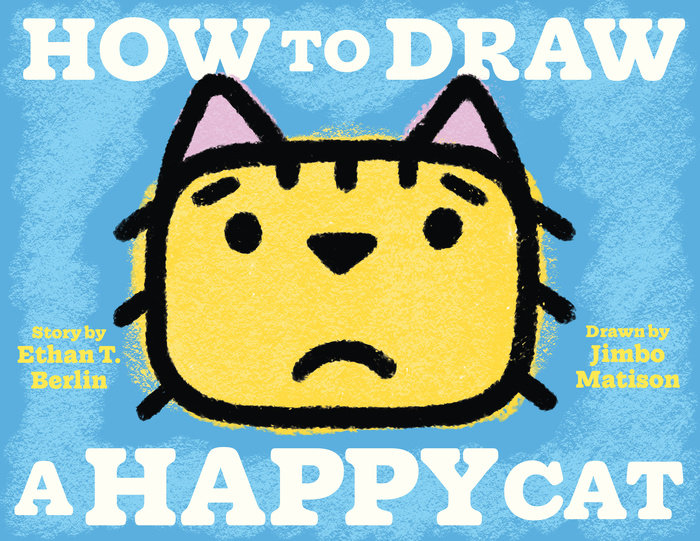
  • Toddler Teaches…HOW TO DRAW A HAPPY CAT

    Toddler Teaches…HOW TO DRAW A HAPPY CAT

    I first came across How to Draw a Happy Cat when our local children’s librarian suggested it for my own writing research. (Side note: Librarians are awesome. Ideas to support your local library here.)

    As a more advanced picture book (SLJ suggests it for grades K-2), I did not expect it to immediately enter S’s favorite book rotation. I should have. Here’s why:

    1. It combines multiple kid-favorite topics.
    2. The language is declarative and snappy.
    3. The book invites the reader to participate in the action.
    4. The illustrations are active and colorful.

    As pretty much all my previous posts have established, S’s current favorite book subjects are animals and transportation. If your book has animals and/or transportation vehicles, S will probably at least give it a spin. If your book combines animals and transportation vehicles, you have dramatically upped your odds that S will want to read your book, and likely more than once. (Exhibit A: Animals Go Vroom!, an all-time S favorite.)

    How to Draw a Happy Cat does one better, and introduces not only animals and airplanes, but also one of S’s favorite foods: pizza.

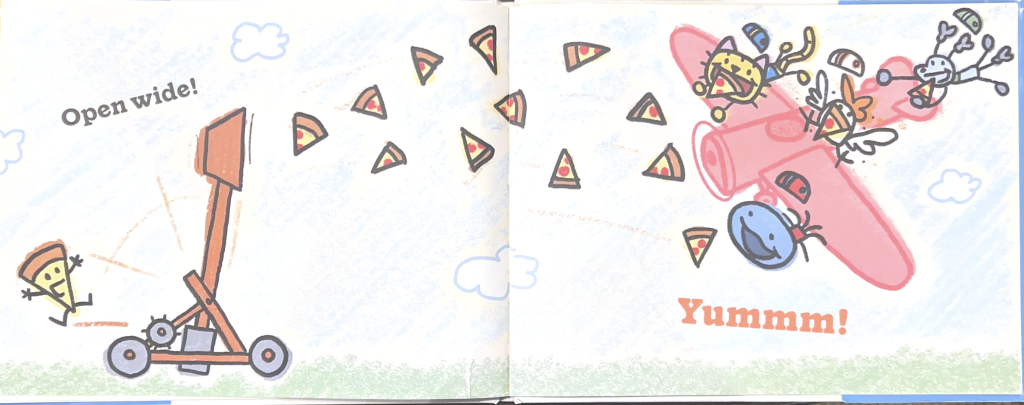
    This may be one of S’s favorite images in any picture book we’ve read. It’s got a cat eating pizza being flung from a catapult, all while hanging onto an airplane. Pretty much toddler heaven.

    It’s like Ethan Berlin was handed a list of S’s interests and told to craft a story around them. Even without a great story, S would be predisposed to flip through the story over and over again, just to look at pictures of cats, airplanes, pizza, and cats eating pizza on airplanes.

    But the story works. It’s a hysterical, modern, interactive version of If You Give a Mouse a Cookie. And while the story is complex, the way it’s written and illustrated extends the age range downward.

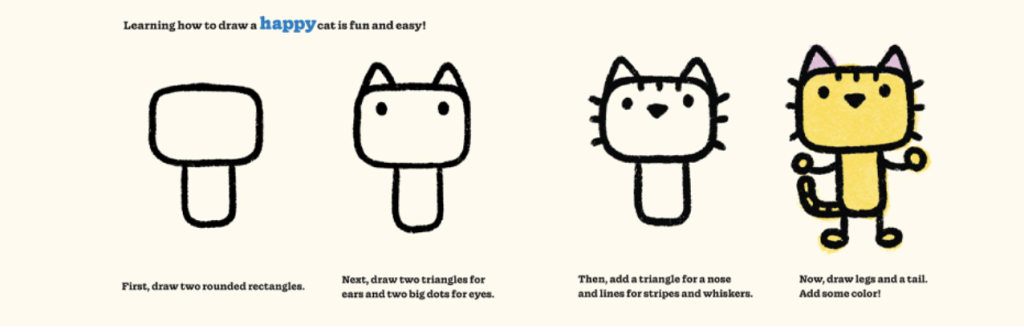
    The story starts by inviting the reader to participate in the action — drawing our main character.

    Learning how to draw a happy cat may be fun and easy, but no one said anything about keeping that cat happy…

    It goes on from there in the same vein – each time we think the cat is finally happy, something happens, and we have to draw/solve her next problem.

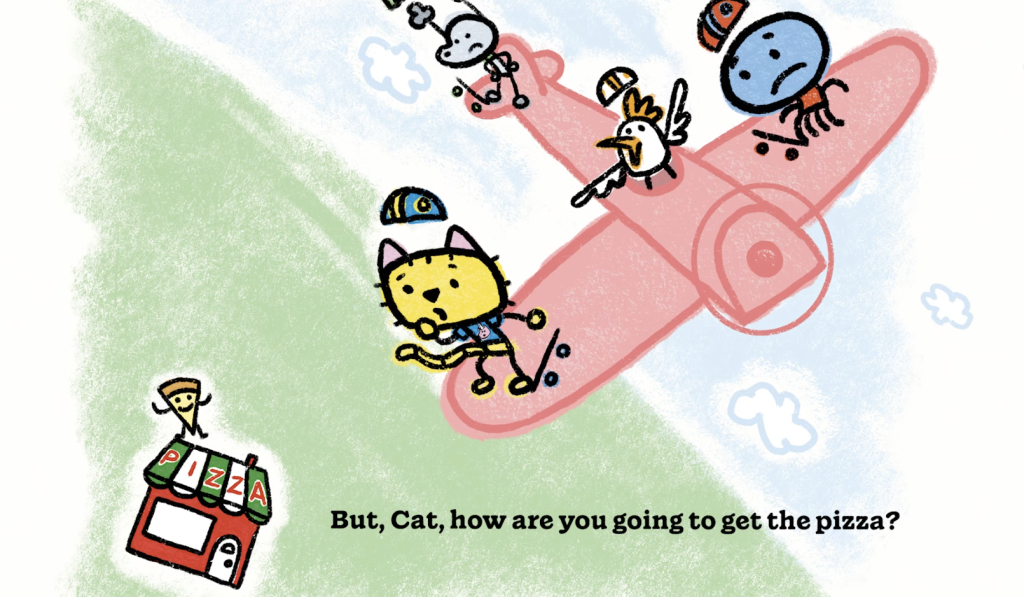
    The sentences are often short and limited to one or two per page, conveying complicated problems and emotions with clean, simple language that is easy for S to understand. (How is the cat going to get the pizza? We have to turn the page to find out!)

    The cadence is great for listening, and the interactive language choices also keep S engaged – S is getting all the credit for helping out our new friend Cat. (“Great! She’s so happy! Good job!”)

    The sentences are also frequently accompanied by an illustration per idea. This decision is genius from a craft perspective, because it gives the reader the impression that they are impacting the story by “drawing” new things as the narrator directs them to do so.

    It also has a possibly-unintended benefit from a toddler attention-span perspective. As with Itty-Bitty Kitty-Corn, the sentence-per-illustration model of picture book creation is crucial to keeping S’s attention in longer books because each sentence gives S a new thing to look at (and the new illustration reinforces S’s ability to understand what the text is saying).

    So while Ethan Berlin and Jimbo Matison probably almost certainly didn’t set out to create this book for an under two year old, a few simple choices turned this book into an unexpected repeat pick.

    How to Draw a Happy Cat By the Numbers:

    Pages: 40

    Word Count: 311

    Words Per Illustration: 7.78

    Words Per Sentence: 5.65

  • Toddler Teaches…HUG

    Toddler Teaches…HUG

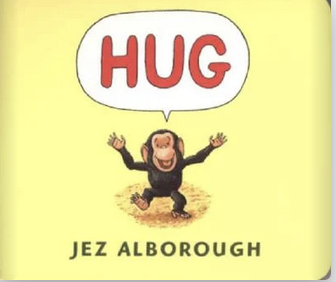
    Jez Alborough’s Hug is a delight. S asked for it daily at 19-20 months old, and still enjoys reading it several months later.

    Why Hug?

    As with many of S’s favorites, Hug has bright, active illustrations; lovable animal characters; and invites engagement with the text. It also starts quickly, introducing you to the main character and problem right away.

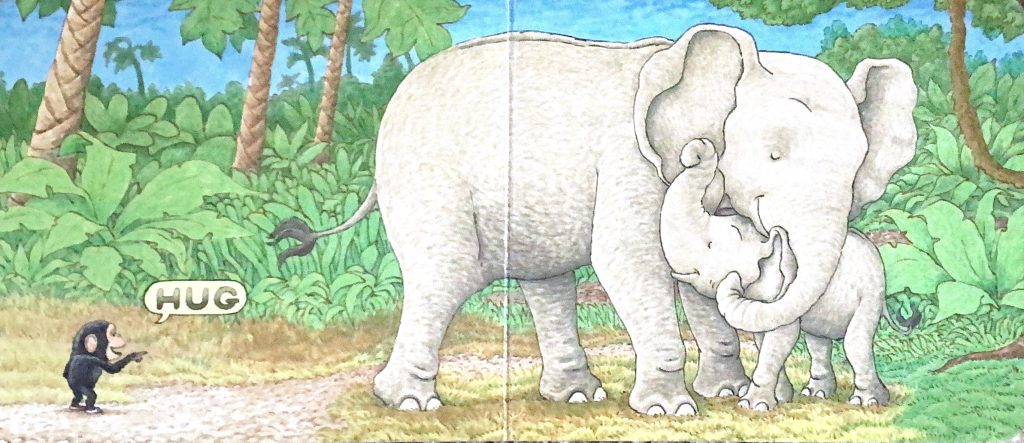
    The first spread immediately sets out the subject and tone of the book. Our monkey protagonist (who we later learn is named Bobo) notices two elephants hugging. Alborough does an incredible job conveying the warmth of the hug in the illustration. The page just FEELS cozy, which S picks up on.

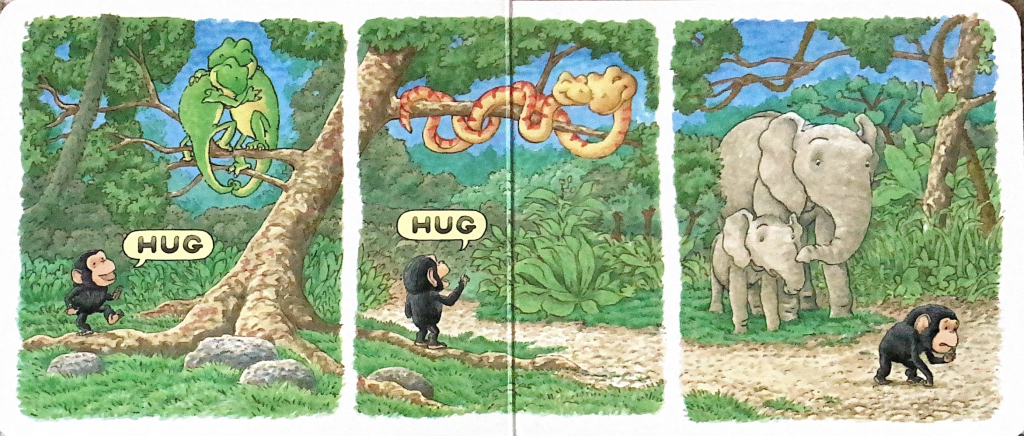
    Having set up our world, the second page moves quickly to reinforce it and introduce our problem. Bobo happily spots other animals hugging until…hmmm? Where’s Bobo’s hug?

    S loves to look at all the different animals hugging, loves the warmth of their hugs, and loves saying “hug” along with Bobo. S is also interested in Bobo’s emotional journey, conveyed beautifully and simply through illustrations and the word “hug” — repeated 25 times in various intonations as Bobo gets increasingly distraught over his lack of hug.

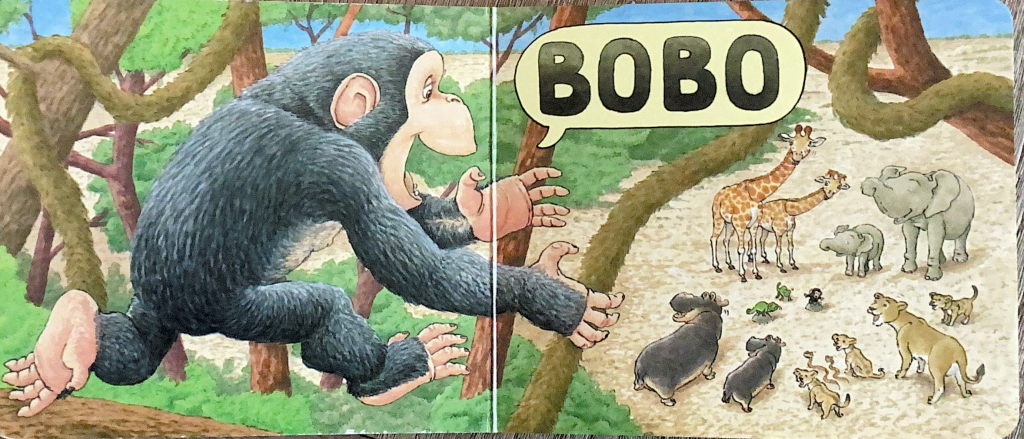
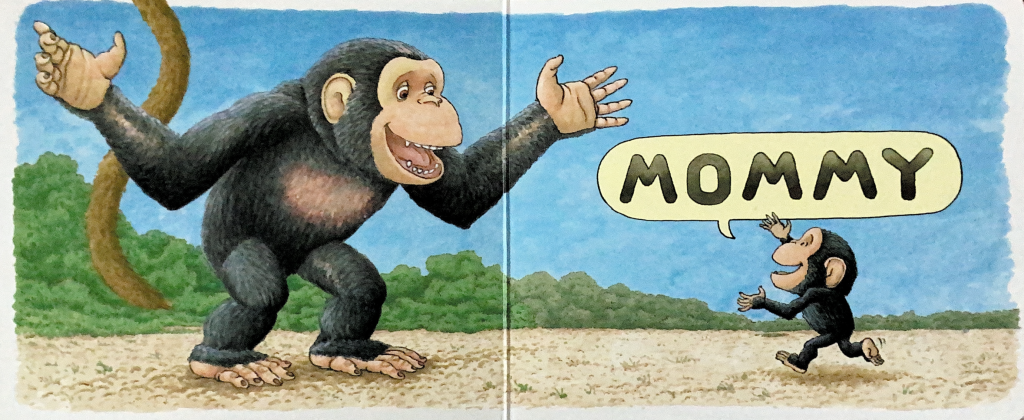
    Bobo’s distress culminates in S’s absolute favorite part of the story — Bobo is reunited with his mommy in a sweeping multi-page arc:

    Their excitement to see each other is palpable, the illustrations are active, and Bobo’s problem is resolved with (you guessed it) a hug.

    S loves to repeat the text on these pages: “Bobo!” “Mommy!”

    It is the only time in the entire story that a word appears that is not “hug.”

    S’s love of these two pages highlights the importance of naming picture book characters in ways I was not expecting. I distinctly recall having a conversation with the friend who got S the book about whether the book would be stronger if “hug” was the only word in the book. More artistic? Possibly. But after reading Hug to S over 50 times, I can confidently answer that question “no.”

    Why is it so important that Bobo have a name?

    First, having a name helps S identify with Bobo. He’s not just “the monkey.” He’s a monkey with a personality, a family, and problems.

    Second, Bobo having a name gives us a way to talk about Bobo throughout the book. He’s not just “Bobo” in the one scene where his mommy calls out to him; he’s Bobo in every scene in all subsequent re-reads.

    Third, the simplicity of Mommy and Bobo calling out each other’s names while running towards each other adds a joy to the book that S can understand and participate in. Their reunion would not be nearly as powerful if I narrated a wordless spread of them finding each other, running, and hugging.

    Fourth, Bobo is a perfectly chosen name. It’s fun, easy for S to say, and thus easy for S to remember.

    While S definitely has favorite books and characters without human names, I have found in reading Hug and other SEL books that S identifies better with the character when they are named. (See also: Milo the penguin — S identifying with “Milo” in particular as opposed to any old penguin goes a long way toward S’s caring about his dilemma).

    Some quick stats on Hug:

    Page count: 28 pages of what I would consider the “main” book

    Word count: 27 (25 of which are “Hug”)

    Average word count per illustration: 1.5