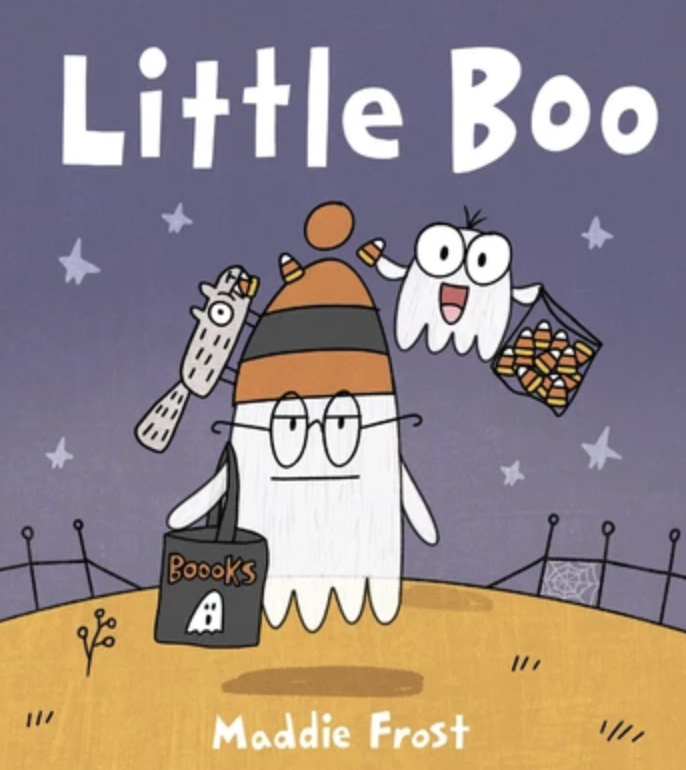
Maddie Frost‘s adorable Little Boo is in heavy rotation in our house right now. While it’s now officially fall, Little Boo‘s popularity is not Halloween related. (Though I did enjoy S pointing at the ghost-shaped chips at Trader Joe’s and telling me that they looked like Little Boo this week.) We’ve been reading Little Boo for at least a month or two at this point, if not longer (what is time, anyway?). Here’s why I think it has staying power:
Relatable subject matter
At its core, Little Boo is about sibling relationships. Our narrator — Little Boo’s older sibling — walks us through Little Boo’s transformation from adorable baby ghost that did whatever the narrator wanted to annoying toddler ghost that wreaks havoc on the narrator’s toys/life/ability to eat cereal in peace.
S is particularly interested in sibling stories right now on account of expecting one soon. But none of the other sibling stories we’ve read have garnered anywhere near this level of interest, which makes me think that the other reasons for S’s interest are as, if not more, important. So let’s discuss those.
Little Boo quickly introduces its lovable main character
The story opens by getting the reader to fall for Little Boo:
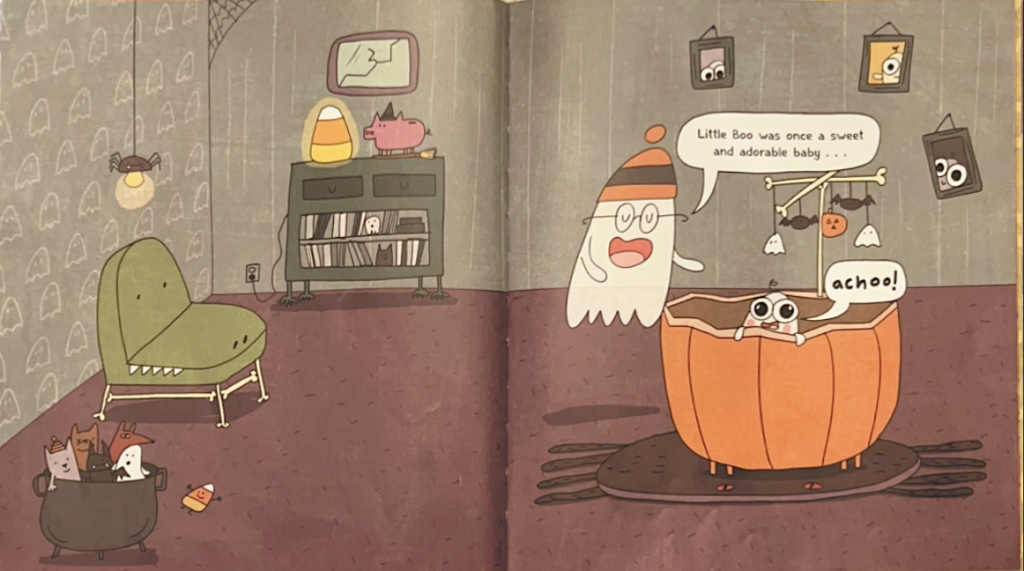
This is accomplished by (1) outright telling us that Little Boo is adorable, (2) backing it up with the illustrations, and (3) picking a relatable character name.
Calling something “little” is an easy way to get S interested in it. Toddlers aren’t babies, but they’re also not big kids — those are the elementary schoolers that run past them on the playground. S seems to take a particular interest in things when they are “little” — just like S. (See, e.g., Little Blue Truck, five little monkeys, Little Red Hen…).
So in just 10 words and one introductory spread, we’ve fallen for Little Boo. That gives the story staying power. (Fast introductions to lovable characters are a hallmark of the books we read over and over.)
And Little Boo is absolutely S’s main reason for reading the book. Little Boo goes “off screen” for a few pages in the middle of the book as part of a sibling swap between the narrator and a friend, and during those pages S consistently asks after her (“Where’s Little Boo?”).
The swapped sibling, Little Howl, simply does not cut it. We were introduced to Little Boo straightaway, became attached to Little Boo straightaway, and no substitutes will do. (Little Howl’s descent into a hunger-fueled monster-state — see below — may also have something to do with it.) S is always excited when Little Boo returns.
Fun sounds
Little Boo is chock full of onomatopoeia and short, repeatable phrases that are fun to say.
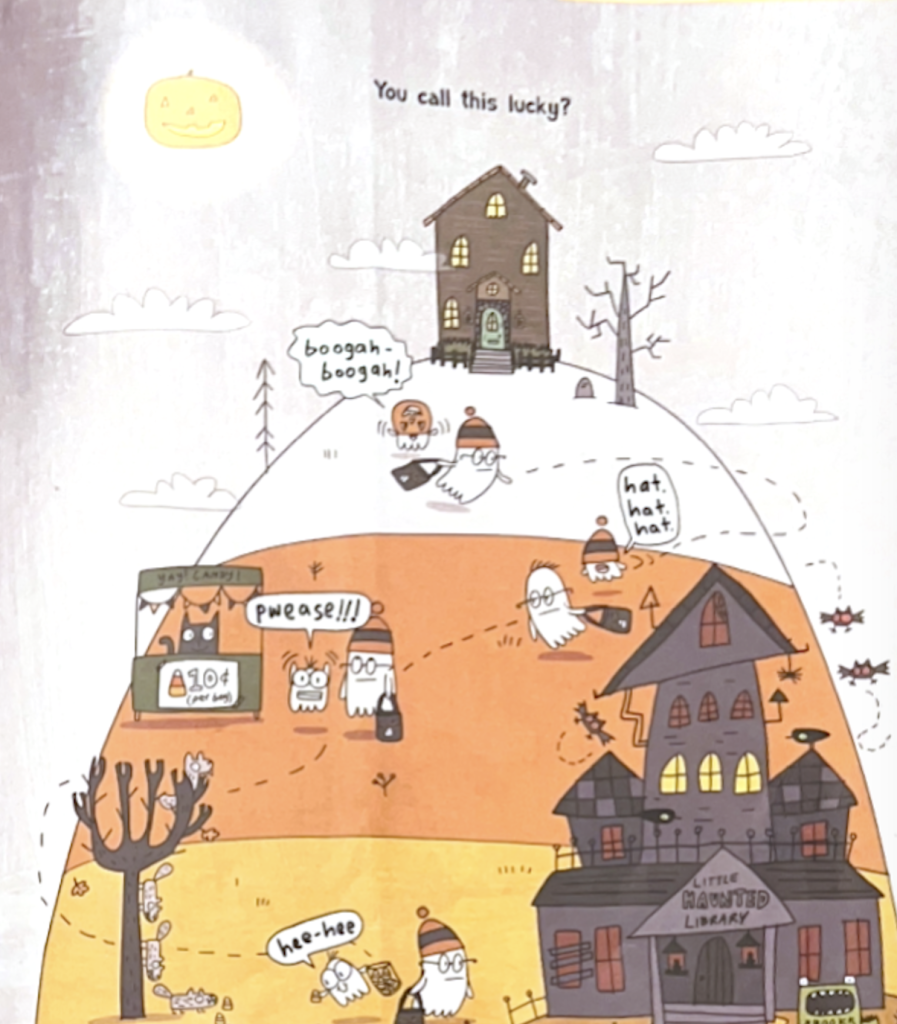
S loves this page, which has our siblings headed to the library while Little Boo says and does ridiculous things. For some reason, repeating “boogah-boogah!” and “hat hat hat” are highlights of the story.
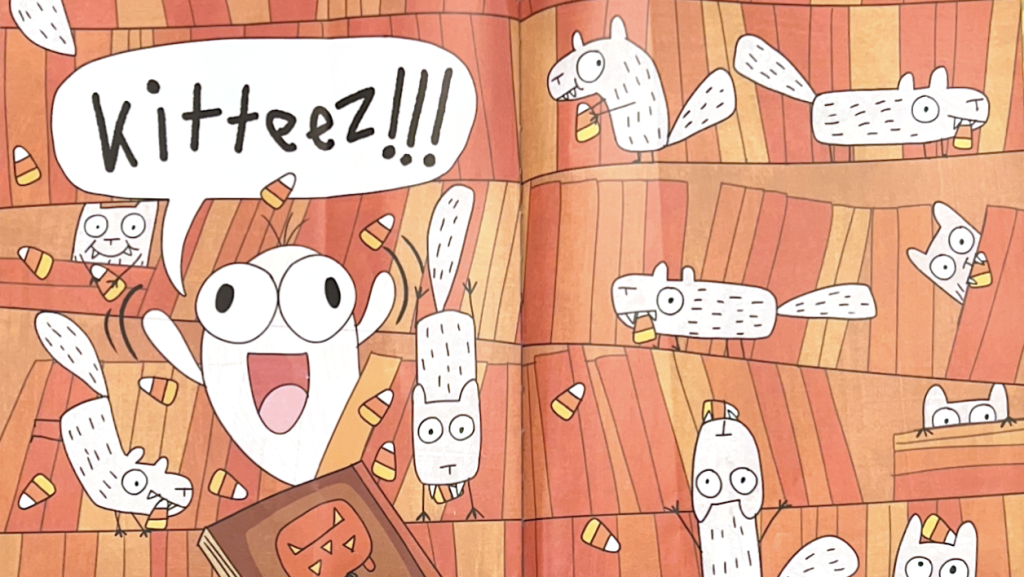
As is shouting “kitteez!!!” The page and its punctuation just ooze excitement and beg to be repeated over and over.
As an aside, however, S always wants me to skip this page:
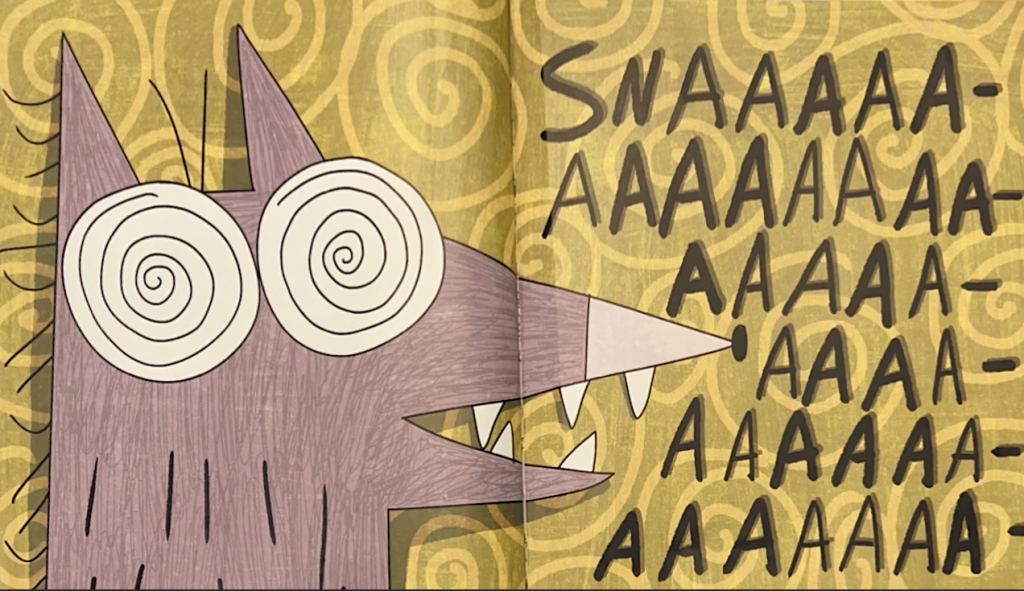
Apparently the combination of Little Howl’s descent into monster madness and the way I read “Snaaaaaaaaaaaaaaaaa[ck]” is less than desirable.
Colorful, active illustrations and short, punchy sentences
As you can see from the pictures above, Frost’s illustrations have tons of movement, lots of color, and lots of variety. They also have a lot of panels, which keep S’s interest since there are often 2 to 3 to 4 things happening on a given page.
The book’s sentences are also very short, averaging just over 4 words per sentence (and even shorter if you add all in the onomatopoeia sentences). That makes Little Boo a fast read, which is great for a toddler attention span and which invites (numerous) subsequent re-read requests.
And from an adult perspective, there’s a ton of value to the illustrations and short sentences too. Every time I open the book, I spot something new (the hill being a candy corn and the sun being a jack-o-lantern, the impressive way that the ghosts are somewhat transparent, etc., etc.). That doesn’t impact S’s interest in the book, but the cleverness of the illustrations combined with the fact that it’s a quick read do make me far more willing to read it back to back to back.
Little Boo By the Numbers
Pages: 31 pages of what I would consider the “main” book
Word Count: 285 (including onomatopoeia), 258 (not including onomatopoeia)
Words Per Illustration: 7.125
Words Per Sentence: 4.16 (excluding onomatopoeia)