Every so often we stumble upon a book that S keeps requesting even though the book is too long or complicated for a two-and-a-half year old attention span.
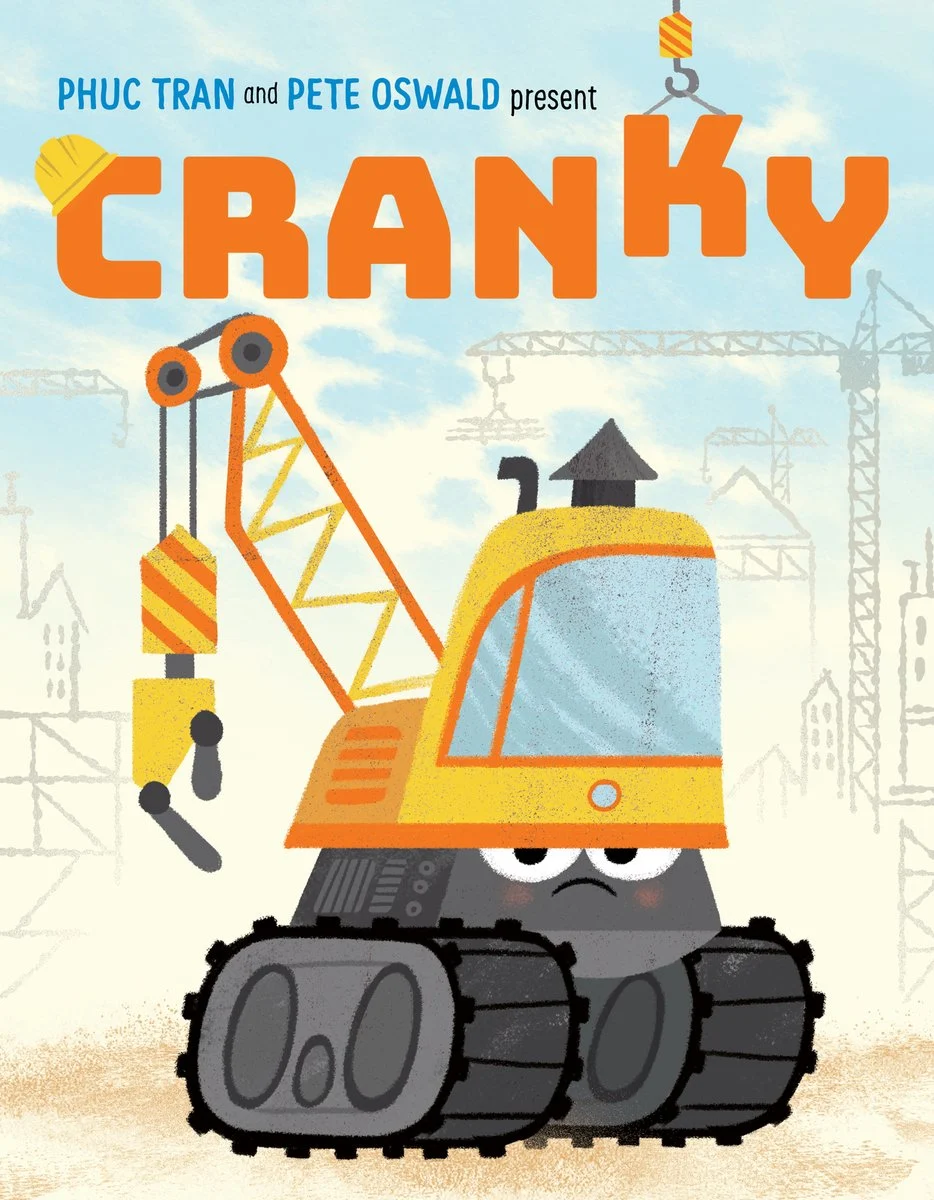
Phuc Tran and Pete Oswald‘s Crankyhits all three criteria for such a book. It’s too long for S and the puns go straight over S’s head. But S keeps asking to read it because it features (1) construction vehicles, (2) wonderful illustrations, and (3) a main character that S can root for from page one. Also ice cream, which we’ll come back to.
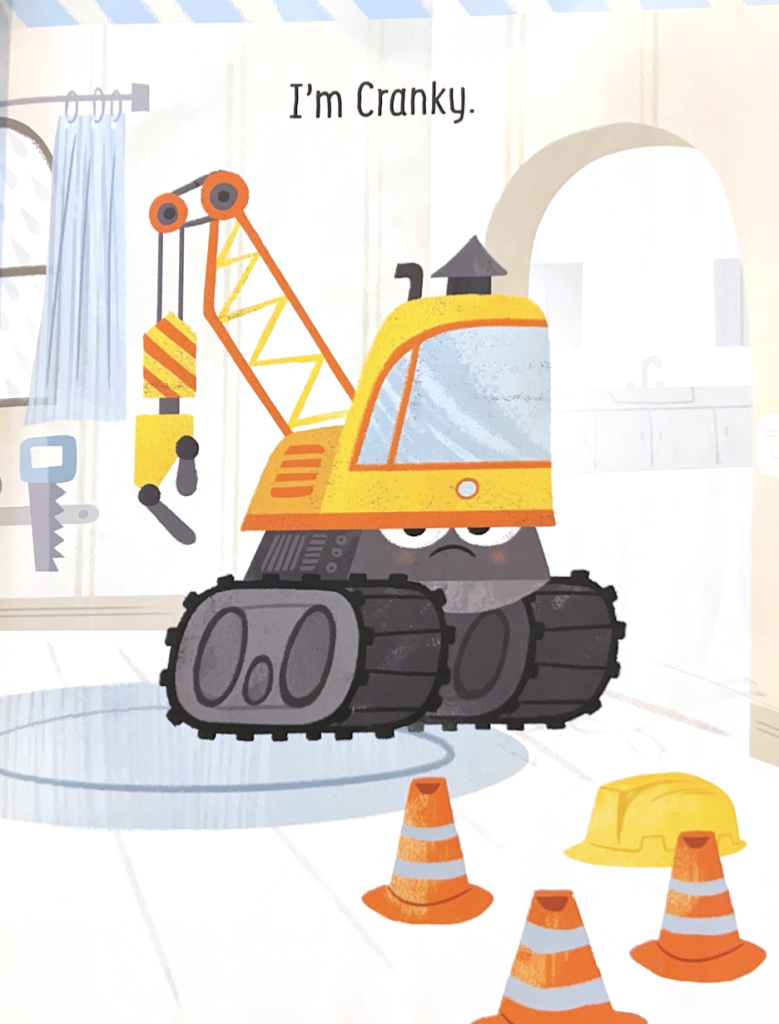
On a typical read, we make it through about the first seven pages of the book. The first five pages are tight, snappy and have about 10 words per page. They also quickly introduce our main character, Cranky, and his problem — he’s cranky, but he doesn’t want to talk about it. (It’s like Grumpy Monkeywith construction vehicles…) Oswald’s illustrations imbue Cranky with a life and personality that makes him feel friendly and compelling to S, frown and self-proclaimed crankiness aside.
Two simple words and a brightly colored picture introduce us to our main character, who has Oscar the Grouch vibes — grumpy yet still personable.
The next two pages have nearly 40 words per page, and significantly longer sentences. After that, we sometimes keep going, with me paraphrasing the text, but by page 11, the same thing happens every time: S declares that it is time to look for the ice cream, and flips all the way to the last two pages of the book.
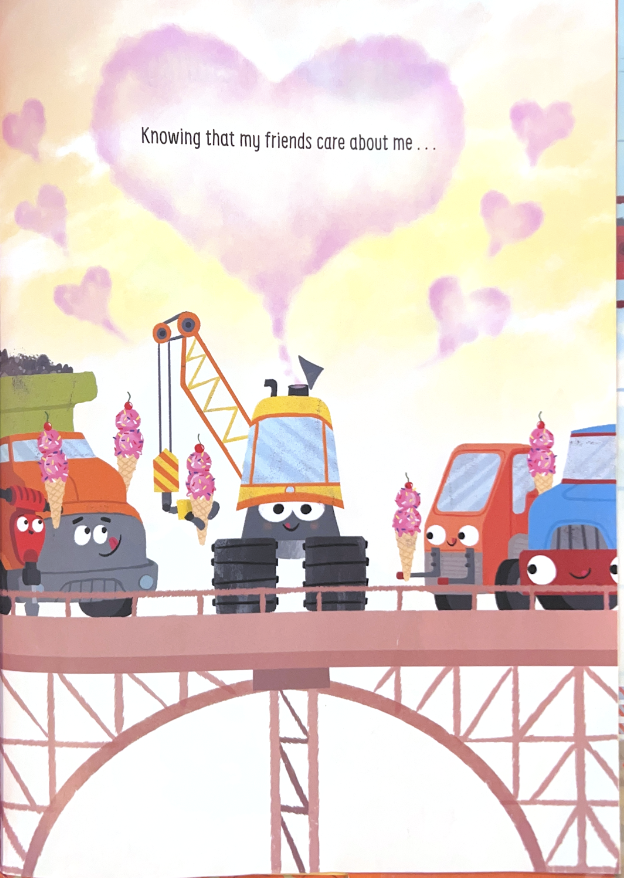
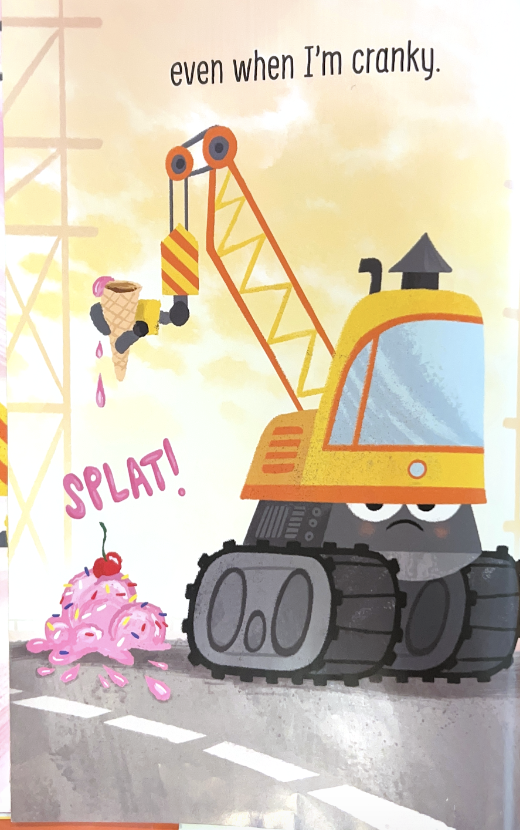
Said last two pages.
These last two pages are notable to S not for Cranky’s epiphany about friendship (we skip almost the entire plot of this book), but solely for the giant ice cream cones. They really are quite impressive – brightly colored, two scoops, lots of sprinkles, a cherry… S loves to look at the ice cream. The splat is irrelevant, just the fact of the ice cream is what matters.
The sheer amount of work that these ice cream cones are doing for S’s interest in the book gave me even more appreciation for the work illustrators do. Nothing in the text suggests the need for the presence of ice cream, yet the ice cream (and the splat!) are a perfect visual ending for the book. It also highlights yet again the value of having multipletoddler hooks in a given book, regardless of length.
And now I’m off to daydream about ice cream.
Cranky By the Numbers
Pages: 30 pages of what I would consider the “main” book
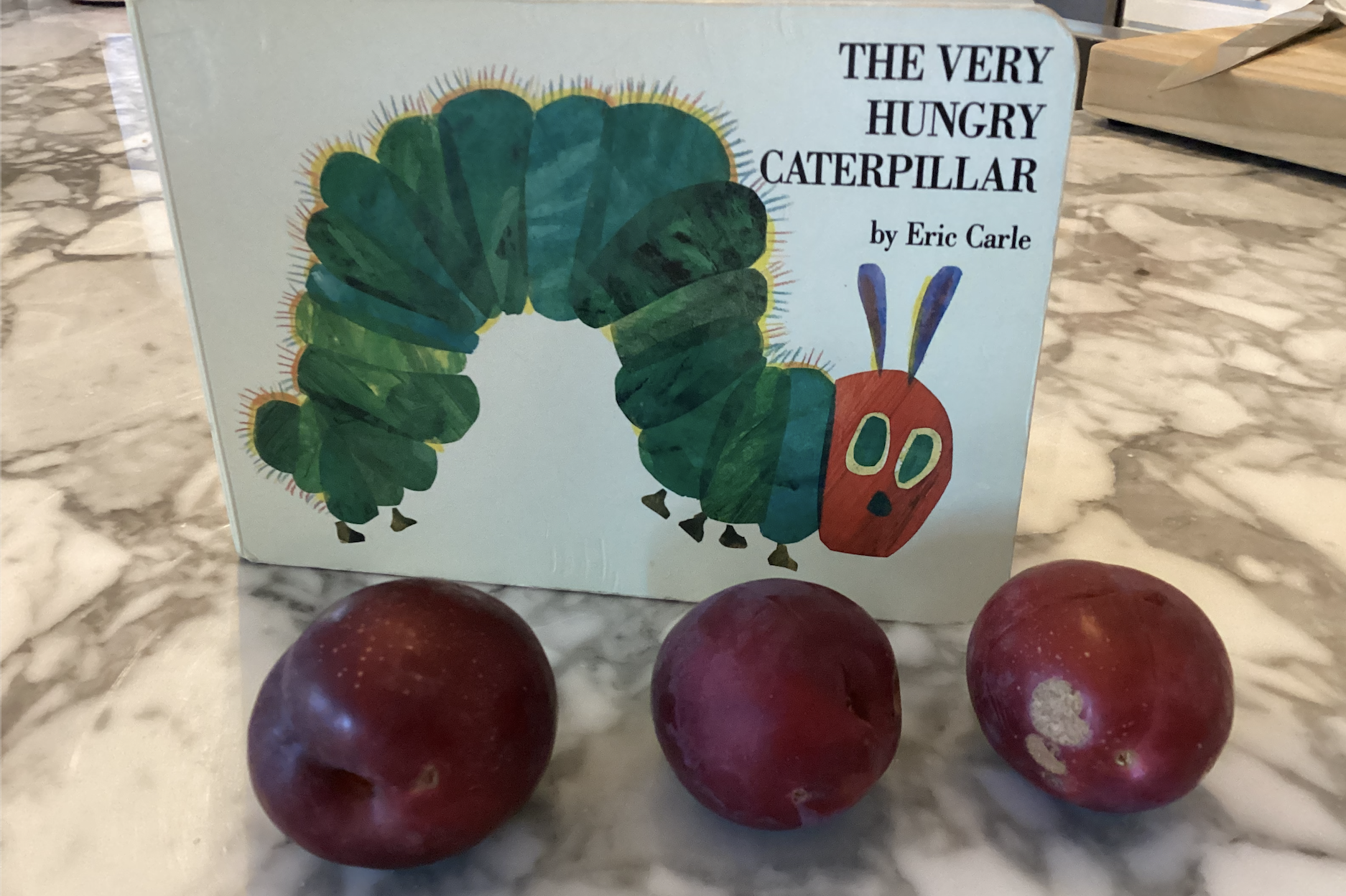
Eric Carle’s The Very Hungry Caterpillaris iconic. It was one of my absolute favorite children’s books 30-something years ago, and it is one of S’s favorites now. Whenever S spots the book, I have to read it at least 3 times, often back-to-back-to-back. This is not surprising. From a picture book construction perspective, the book is near flawless. And each of the things the book does well make it a toddler classic. Here’s why.
A Quick Introduction to an Adorable Main Character
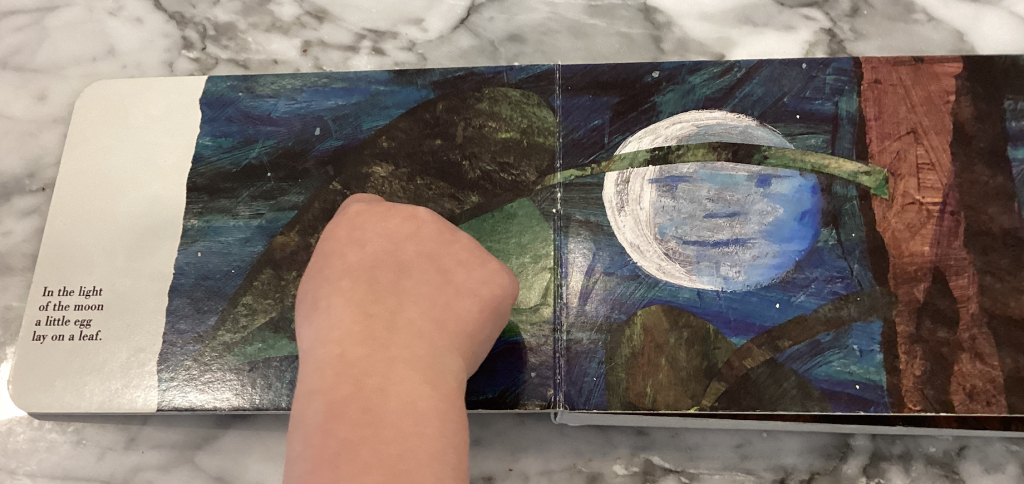
The very first spread of The Very Hungry Caterpillar sets up the anticipation of what is going to happen in the story. We’re told that a little egg lays on a leaf, and that’s it. Things that are small are very appealing to toddlers, and S loves to point out the egg on the leaf.
Pointing out the little egg.
And then the next morning, the warm sun comes up, and the tiny caterpillar comes out of that egg with a “pop.” That littlest bit of onomatopoeia goes a long way; S loves to repeat it, and it sets up the excitement of the caterpillar being born. So in two pages we’ve got anticipation and excitement, and a delightfully plucky, toddler-sized main character that we are now interested in following around.
Hooks on Hooks on Hooks
In just 224 words, Carle manages to seamlessly integrate about a bazillion hooks. I’m sure I’ve missed a few, but at a minimum, we’ve got:
Night and Day – The book opens in “the light of the moon” and transitions to the “warm sun coming up.” (And the sun and the moon are so friendly! Just look at their smiling faces…)
Days of the Week – The story goes from Sunday to Sunday, with the caterpillar eating different foods each day.
Counting – Each time the caterpillar eats a new food, he eats one more of that food, so the reader can visually see what 1, 2, 3, 4, and 5 look like.
STEM – We see the caterpillar transform from egg to butterfly over the course of the book.
Interactivity – S LOVES the holes that the caterpillar “eats” in each food. We touch each one as we count, which adds an interactive element to the reading experience.
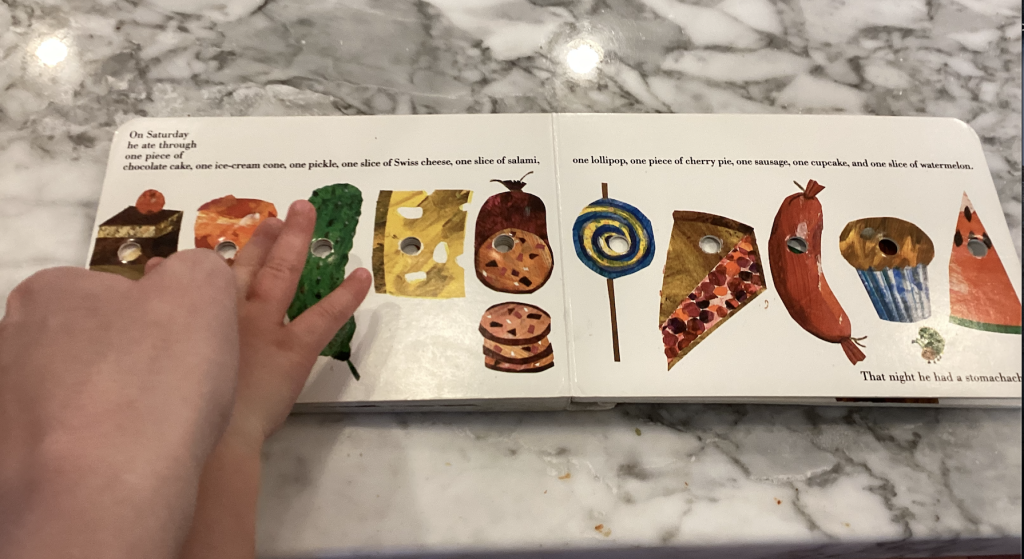
The Greatest Junk Food Sequence Known to Books – S adores this page, which contains pretty much every food a little kid wishes they could eat on the regular.
Rattling off each of the junk foods and touching the food holes as quick as we can!
Fantastic Sentence Construction
The Very Hungry Caterpillar is short, and not just in word count — the story is only 18 total sentences. This concision keeps S engaged — every sentence meaningfully advances the story.
The story also makes brilliant use of refrains, which, as we’ve established on numerousoccasions, are toddler gold. Each day of the week, the caterpillar does something similar. “On Monday, he ate through one apple. But he was still hungry.” On Tuesday, he eats through two pears, “but he was still hungry.” And so on. The repetition gives S something to latch onto and expect with each page turn, while the slight changes give S something to pay attention to — namely, the counting and days of the week hooks. And when the caterpillar goes off the rails on Saturday, it is both hilarious and delightful.
The book’s average “words per sentence” count is markedly higher than S’s normal favorites, but the sentence length is offset by (1) the overall tightness of the story itself and (2) smart sentence construction in the longest sentences. The longest sentences are offset by dashes/easy to understand clauses (ex: the “pop!” that breaks up the sun coming up and the caterpillar coming out of the egg and the long list of foods the caterpillar eats on Saturday) that make it much easier for S to follow along.
Gorgeous, Colorful Illustrations
This one goes without saying. But it certainly contributes to S’s interest in the story. It also creates a payoff at the end when the caterpillar turns into a truly beautiful butterfly.
The Very Hungry Caterpillar By the Numbers
Pages: 22 pages of what I would consider the “main” book
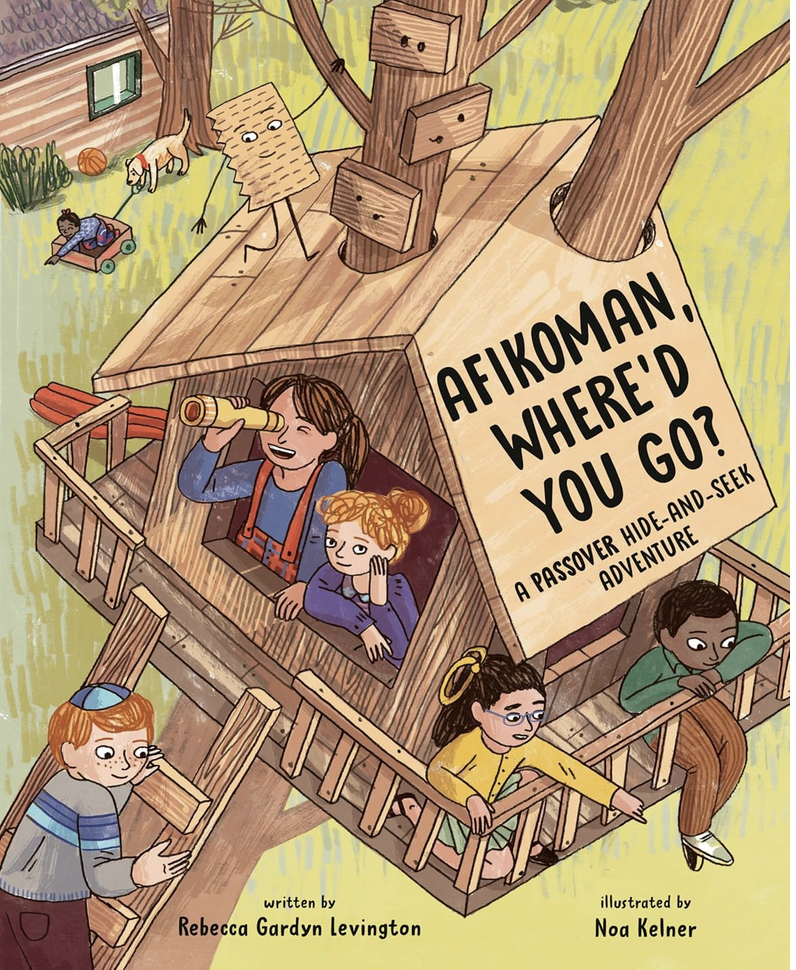
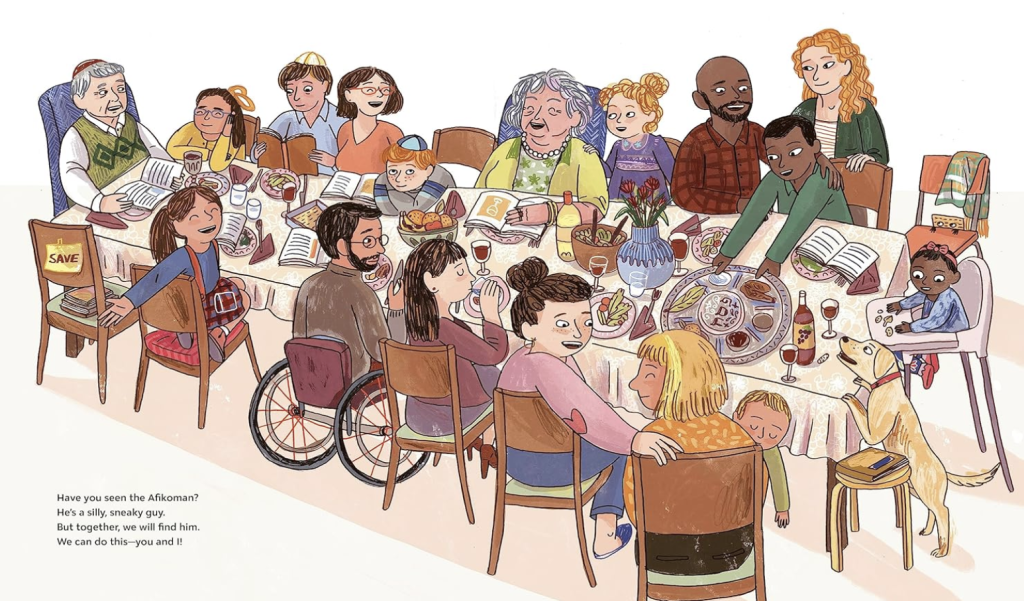
I have been a huge fan of Rebecca Gardyn Levington and Noa Kelner‘s Afikoman, Where’d You Go?ever since it first released two years ago. It’s bouncy, fun, imaginative, and right up my alley (an anthropomorphic afikoman version of Where’s Waldo? = truly incredible stuff). This year, S was finally old enough to understand a bit about Passover, so I was really excited to be able to share the book as part of our celebration.
It was an immediate success. S got it as a prize for finding the afikoman on the first night of Passover (thanks, mom and dad!) and has wanted to read it multiple times a day since. As with Challah Day!, Afikoman, Where’d You Go? is representation at the level that means the most to kids. Finding the afikoman is (in my opinion) the most kid-friendly part of the seder, and the one that intuitively makes the most sense to a toddler (hide and seek! with a snack at the end!). So to be able to relive the fun over and over is exciting.
But it takes a lot more than a great premise to make a great book. So let’s take a deeper dive into some of the things that the book does so well:
Interactivity and Agency
Thanks to Rebecca Gardyn Levington and Noa Kelner for their kind permission to use some of their art in this post!
The story brings the reader into the action immediately, opening with a question: “Have you seen the Afikoman?” We are not going to be passive participants in this story — we are going to be finding the afikoman too. The rest of the stanza further sets this up: “But together we will find him. We can do this — you and I!”
S is immediately hooked and ready to find the afikoman, pointing him out on the first page and every subsequent page. (“He’s over there!” “Right there!” [spoiler alert] “In the doggy’s bed!”)
The first page also immediately sets up Afikoman as a lovable trickster. He’s “silly” and “sneaky” — two words that immediately signal to S that this is going to be fun. S loves when things are “silly,” and now Afikoman has a personality matched by the delightful illustrations.
Extremely active illustrations
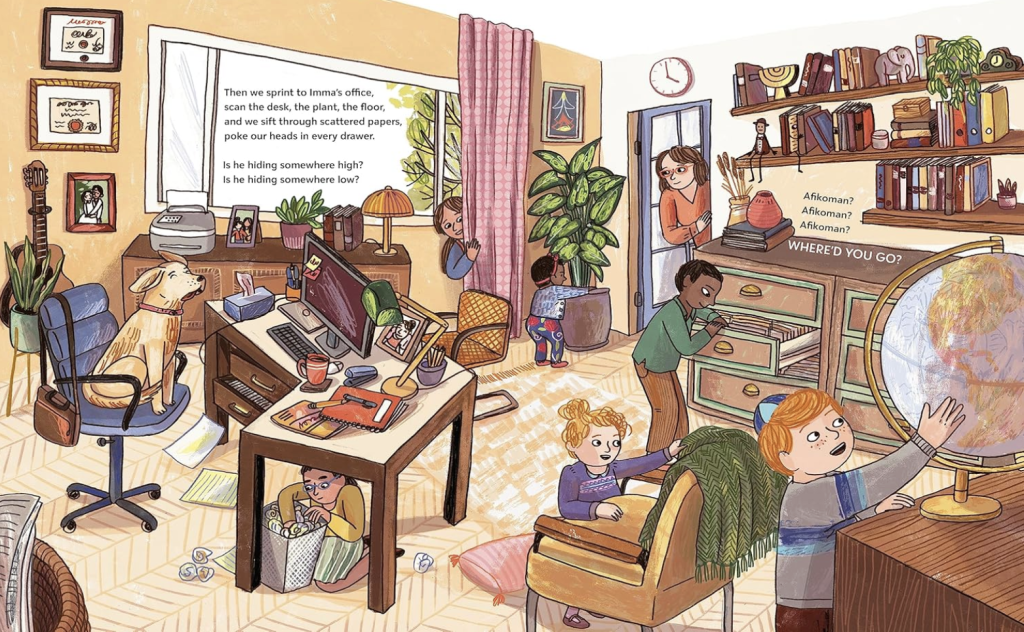
I have often written about how important active illustrations are to keeping S engaged with a story. Afikoman, Where’d You Go? has this going on in spades. Each illustration has tons going on, and the ability to point out so many different interesting things (Afikoman! the dog! bunnies! a basketball!) keeps S’s attention on every page.
A fun refrain that reinforces the interactivity
Every few failed attempts to find the afikoman there is a catchy refrain — “Is he hiding somewhere high? Is he hiding somewhere low? Afikoman? Afikoman? Afikoman? WHERE’D YOU GO?”
The refrain is incredibly effective. For starters, toddlers adore repetition. And this refrain reinforces the interactivity of the story, reminding us to check for Afikoman on every page. It also pushes the adult reader (*cough*, me) to ask the child where the afikoman is on other pages too, if they haven’t done so.
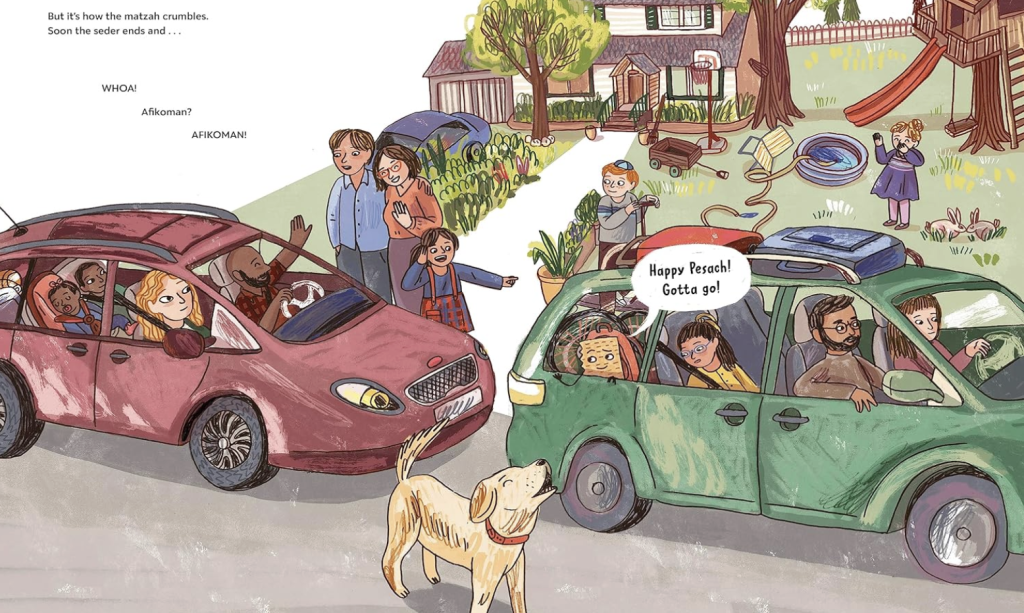
Plus, the refrain sets up two hysterical back to back payoffs at the end. I won’t spoil the first one, which is amazing, but the fact that the structure is parallel to the earlier refrain highlights the change for S.
And then S loves the last page, where Afikoman escapes in a car. (We’re still very into vehicles, so pointing out the car gets us a lot of mileage…bad pun only sort of intended.)
All in all, this book is a blast, and I’m glad I get to read it a lot.
Some random musings
Non-English Words
I have occasionally seen questions in writer’s spaces about the use of non-English or culturally meaningful words in picture books (and concerns about the book not being universal if they’re included). The narrator in Afikoman, Where’d You Go? uses Hebrew words for her family members — Imma (mom), Abba (dad), Savta (grandma), Saba (grandpa). This is a complete non-issue for S. S had never heard those words before, wasn’t bothered by it in the least, and figured out what was going on from the illustrations without my needing to explain anything. (Plus there’s a glossary, for anyone who needs it.) And now they’re familiar words for S, given that we’ve read the book about a gazillion times. So from my perspective, if you are considering using words that have meaning to you in your picture book, go for it!
Book Signings
My parents were able to get the book personalized for S at an event. I thought this was really cool, because I love Rebecca’s work. What surprised me was how much S loves it too. Every time we open the book, the first thing S does is point out the inscription and say, “That’s for me!” Obviously the personalization does not impact sales since we were already buying the book regardless, but I found it interesting. It certainly makes it feel even more special when we sit down to read it.
Afikoman, Where’d You Go? By the Numbers
Pages: 30 pages of what I would consider the “main” book
Word Count: 378
Words Per Illustration: 22.24
Words Per Sentence: 4.15*
*Since the book rhymes, it creates natural pauses that make it easier for S to pay attention to longer sentences. I therefore counted clauses as full sentences where they conveyed a full idea that S could understand (i.e., where they would likely have ended with a period rather than a comma if the book were written in prose). That occurred in about half of the book’s sentences (with the other half naturally being 6 words or less).
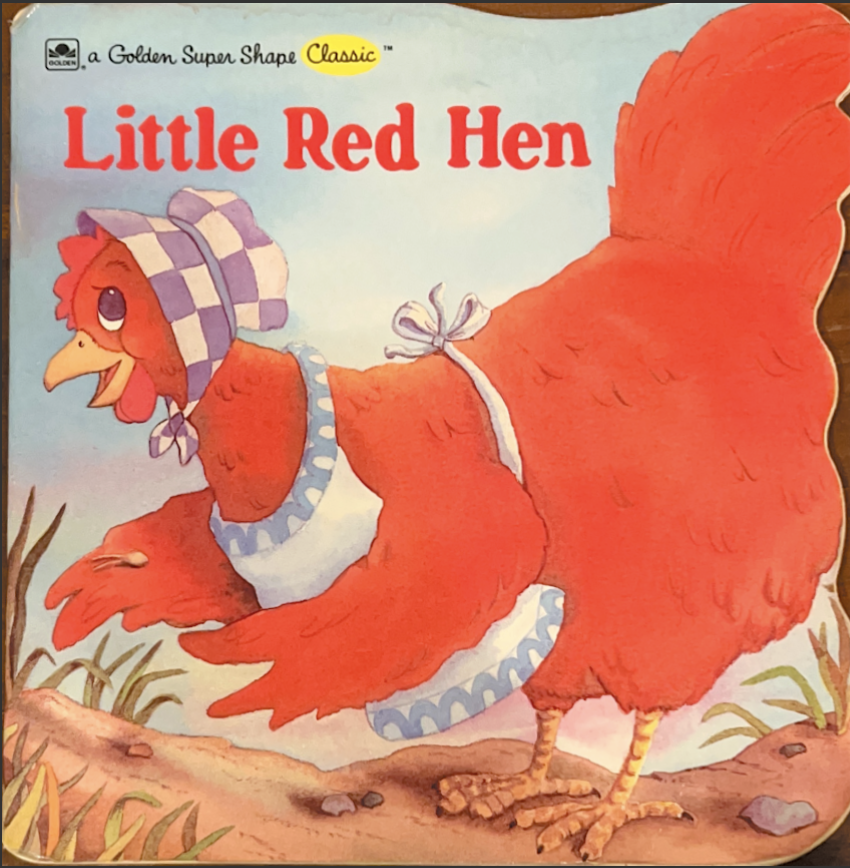
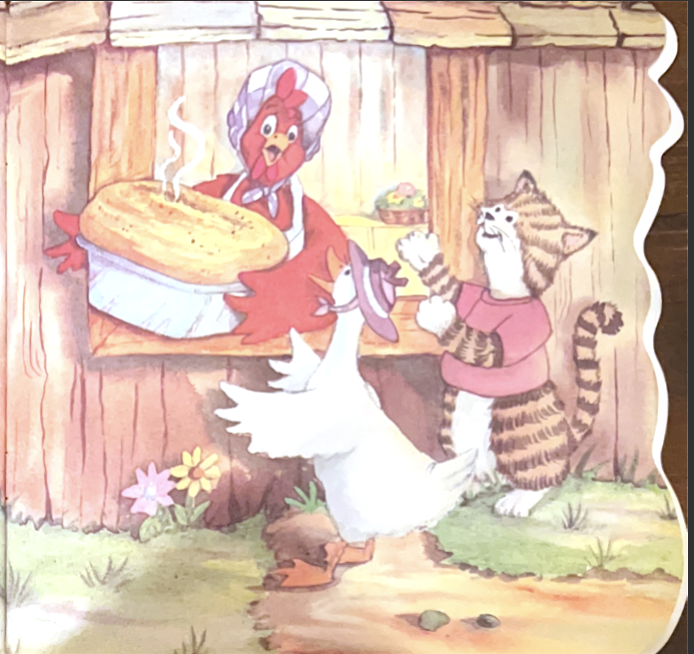
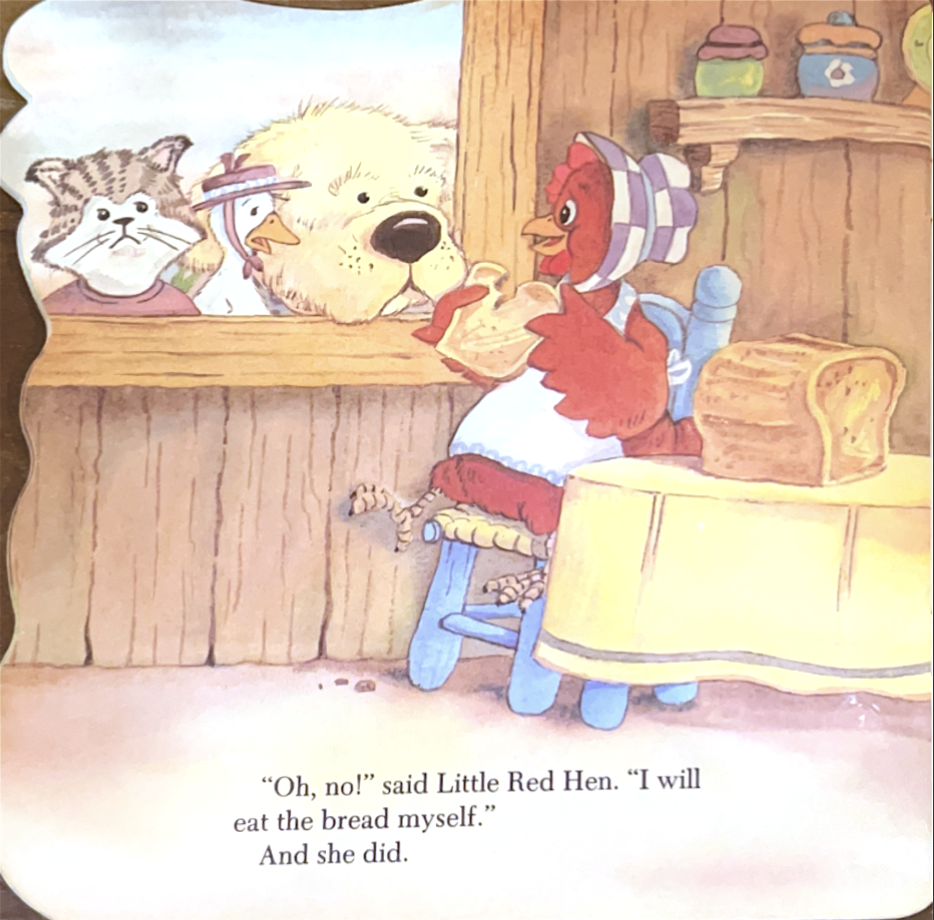
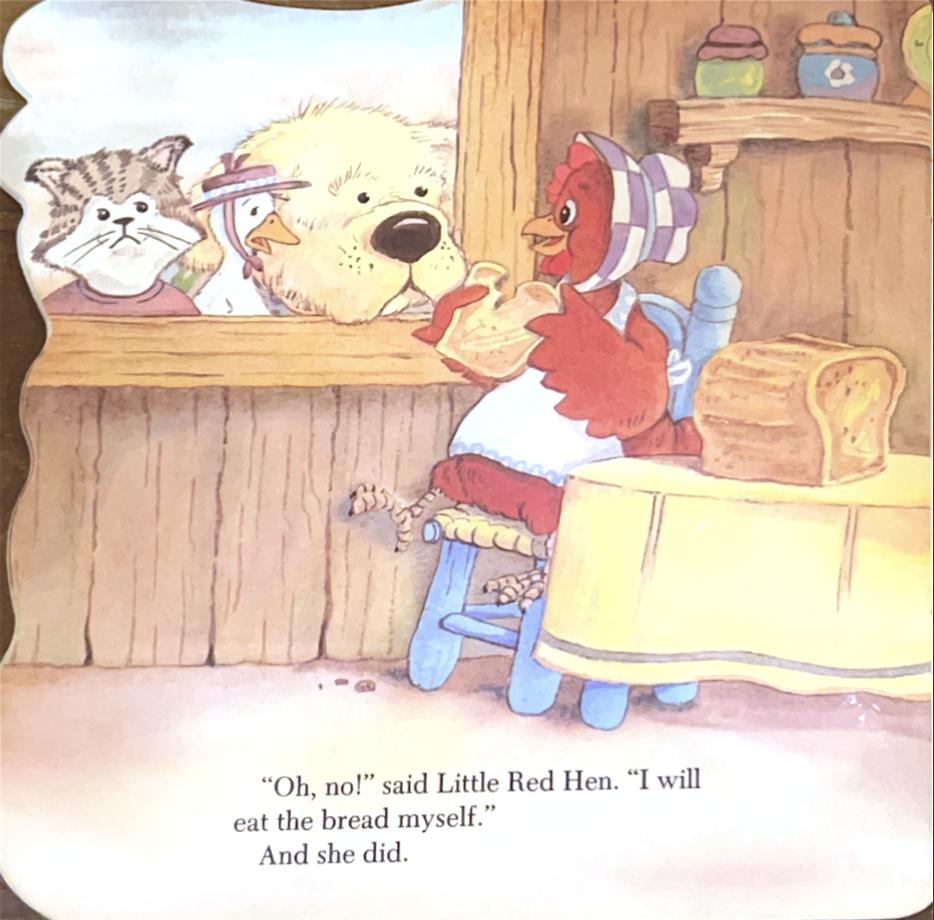
Because they are awesome, my parents held onto my favorite childhood books. Lyn Calder and Jeffrey Severn’s Little Red Hen was high on that list. I loved the Hen’s absolutely giant loaf of bread, as well as her (suddenly smaller) slice of toast.
Seriously, how much bread did the Little Red Hen eat between the prior page and this one? And why is it no longer the size of her torso?
Over the summer, my parents pulled out a number of my childhood favorites to read to S. Little Red Hen was an immediate winner. It’s got all the elements needed for toddler success: animals; bright, colorful illustrations; and short, punchy refrains. Not to mention carbohydrates.
Breaking Down Little Red Hen
Little Red Hen follows a predictable pattern, which got S actively interacting with the story as early as 19-20 months:
First, the Hen asks “Who will help me [do whatever thing she needs help with to keep making the bread]?”
Each time, the other animals respond in the same Rule of 3 refrain: “‘Not I,’ said Duck. ‘Not I,’ said Cat. ‘Not I,’ said Dog.”
Hen responds in a predictable pattern that mirrors her initial ask, reinforcing the language that was already used: “Then I will [do whatever Hen’s initial request was] myself.”
The sequence for each of Hen’s requests concludes with: “And she did.”
S loved the repetitions, and loved chiming in “did” at the conclusion of each section.
The refrains and parallel language are predictable, vocabulary building, and fun. They also use simple, declarative sentences that make it easier for young readers to understand what is happening and participate in the action.
The last few pages invert the animals’ refusals to help, continuing in a Rule of 3 pattern that ties the ending of the book to everything that came before in a satisfying “of course!” conclusion.
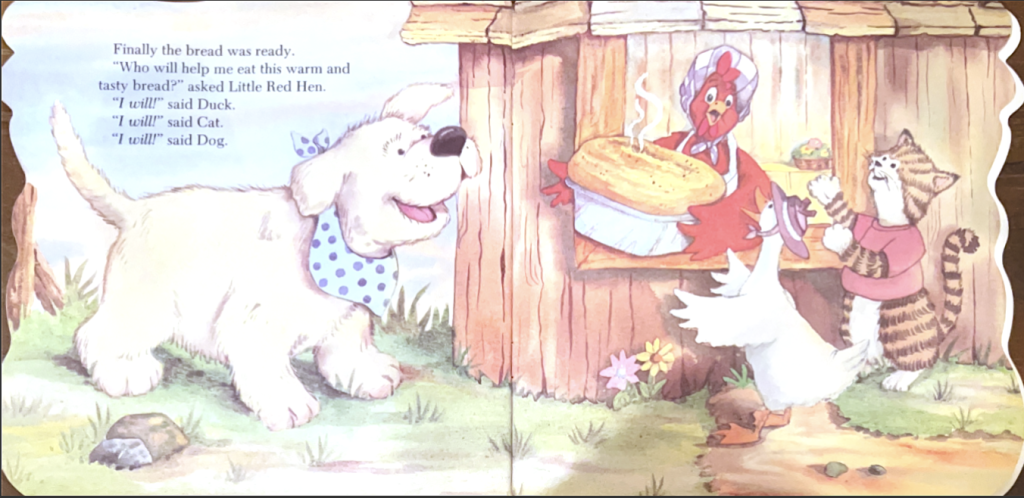
Who will help Hen eat the (absolutely ginormous) bread? “I will!” said Duck, Cat, and Dog. But in a continuation of the previously established pattern, Hen responds that she will eat the bread herself. And in a continuation of the refrain S loves so much, the story ends with a simple, “And she did.”
Analyzing the construction of the book, I can see why I loved Little Red Hen as a kid and why S loves it now. (Though if we’re being honest, I still really like the bread pictures, so maybe it’s more about the carbs than the exceptional construction of the story…)
Trying a Reimagining of the Story
Given S’s love of Little Red Hen, I thought it would be interesting to see S’s reaction to a version of the story geared for slightly older readers.
Thanks to Jasmine Sears for the eARC!
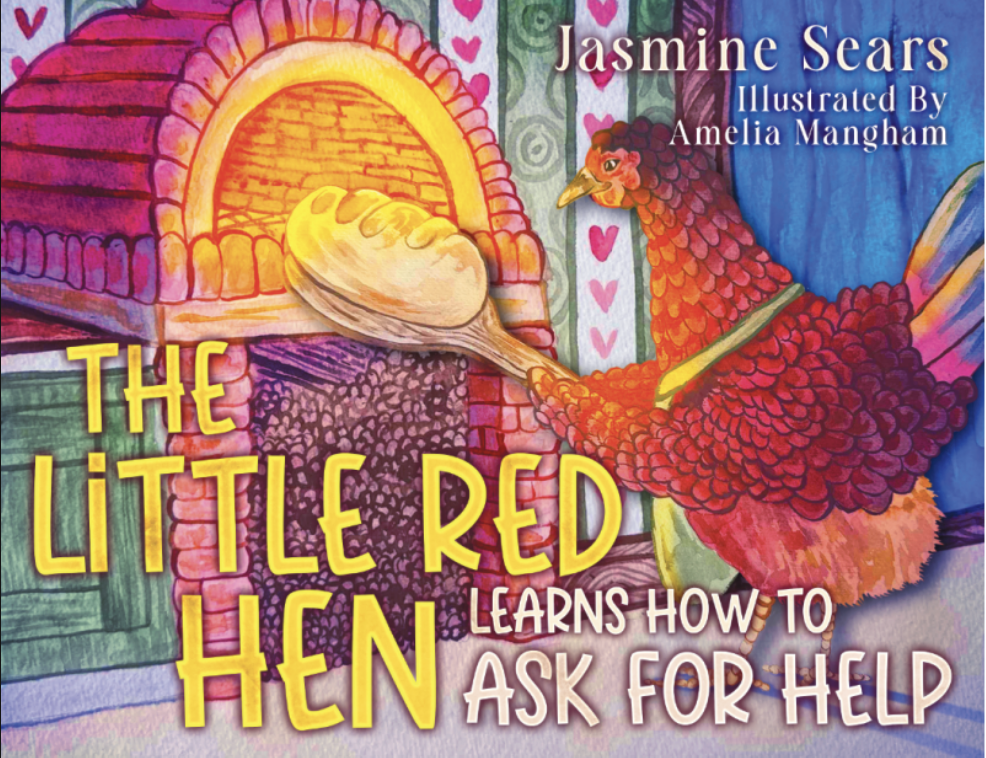
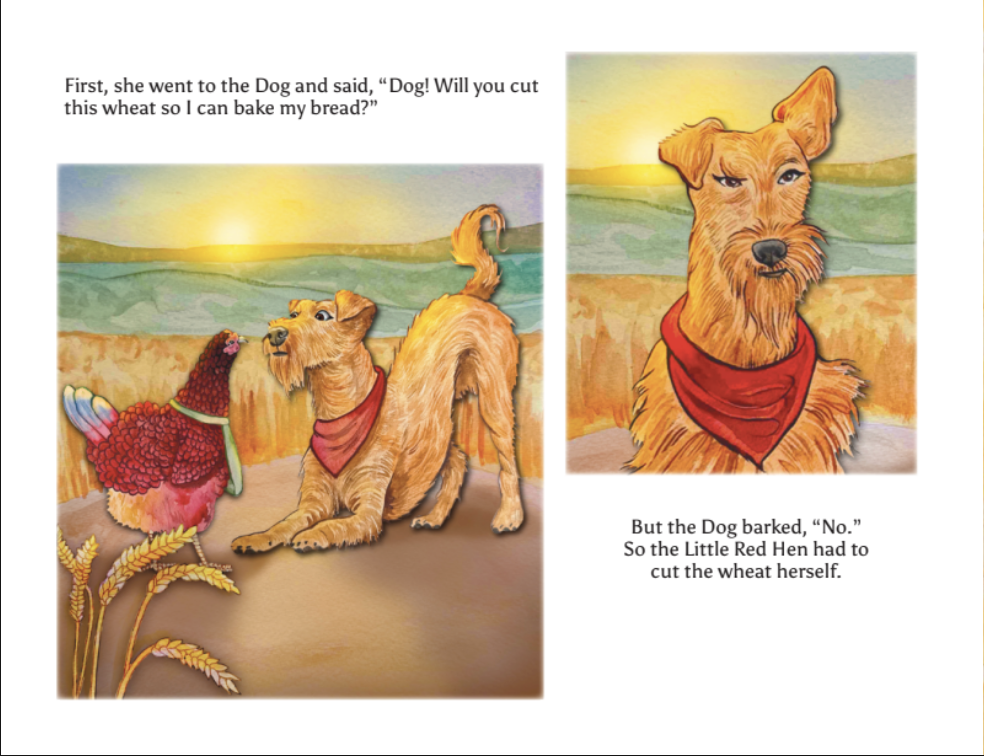
Jasmine Sears‘s and Amelia Mangham‘s upcoming picture book The Little Red Hen Learns How to Ask for Help cleverly reimagines the story in a light more favorable to the Hen’s unhelpful friends. In their retelling, Hen has asked — nay, demanded — each of her friends help her with a task they are unsuited to do. Dog is told to cut the wheat, Cat is told to fetch the water, and so on. It is only after Hen realizes she should be asking nicely and asking her friends for help with things they know how to do (and are not afraid of doing) that they all pitch in and bake the bread together.
S was absolutely transfixed by the illustrations in this version — they’re beautiful, bright, and almost glow from within. We made it to the end of the first half of the story (where Hen eats all the bread herself), which is the part S already knew. That was 367 words, which is on the long side for S’s attention span but doable with this many illustrations (particularly when they are brightly colored and of animals) and predictable, parallel language. The fact that S already knew the basics of the story to that point probably also helped.
S’s interest in the retelling highlights the value of reimagining stories that are familiar to young readers — the more familiar the story, the easier it is for a young reader to understand parts of the retelling, even if generally aimed at an older age group. It’s also another mark in the plus column for animals, parallel language, and brightly colored illustrations (a.k.a. toddler gold).
Little Red Hen By the Numbers:
Pages: 23
Word Count: 297
Words Per Illustration: 24.75
Words Per Sentence: 7.24
TheLittle Red Hen Learns to Ask for Help By the Numbers:
Pages: 36 pages of what I would consider the “main” book.
As we head into a new year, I thought I’d take a moment to highlight some of S’s favorite picture books of 2025 that did not get individual posts. Without further ado, the unsung picture book heroes of the 12-24 month age range:
Short, punchy sentences are key. I can get away with reading significantly more text per page if each sentence is around 5-7 words. If a page has 30 words on it, breaking those 30 words into 5-6 sentences is far preferable to 2 sentences.
Refrains are toddler gold.
S was not nearly as into rhyme as I would have expected. Of all the books on this list, only 5 of them are rhyming, and the rhyme is not the reason S likes the book. Punchy, repetitive sentences that S can anticipate and participate in (a la “Click, clack, moo!”) are far more important for getting S engaged in the text than rhyming is.
Subject matter is key, but idiosyncratic. Even having the subject of interest in a background image will often suffice to have S ask to read the book. Combining multiple kid-friendly topics optimizes chances of hitting on a preferred topic at any given time.
Flaps, cutouts, and other forms of physical interactivity got high marks this year. This ran the gamut from the holes in The Very Hungry Caterpillar to textures in Little Blue Truck Feeling Happy (which quickly surpassed its namesake because it had feathers and wool and a shiny blue truck to touch).
Hope you all have a great new year — see you in 2026!
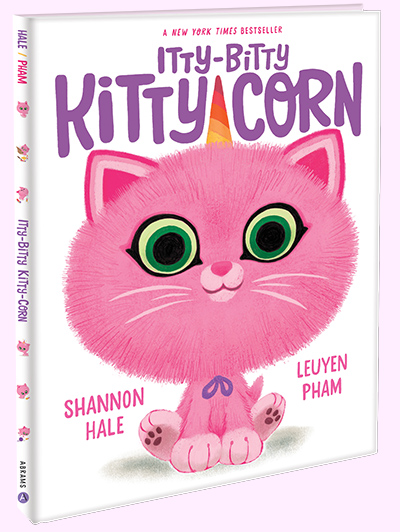
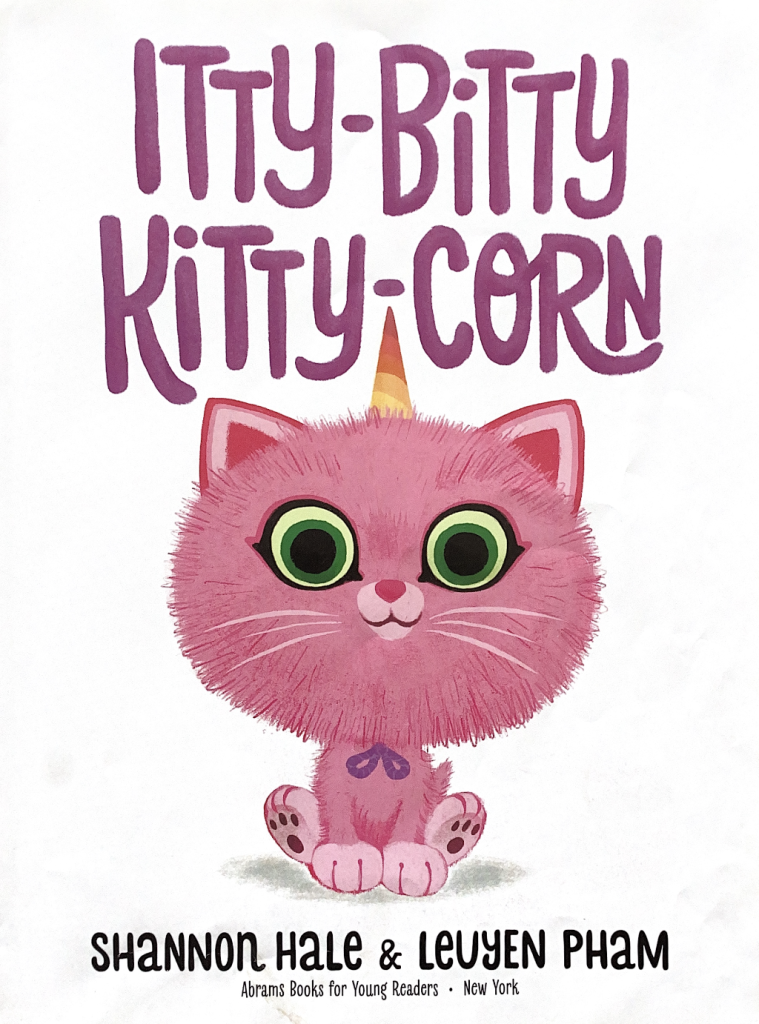
Shannon Hale and LeUyen Pham’s Itty-Bitty Kitty-Cornis — pardon the pun — a unicorn: a 40-page, 413-word picture book that my toddler will not only sit through cover-to-cover but request again and again. That’s because it ticks off every box for S’s favorite books:
A cute, cuddly main character
A subject S loves (here, animals)
Onomatopoeia
Active, colorful illustrations
Active, short, punchy sentences
Repetition and word choices that invite interaction from the listener
I’ll take them in turn, though many of these points can easily be combined differently under multiple topic headers. (In short, the reasons this is S’s co-favorite book are self-reinforcing.)
1. A cute, cuddly main character
This one’s pretty self-explanatory. Just look at Kitty:
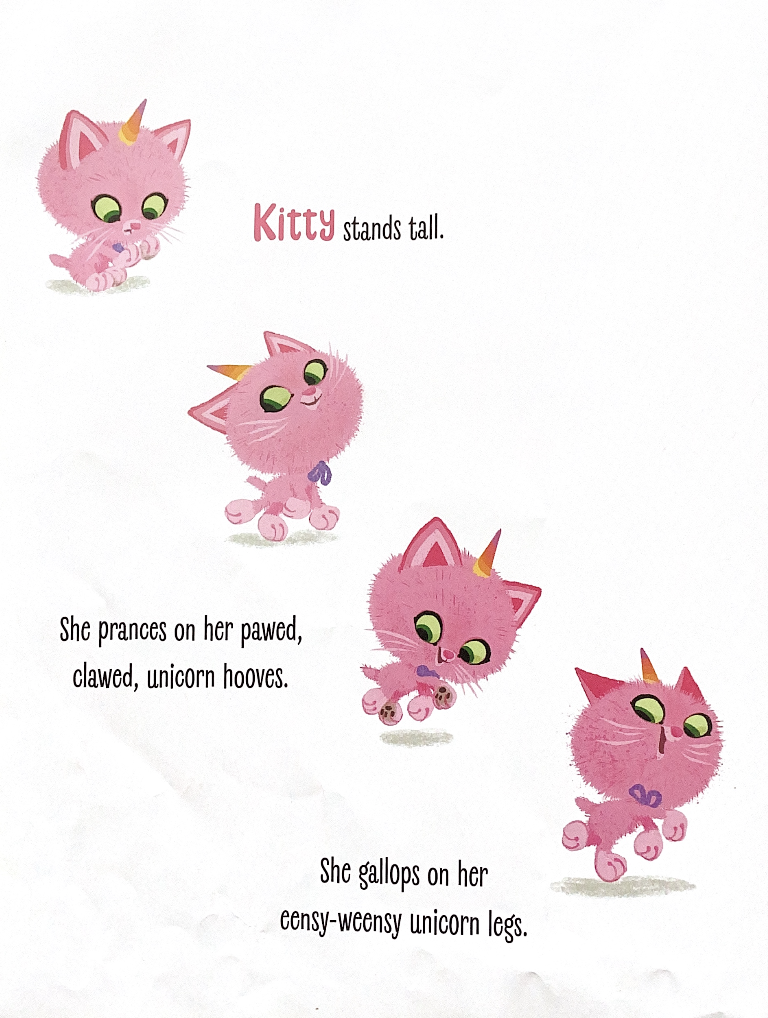
She’s adorable. And she prances and preens and trots and gambols all the way through the book:
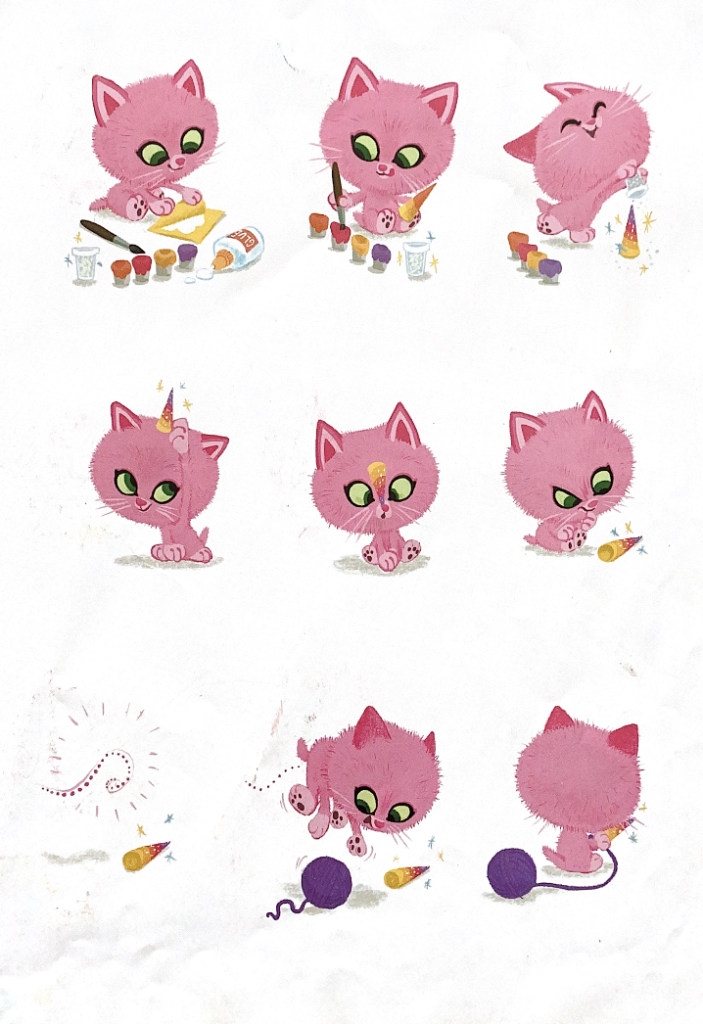
S LOVES these end pages, which open the book showing Kitty’s desire to be a unicorn, and the creation of her iconic horn.
Even when (spoiler alert) Kitty gets sad, she remains utterly adorable. You just want to give her a big hug. S loves to look at all the pictures of Kitty throughout the book, helping to hold S’s attention through the text.
2. Animals
This one’s also pretty self-explanatory. S loves animals, and this is a book with animal characters. I will note that the type of animals in the book was not a selling point; just the mere fact of animal characters was what did it. Prior to reading this book, S was not into kitties, unicorns, geckos, or parakeets, but S left the book a fan of kitties, unicorns, and kitty-corns.
3. Onomatopoeia
Itty-Bitty Kitty-Corn uses well-placed, fun onomatopoeia. Kitty “neighs” (a favorite animal sound that immediately endeared the book to S). Her tail goes “poof.” The unicorn goes “clop clop.”
The onomatopoeia is not over the top, but sprinkled in only where it makes sense to move the story along. And S loves to chime in with it.
4. Active, Colorful Illustrations
You can get a sense of this from some of the pictures above, but Kitty is constantly moving. Her expressions and actions change across and down the page.
The fact that the illustrations frequently feature Kitty doing multiple different things on a given page help hold S’s attention — there are lots of varied illustrations that S can look at while I read the corresponding sentences, which makes it much easier to get through longer text blocks (and presumably make it easier for S to understand what the text is conveying when it uses new words).
5. Active, Short, Punchy Sentences
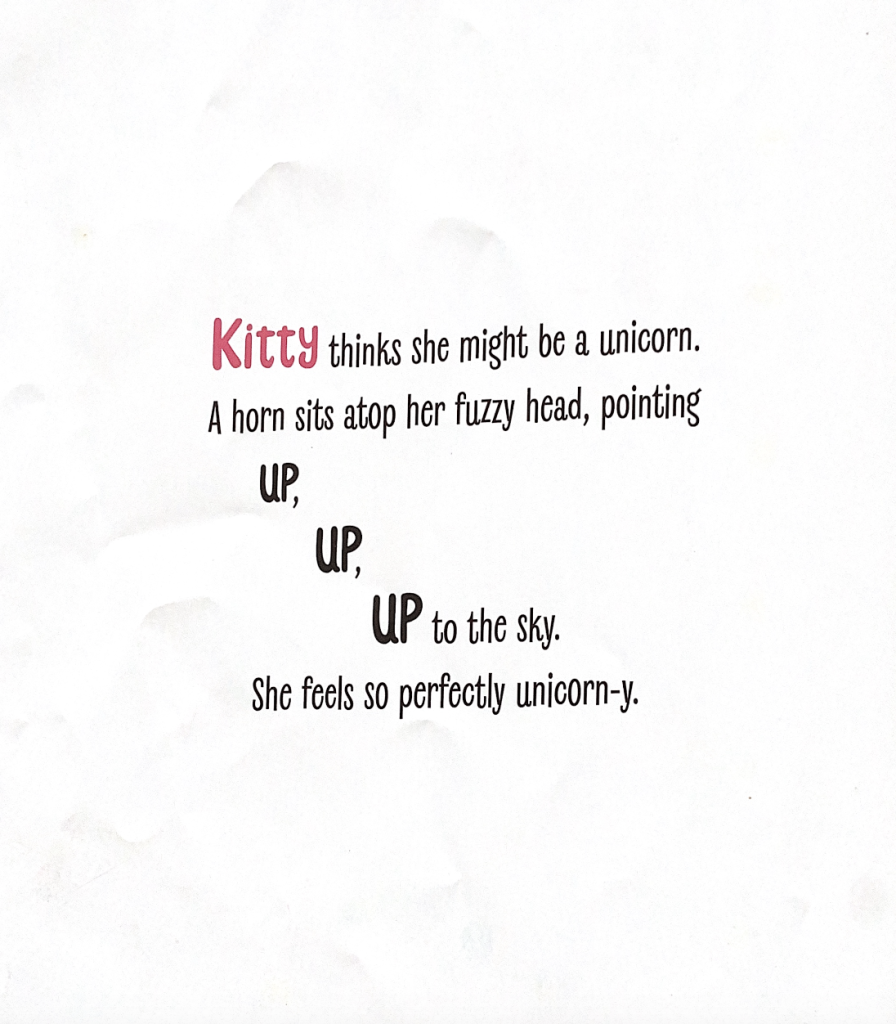
Itty-Bitty Kitty Corn may be on the absolute high end of word count for books S and I read together, but it does not feel long in the slightest. Shannon Hale’s text is phenomenally tight. Sentences are short, punchy, and active (and often tied to individualized illustrations per sentence). There are frequently no more than 2-3 sentences on a page. Those sentences are often no more than 5 words, making them easier for a young reader to follow (and adding to the rhythm of the story). Dramatic pauses are built into the writing, and also to the text layout:
6. Repetition and Interactive Sentences
Itty-Bitty Kitty-Corn makes great use of repetition and near repetition, as well as interactive sentences that let S anticipate and join in with me. S especially loves the onomatopoeia and saying “up up up” along with me.
***
TL;DR – this book is adorable, and does so many things right for appealing to multiple age groups. I can easily see it remaining a favorite for a long time.
Some quick stats on Itty-Bitty Kitty-Corn:
Page count: 40 pages of what I would consider the “main” book
Word count: 413
Average word count per illustration: 10.86 (or 10.33 if you count standalone pages of text with pretty font as their own illustration)
Average sentence length: 5.9 words per sentence (or 6.16 if you include semicolons and sentences that were broken over multiple pages and illustrations as single sentences)
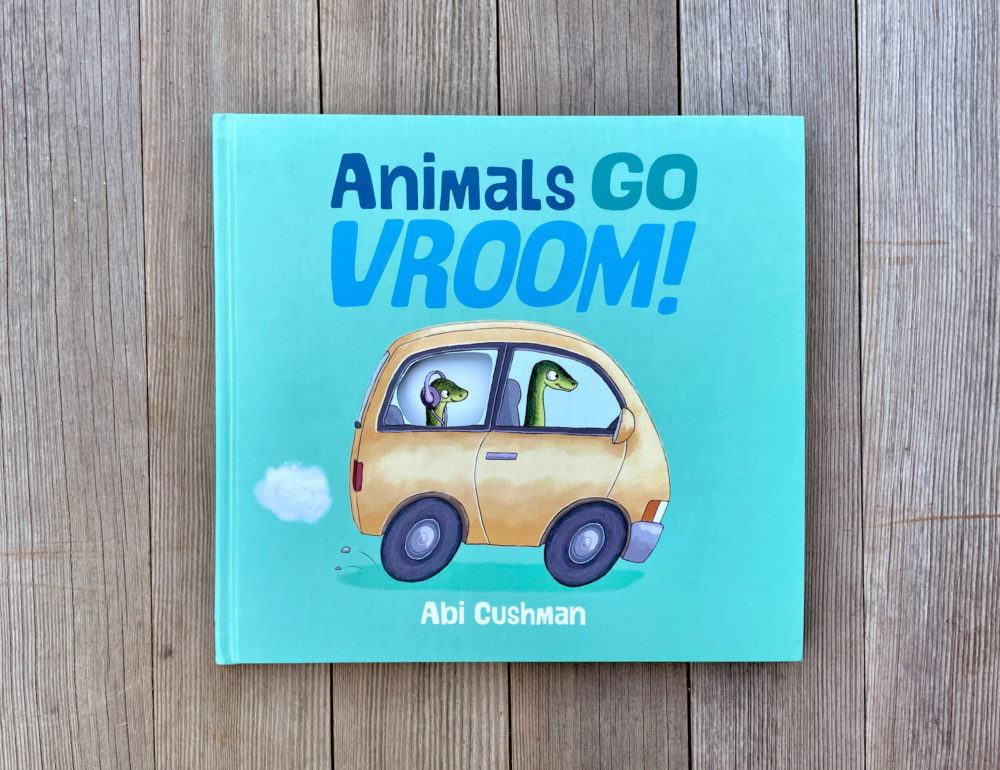
It is only fitting that the first deep dive into my toddler’s favorite books is the brilliant Animals Go Vroom! by Abi Cushman. Animals Go Vroom! has been in a two-way tie for S’s favorite book for months, right from the moment S pulled it off a library shelf and was so transfixed we had to make it S’s first library book. Here’s why:
Surprising, Interactive Page Turns that Follow a Pattern
Active, Interactive Illustrations
Combining Two Favorite Subjects (Animals and Transportation)
Fun Animal and Transportation Sounds
Evocative Word Choices in Short Sentences
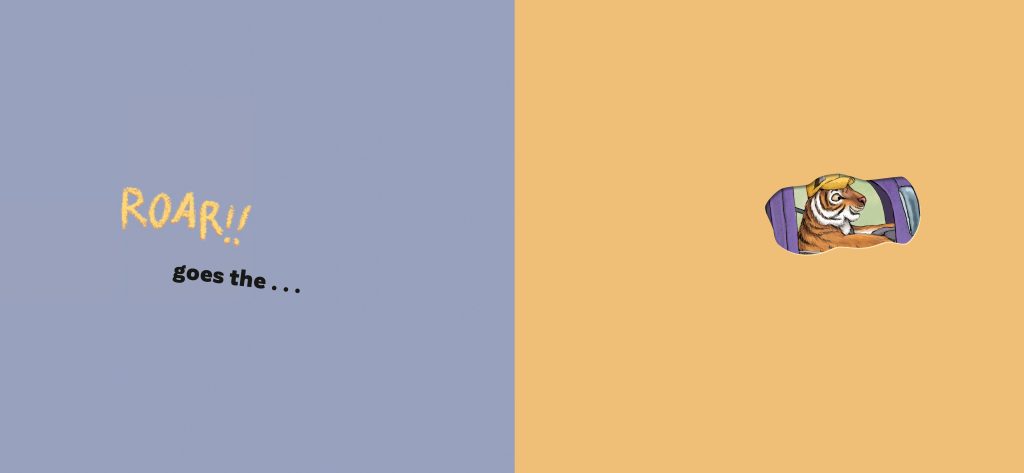
Each spread in the book follows the same interactive pattern. The left side of the book contains an animal sound seemingly related to an animal visible through a cut out on the right side of the book. The text invites the reader to guess what is making the sound, and to turn the page to finish the sentence.
A huge thank you to Abi Cushman for providing the high quality book images for use in this blog!
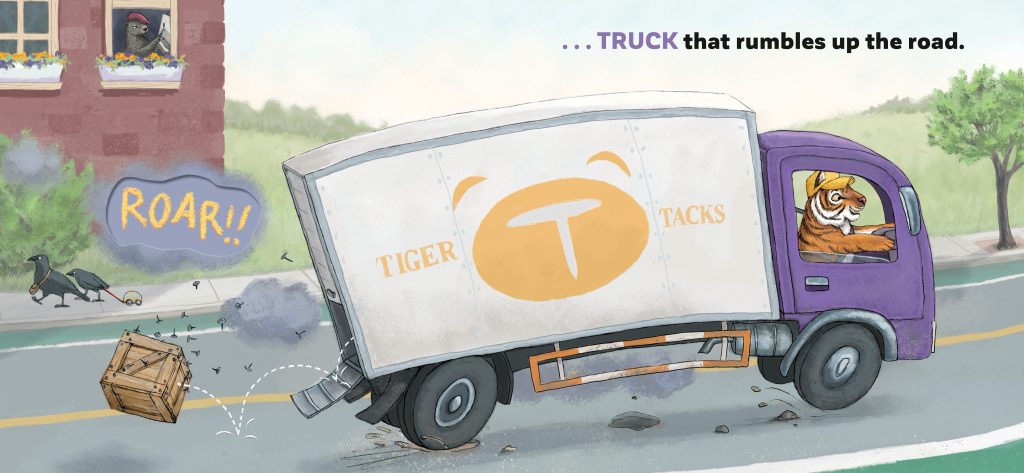
And when you turn the page …
You see that the animal sound wasn’t an animal sound at all, but a transportation sound!
S LOVES this. S loves saying “roar” and all the other fun sounds in the book (“hiss” and “awoooooooooo” are particular favorites). S loves the surprise page turns, and the fact that they follow a predictable pattern, which heightens the suspense and excitement of each page turn. S also loves turning the pages by jamming one hand into the cutouts (a fun textural element!) while I hold my breath and silently thank the publisher for using sturdy paper.
Animals Go Vroom! is also a favorite because it does a lot to keep S’s attention.
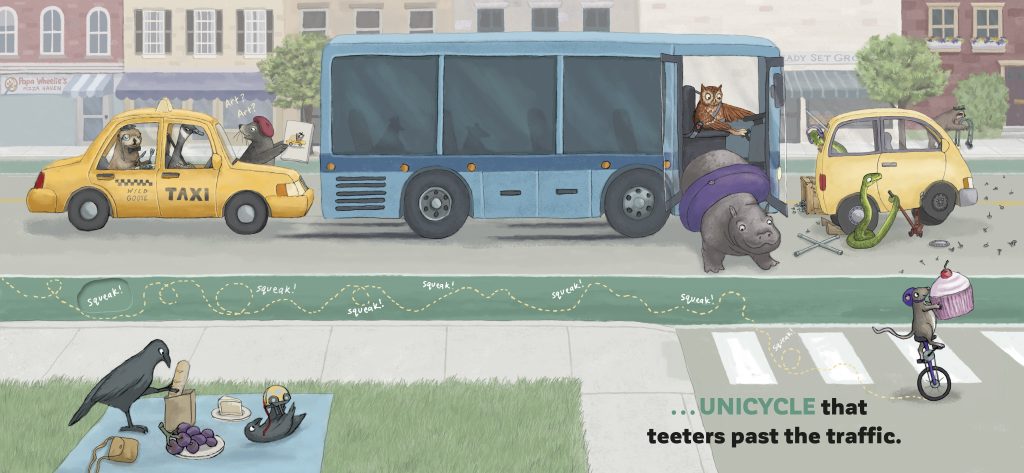
Sentences are short, punchy, and active, with juicy word choices and alliteration. The truck doesn’t drive up the road – it rumbles. The unicycle doesn’t roll past the traffic – it teeters. The words aren’t just fun to say – they also sound like their meanings, which combined with the illustrations have added to S’s vocabulary.
Complementing the text, the illustrations are active, bright, and colorful. They also include a lot of background details for us to sink our teeth into and engage with as we read.
S loves to point out the hat on the tiger in both the “hidden” and fully revealed spreads above. In the spread below, S likes to point out the hippo (a favorite animal) and the picnic, bread, and cheese.
The images in the story also build off each other, with whole stories happening in the illustrations. It’s both world building and word building. On each page, S and I can discuss everything that is going on beyond the text on the page. The detail in the illustrations also offers a lot of new, easy, and exciting words to learn and/or practice. In the unicycle spread alone, we have a mouse in a helmet riding with a cupcake; the baby crow has a toy; the mommy crow has bread, grapes, cheese, and a bag; there are hippos and snakes and owls; the painter is in a hat….
These details not only make the story more interactive, but S’s interest in pointing them out builds vocabulary that S enjoys utilizing the next time we read the book.
Put simply, there’s a reason why S requests this book multiple times a week. Check it out – I hope you love it as much as we do!
Some quick stats on Animals Go Vroom!:
Page count: 30 pages of what I would consider the “main” book
Word count: 70
Average word count per illustration: 4.67 (I have a hunch that word count per illustration is going to be lowest in the books we read the most, so I’ll be tracking that over time. Check back to see how that hypothesis holds up….)