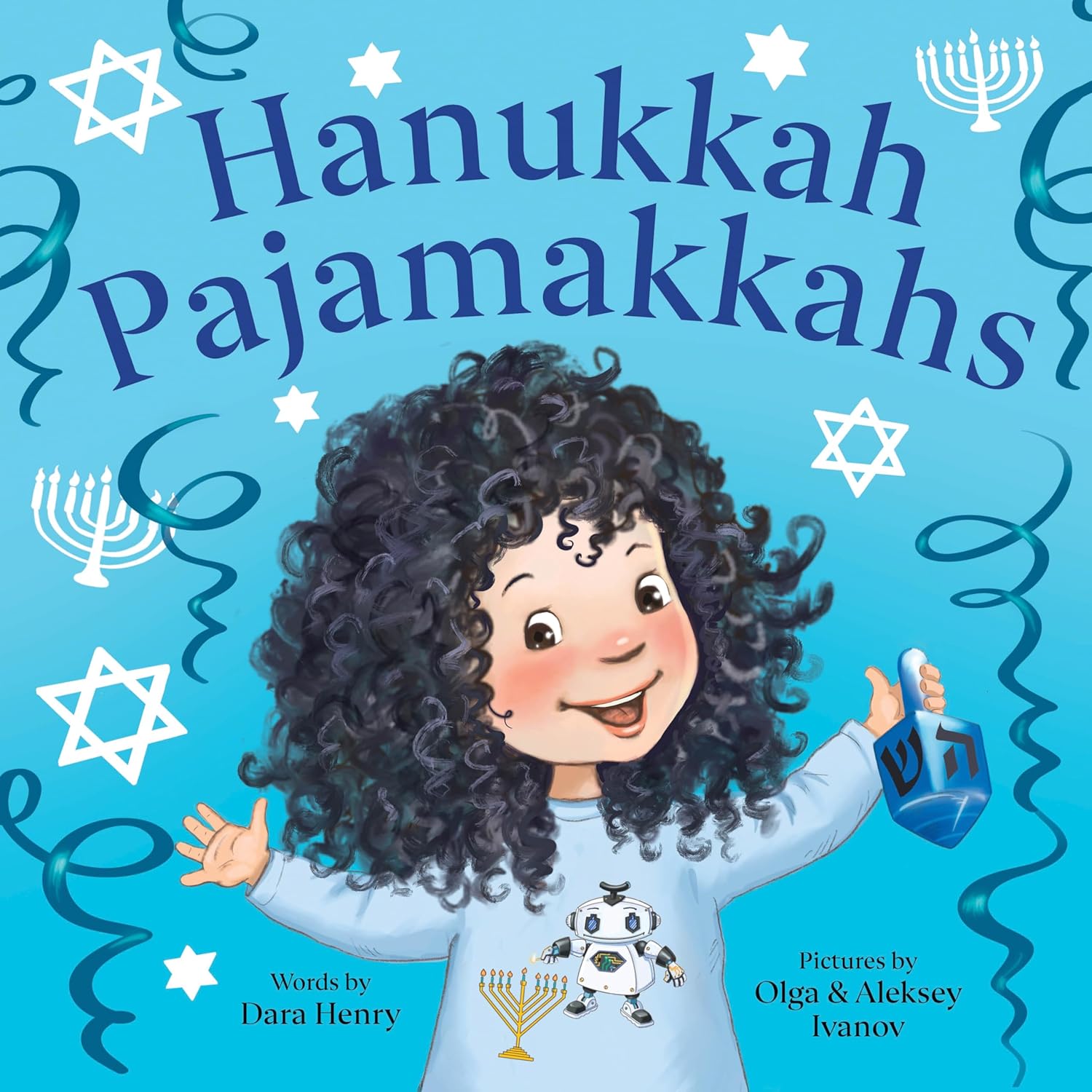
Continuing our theme of “representation matters,” let’s take a look at Dara Henry and Olga and Aleksey Ivanov’s adorable Hanukkah Pajamakkahs.
The story is geared for readers ages 4 and up, and its main joke/premise goes over S’s two-year old head. Ruthie wants to wear her fun new Hanukkah pajamas for all eight nights of Hanukkah and promises her parents she will keep them spotless. She naturally proceeds to get them extremely messy, but claims she’s in the clear because streaks, drips, and splotches aren’t technically spots.
The book’s sentences are also generally too long for S’s attention span and comprehension abilities. Excluding one-word onomatopoeia sentences, the book averages 8.5 words per sentence, with nearly half of them clocking in at 9+ words per sentence. I wind up doing a fair amount of summarizing on each page, which I think makes S less likely to request an immediate re-read of the book when we finish it (there’s less repetition/consistency when I summarize, and toddlers seem to adore repetition/consistency).
Nonetheless, S is always excited to read Hanukkah Pajamakkahs when she spots it (terrible pun intended) on the shelf. Here’s why:
Hanukkah Pajamakkahs introduces its prime toddler hook quickly.
The book begins with Ruthie opening her Hanukkah pajamas, which she calls “pajamakkahs.” S finds this delightful. “Pajamakkahs” is fun to say, and the book instructs the reader to say it with excitement — both the text (Ruthie “squealed in delight”) and the layout (putting “pajamakkahs” in big, colorful font) demand that “pajamakkahs” be uttered with verve. S loves to join in and shout “pajamakkahs!”
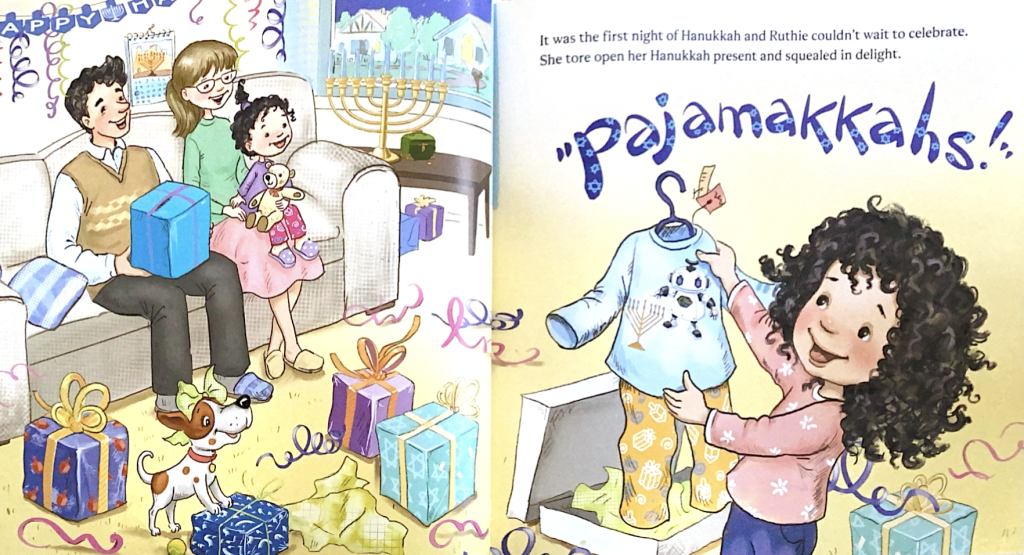
In addition to starting the story off with excitement, the pajamakkahs are relatable — like Ruthie, S has Hanukkah pajamas and loves to wear them, regardless of the time of year. Hanukkah is exciting, and Hanukkah pajamas carry that excitement forward into something mundane (bedtime).
Like the joyful challah-baking in Challah Day!, Ruthie’s excitement over pajamakkahs (and the existence of a book centering that excitement) is a prime example of meaning coming from something small — a slice-of-life kind of representation.
The book features lots of relatable Hanukkah items and activities.
S also identifies with and enjoys pointing out the other Hanukkah items in the story. Ruthie lights a menorah, makes latkes, and plays dreidel, and many of these items can be found in the background of multiple spreads. These items are exciting, and keep S turning the pages to find more of them.
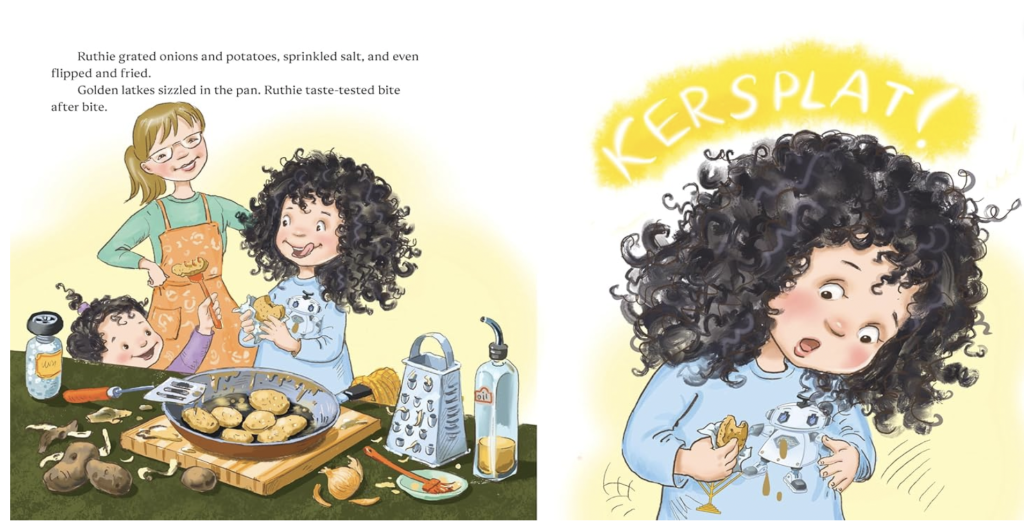
There is a ton going on in the illustrations, Hanukkah-related and otherwise.
As noted above, S loves to point out Hanukkah-related items in the book, and Hanukkah Pajammakahs‘ illustrations have no shortage of them to look at. They also have a ton of other things going on, which keep S engaged and interacting with the book.
The below spread is probably S’s favorite spread in the whole story. It takes place outdoors (always a favorite) and features kids playing soccer, a dog running around, flying food, and lots of ancillary items to take note of — hats, scarves, a picnic, etc. There is a lot of action and joy in this spread, which S picks up on.
The book makes fun use of onomatopoeia.
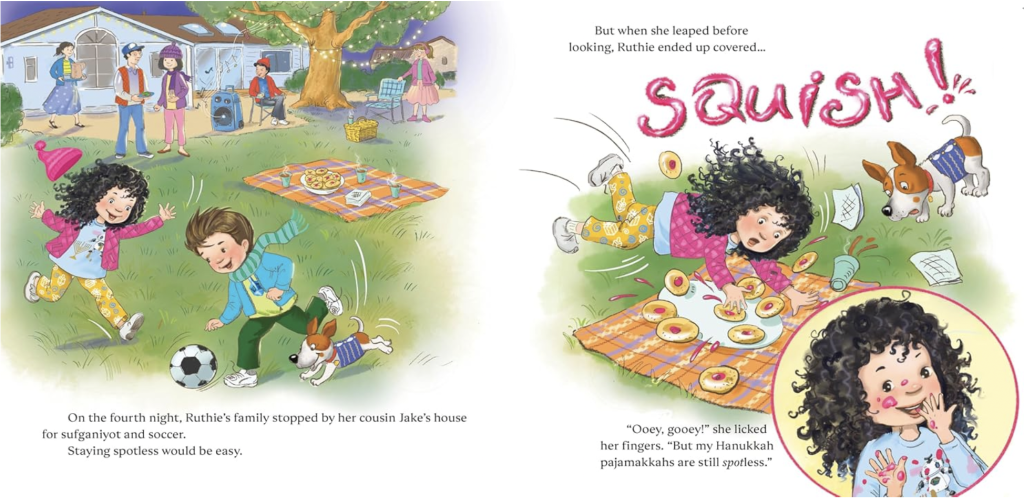
Each time Ruthie gets her pajamas messy, the book uses fun onomatopoeia to describe what is happening. Latke drippings go “kersplat!,” jelly donuts go “squish!,” glitter goes “floof!,” and so on.
Like the initial use of “pajamakkahs!,” the onomatopoeia acts as a cheerleader in the middle of the story, raising our enthusiasm level as we read.
Potentially of note for anyone trying to use onomatopoeia as an element to bring in younger readers: S tends to get more excited by certain kinds of onomatopoeia than others. At age 2, words that make sense in context like “squish,” “crash,” or “whoops” tend to get a better reaction than words that convey a sound that S may not understand.
TL;DR: If you or your kids like Hanukkah, fun sounds, giant messes, or rules lawyering, check Hanukkah Pajamakkahs out. It’s a fun read!
Hanukkah Pajamakkahs By the Numbers
Pages: 31 pages of what I would consider the “main” book
Word Count: 468
Words Per Illustration: 15.6
Words Per Sentence: 7.1 (8.5 if one-word onomatopoeia sentences are removed)