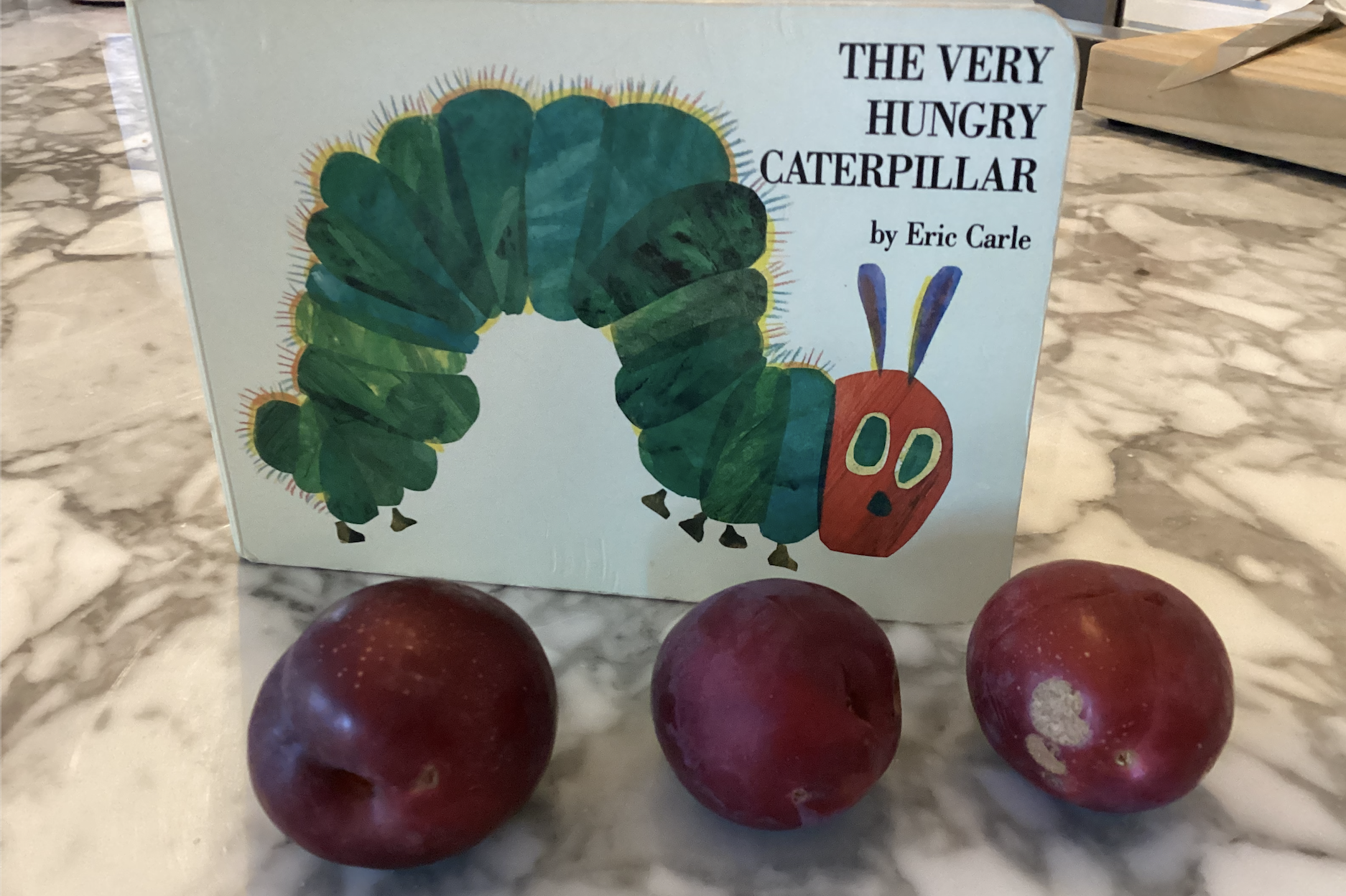
Eric Carle’s The Very Hungry Caterpillar is iconic. It was one of my absolute favorite children’s books 30-something years ago, and it is one of S’s favorites now. Whenever S spots the book, I have to read it at least 3 times, often back-to-back-to-back. This is not surprising. From a picture book construction perspective, the book is near flawless. And each of the things the book does well make it a toddler classic. Here’s why.
A Quick Introduction to an Adorable Main Character
The very first spread of The Very Hungry Caterpillar sets up the anticipation of what is going to happen in the story. We’re told that a little egg lays on a leaf, and that’s it. Things that are small are very appealing to toddlers, and S loves to point out the egg on the leaf.
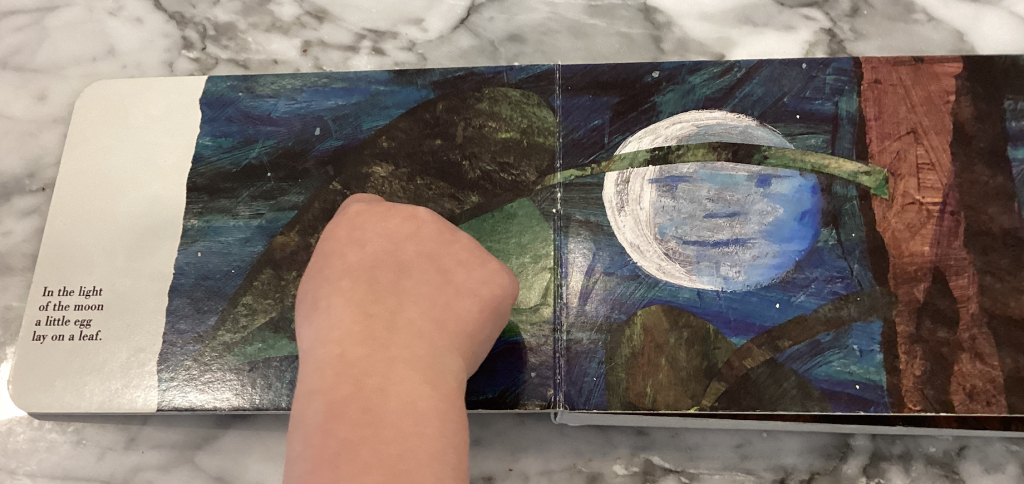
And then the next morning, the warm sun comes up, and the tiny caterpillar comes out of that egg with a “pop.” That littlest bit of onomatopoeia goes a long way; S loves to repeat it, and it sets up the excitement of the caterpillar being born. So in two pages we’ve got anticipation and excitement, and a delightfully plucky, toddler-sized main character that we are now interested in following around.
Hooks on Hooks on Hooks
In just 224 words, Carle manages to seamlessly integrate about a bazillion hooks. I’m sure I’ve missed a few, but at a minimum, we’ve got:
- Night and Day – The book opens in “the light of the moon” and transitions to the “warm sun coming up.” (And the sun and the moon are so friendly! Just look at their smiling faces…)
- Days of the Week – The story goes from Sunday to Sunday, with the caterpillar eating different foods each day.
- Counting – Each time the caterpillar eats a new food, he eats one more of that food, so the reader can visually see what 1, 2, 3, 4, and 5 look like.
- STEM – We see the caterpillar transform from egg to butterfly over the course of the book.
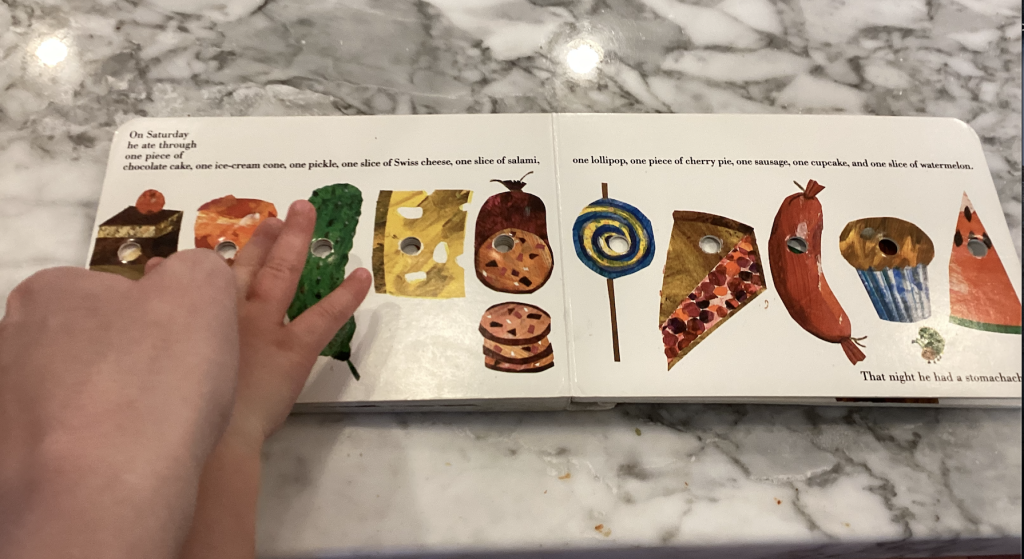
- Interactivity – S LOVES the holes that the caterpillar “eats” in each food. We touch each one as we count, which adds an interactive element to the reading experience.
- The Greatest Junk Food Sequence Known to Books – S adores this page, which contains pretty much every food a little kid wishes they could eat on the regular.
Fantastic Sentence Construction
The Very Hungry Caterpillar is short, and not just in word count — the story is only 18 total sentences. This concision keeps S engaged — every sentence meaningfully advances the story.
The story also makes brilliant use of refrains, which, as we’ve established on numerous occasions, are toddler gold. Each day of the week, the caterpillar does something similar. “On Monday, he ate through one apple. But he was still hungry.” On Tuesday, he eats through two pears, “but he was still hungry.” And so on. The repetition gives S something to latch onto and expect with each page turn, while the slight changes give S something to pay attention to — namely, the counting and days of the week hooks. And when the caterpillar goes off the rails on Saturday, it is both hilarious and delightful.
The book’s average “words per sentence” count is markedly higher than S’s normal favorites, but the sentence length is offset by (1) the overall tightness of the story itself and (2) smart sentence construction in the longest sentences. The longest sentences are offset by dashes/easy to understand clauses (ex: the “pop!” that breaks up the sun coming up and the caterpillar coming out of the egg and the long list of foods the caterpillar eats on Saturday) that make it much easier for S to follow along.
Gorgeous, Colorful Illustrations
This one goes without saying. But it certainly contributes to S’s interest in the story. It also creates a payoff at the end when the caterpillar turns into a truly beautiful butterfly.
The Very Hungry Caterpillar By the Numbers
Pages: 22 pages of what I would consider the “main” book
Word Count: 224
Words Per Illustration: 13.18
Words Per Sentence: 12.44