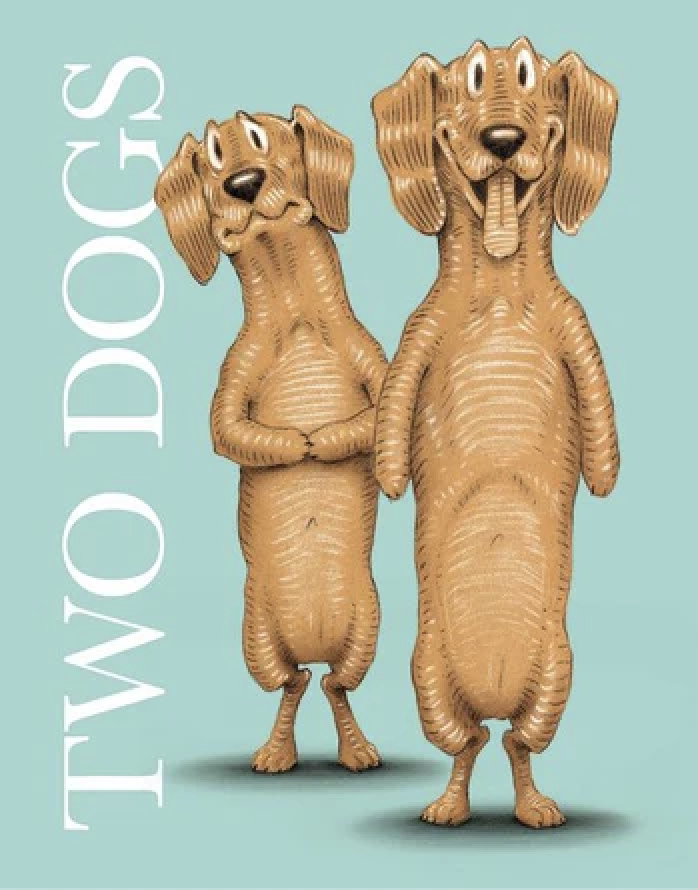
Ian Falconer’s Two Dogs is a bit of a mystery to me. S loves it. But with the exception of having two dogs as protagonists, it defies almost everything I thought I knew about what makes books appealing to a 2-year old.
Start with the intro. It’s unique, clever, and makes no sense to S:
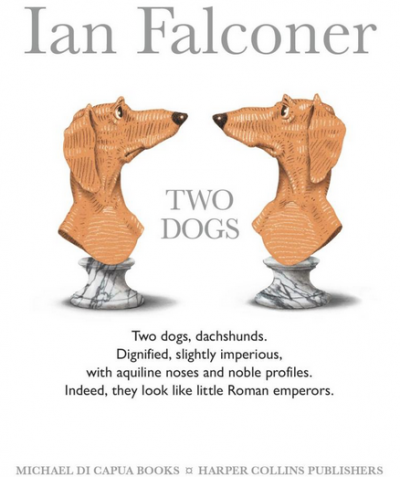
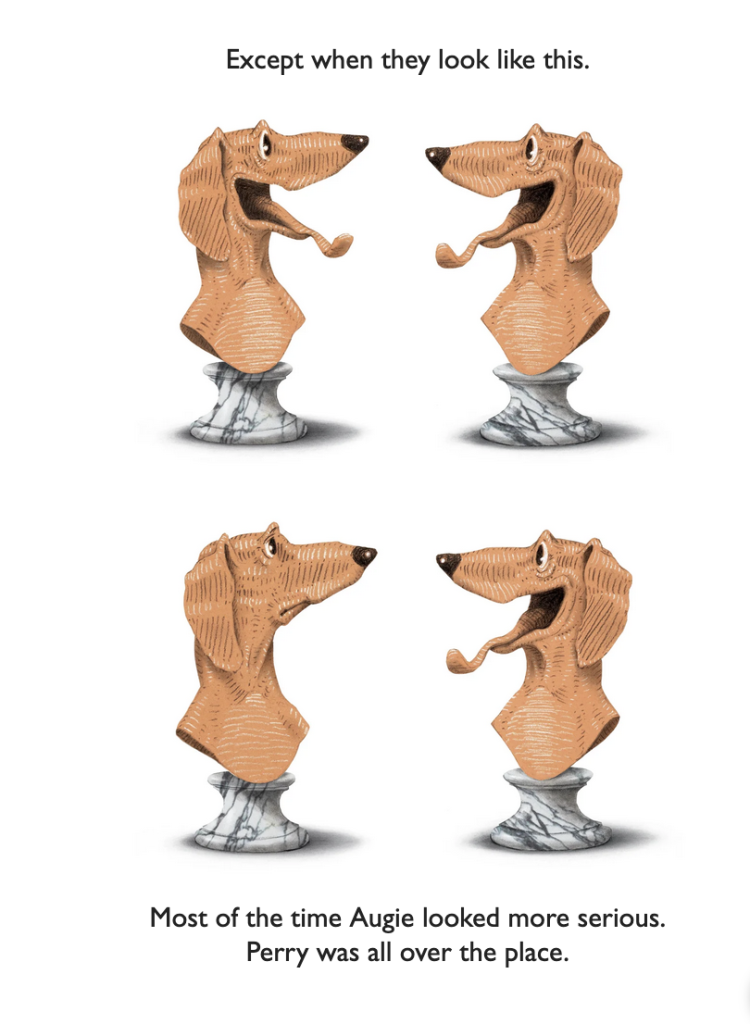
Over the next several pages, the story introduces Perry and Augie, their differing personalities, and their problem: their family played with them all the time as puppies, but now leave them alone all day. (Darn work and school!)
These concepts go completely over S’s head. Most days, we flip past all of the intro pages without even paraphrasing them. For S, the book begins on page 7. That’s when Perry steals Augie’s ball.
Over the next several pages, Augie asks Perry for his ball back with increasing levels of desperation.
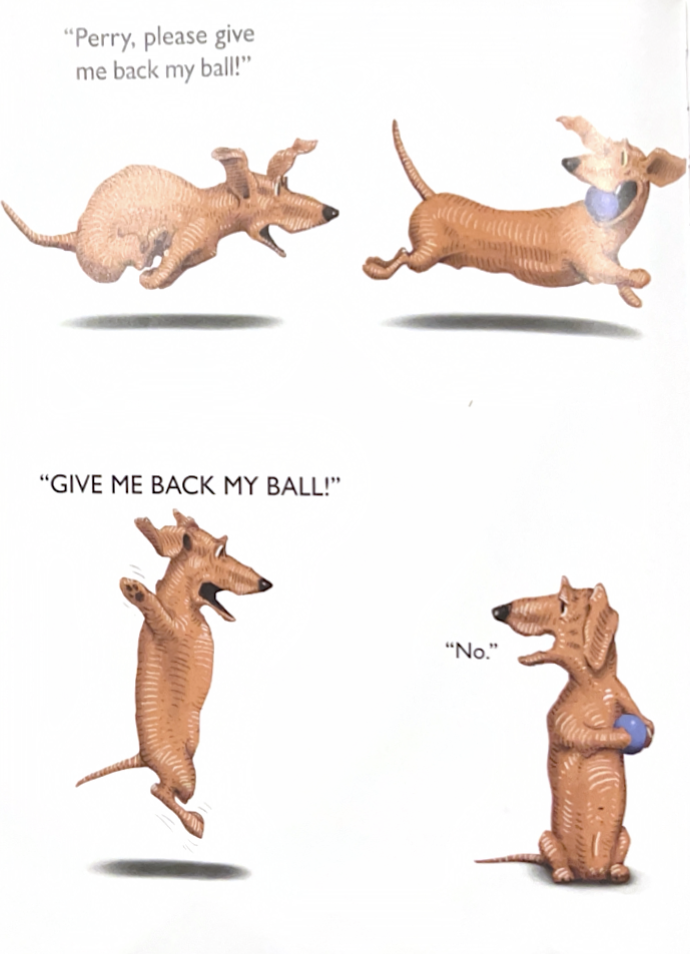
S loves this section of the story, and will point at these pages and say “Give the ball back.” “Give it back!” S will also open the book directly to these pages and say “Read Perry book!” I think S enjoys the repetition in Augie’s requests, as well as looking at the pictures of Augie and Perry jumping around – they are very active. I also think S identifies with the song-and-dance of trying to get your toy back. It seems to be a common thing in early preschool.
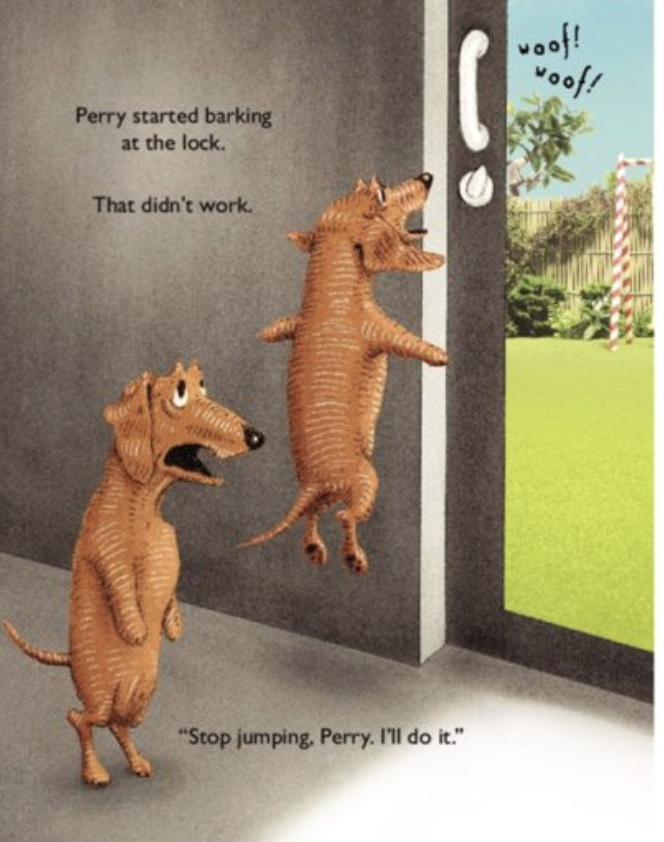
S also loves the next section of the story, where Augie and Perry try to open the door to leave the house. Each time we read it, S informs me that the dogs are trying to “open the door.” This is a relatively new skill for S, which may be why it is of interest. The pictures are also quite colorful, which certainly doesn’t hurt.
After that, we mostly skip pages or paraphrase. Of the dogs’ antics outside, we focus on their playing on the playground and swimming in the pool — things that S is familiar with and likes. Their other activities are funny but go over S’s head (ex: “watering” the flowers) or are written in a manner that is too advanced for a 2 year old and never caught S’s attention.
But even though we read less than half of the book each time, S keeps asking for it.
So what can Two Dogs teach us about appealing to toddlers despite being geared toward older readers?
- There is value in including topics that may be of interest to multiple age ranges. You never know what will pique a toddler’s interest or make a book suitable for siblings of different ages.
- Though the book starts “slowly”, I continue to think that starting your story quickly and with short, punchy sentences is the best way to appeal to a younger reader. If I had followed S’s cues rather than my own curiosity, I would have stopped reading long before we got to the part S enjoys so much.
- Shorter sentences and more illustrations per sentence help with complex topics. The pages we read have half the number of words per illustration of the ones we don’t. It’s been a pretty common phenomenon — S is more likely to want to read stories with shorter sentences and fewer words per picture.
- Dogs are always a good protagonist choice, particularly when they’re engaged in fun antics like Augie and Perry.
Two Dogs By the Numbers:
Page count: 40
Word count: 423
Average word count per illustration on pages we read aloud: 6.72
Average word count per illustration on pages we don’t read aloud: 13.13
Average sentence length on pages we read aloud: 4.48
Average sentence length on pages we don’t read aloud: 6.71