Jennifer Tarr

Writing picture books for kids and their grown ups.

Category: Bunnies

  • Toddler Teaches…AFIKOMAN, WHERE’D YOU GO?

    Toddler Teaches…AFIKOMAN, WHERE’D YOU GO?

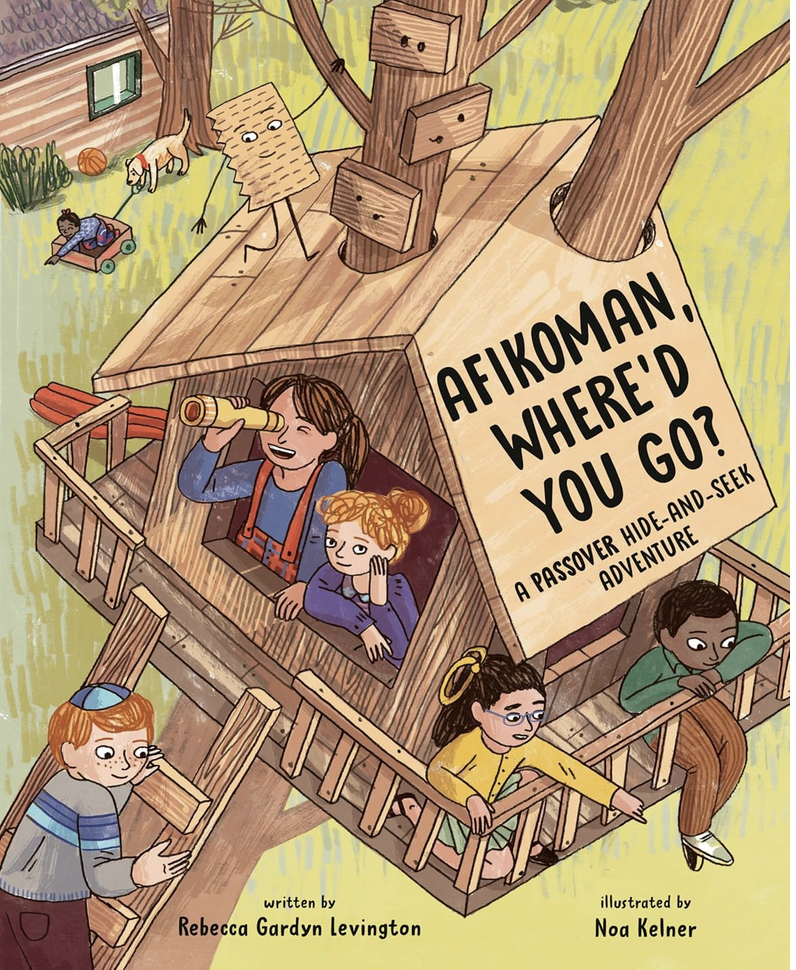
    I have been a huge fan of Rebecca Gardyn Levington and Noa Kelner‘s Afikoman, Where’d You Go? ever since it first released two years ago. It’s bouncy, fun, imaginative, and right up my alley (an anthropomorphic afikoman version of Where’s Waldo? = truly incredible stuff). This year, S was finally old enough to understand a bit about Passover, so I was really excited to be able to share the book as part of our celebration.

    It was an immediate success. S got it as a prize for finding the afikoman on the first night of Passover (thanks, mom and dad!) and has wanted to read it multiple times a day since. As with Challah Day!, Afikoman, Where’d You Go? is representation at the level that means the most to kids. Finding the afikoman is (in my opinion) the most kid-friendly part of the seder, and the one that intuitively makes the most sense to a toddler (hide and seek! with a snack at the end!). So to be able to relive the fun over and over is exciting.

    But it takes a lot more than a great premise to make a great book. So let’s take a deeper dive into some of the things that the book does so well:

    Interactivity and Agency
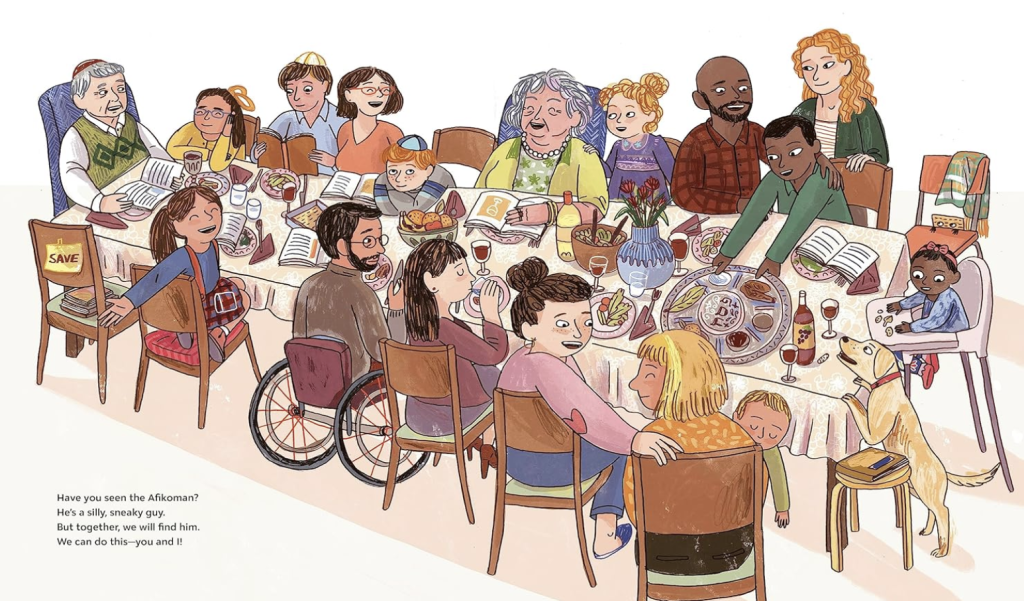
    First page of Afikoman, Where'd You Go?
    Thanks to Rebecca Gardyn Levington and Noa Kelner for their kind permission to use some of their art in this post!

    The story brings the reader into the action immediately, opening with a question: “Have you seen the Afikoman?” We are not going to be passive participants in this story — we are going to be finding the afikoman too. The rest of the stanza further sets this up: “But together we will find him. We can do this — you and I!”

    S is immediately hooked and ready to find the afikoman, pointing him out on the first page and every subsequent page. (“He’s over there!” “Right there!” [spoiler alert] “In the doggy’s bed!”)

    The first page also immediately sets up Afikoman as a lovable trickster. He’s “silly” and “sneaky” — two words that immediately signal to S that this is going to be fun. S loves when things are “silly,” and now Afikoman has a personality matched by the delightful illustrations.

    Extremely active illustrations

    I have often written about how important active illustrations are to keeping S engaged with a story. Afikoman, Where’d You Go? has this going on in spades. Each illustration has tons going on, and the ability to point out so many different interesting things (Afikoman! the dog! bunnies! a basketball!) keeps S’s attention on every page.

    A fun refrain that reinforces the interactivity
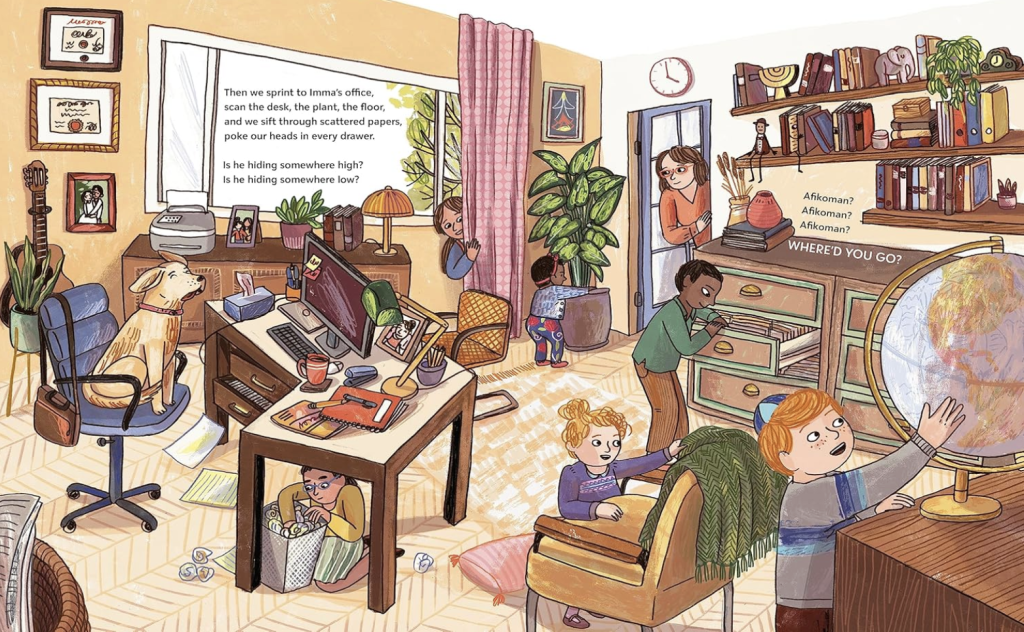
    Every few failed attempts to find the afikoman there is a catchy refrain — “Is he hiding somewhere high? Is he hiding somewhere low? Afikoman? Afikoman? Afikoman? WHERE’D YOU GO?”

    The refrain is incredibly effective. For starters, toddlers adore repetition. And this refrain reinforces the interactivity of the story, reminding us to check for Afikoman on every page. It also pushes the adult reader (*cough*, me) to ask the child where the afikoman is on other pages too, if they haven’t done so.

    Plus, the refrain sets up two hysterical back to back payoffs at the end. I won’t spoil the first one, which is amazing, but the fact that the structure is parallel to the earlier refrain highlights the change for S.

    And then S loves the last page, where Afikoman escapes in a car. (We’re still very into vehicles, so pointing out the car gets us a lot of mileage…bad pun only sort of intended.)
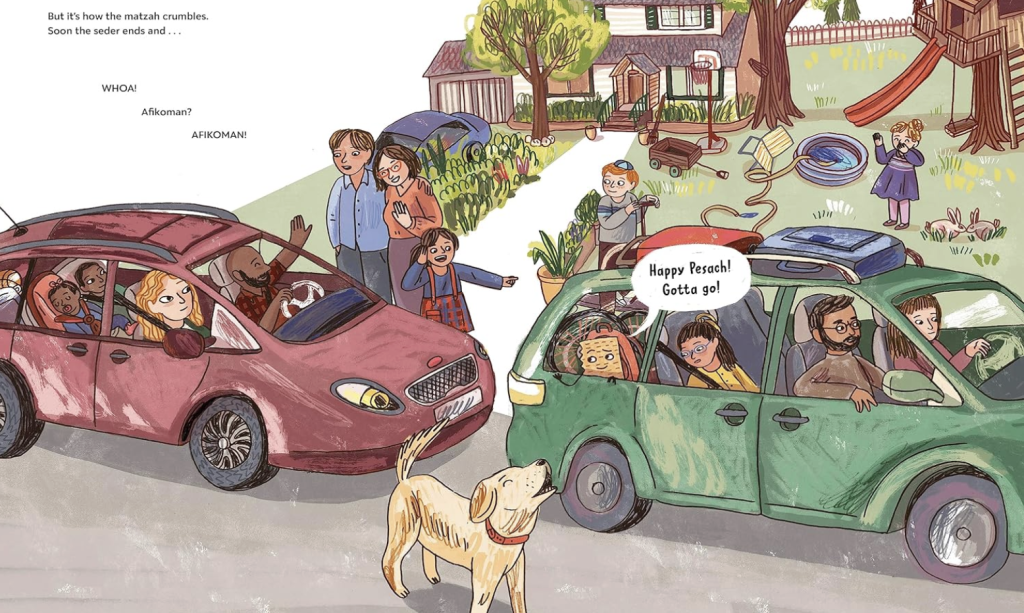
    Afikoman makes a great escape!

    All in all, this book is a blast, and I’m glad I get to read it a lot.

    Some random musings

    Non-English Words

    I have occasionally seen questions in writer’s spaces about the use of non-English or culturally meaningful words in picture books (and concerns about the book not being universal if they’re included). The narrator in Afikoman, Where’d You Go? uses Hebrew words for her family members — Imma (mom), Abba (dad), Savta (grandma), Saba (grandpa). This is a complete non-issue for S. S had never heard those words before, wasn’t bothered by it in the least, and figured out what was going on from the illustrations without my needing to explain anything. (Plus there’s a glossary, for anyone who needs it.) And now they’re familiar words for S, given that we’ve read the book about a gazillion times. So from my perspective, if you are considering using words that have meaning to you in your picture book, go for it!

    Book Signings

    My parents were able to get the book personalized for S at an event. I thought this was really cool, because I love Rebecca’s work. What surprised me was how much S loves it too. Every time we open the book, the first thing S does is point out the inscription and say, “That’s for me!” Obviously the personalization does not impact sales since we were already buying the book regardless, but I found it interesting. It certainly makes it feel even more special when we sit down to read it.

    Afikoman, Where’d You Go? By the Numbers

    Pages: 30 pages of what I would consider the “main” book

    Word Count: 378

    Words Per Illustration: 22.24

    Words Per Sentence: 4.15*

    *Since the book rhymes, it creates natural pauses that make it easier for S to pay attention to longer sentences. I therefore counted clauses as full sentences where they conveyed a full idea that S could understand (i.e., where they would likely have ended with a period rather than a comma if the book were written in prose). That occurred in about half of the book’s sentences (with the other half naturally being 6 words or less).
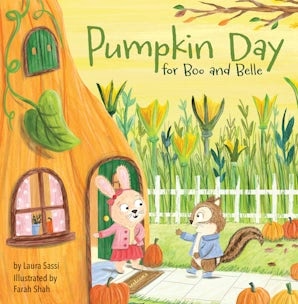
  • Toddler Teaches…PUMPKIN DAY FOR BOO AND BELLE

    Toddler Teaches…PUMPKIN DAY FOR BOO AND BELLE

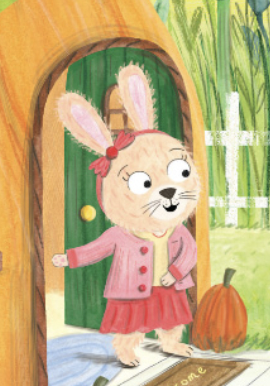
    In mid-to-late January, S started to get particularly into bunny rabbits. At the same time, S began to gravitate towards Laura Sassi and Farah Shah’s Pumpkin Day for Boo and Belle. This isn’t surprising — the book is adorable and prominently features a bunny as the main character.

    Said bunny.

    What surprised me a bit was the depth of S’s interest in the book. It’s not just any book; it’s “my” book. As in, the book gets thrust toward me with the instruction to “read MY book.”

    The book is very long for S’s normal attention span (561 words), but we can often get through the full text because the sentences are short and bouncy and there’s lots going on on each page.

    For the most part, though, S actually “reads” the book without me by picking it up and flipping through the pages. This is a testament both to Shah’s colorful, inviting illustrations (and the volume of fun things to spot in them), and to Sassi’s writing creating the opportunity for new and exciting illustrations on each page.

    Since the illustrations seem to drive S’s interest in the book, I thought it would be interesting to highlight a few images and point out what captures S’s attention in them.

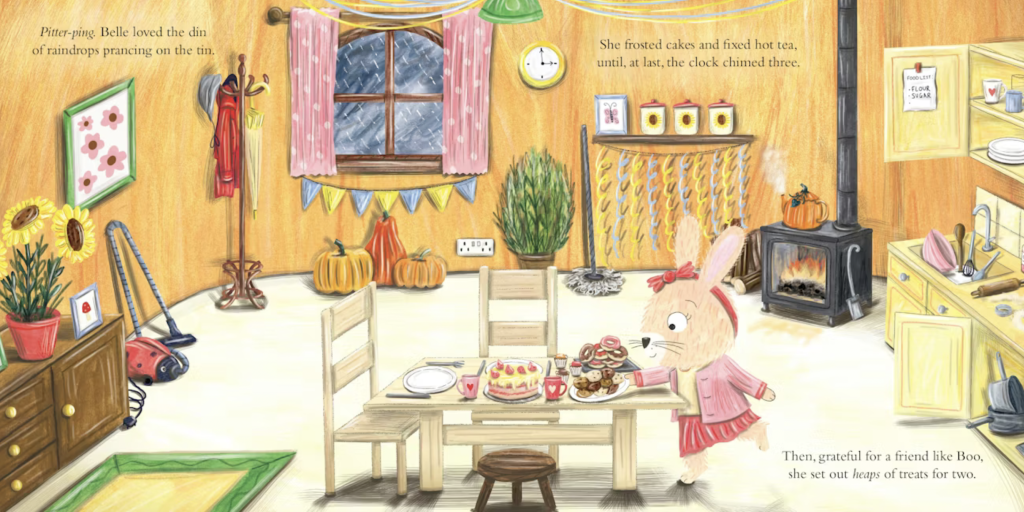
    This is probably one of S’s favorite images in the book. We’ve got (1) a bunny (2) wearing a bow (3) setting out cakes. And in the background, there are pumpkins, flowers, a ladybug vacuum that S loves to point out (“ladybug!”), and a clock on the wall that S also loves (“clock!”).

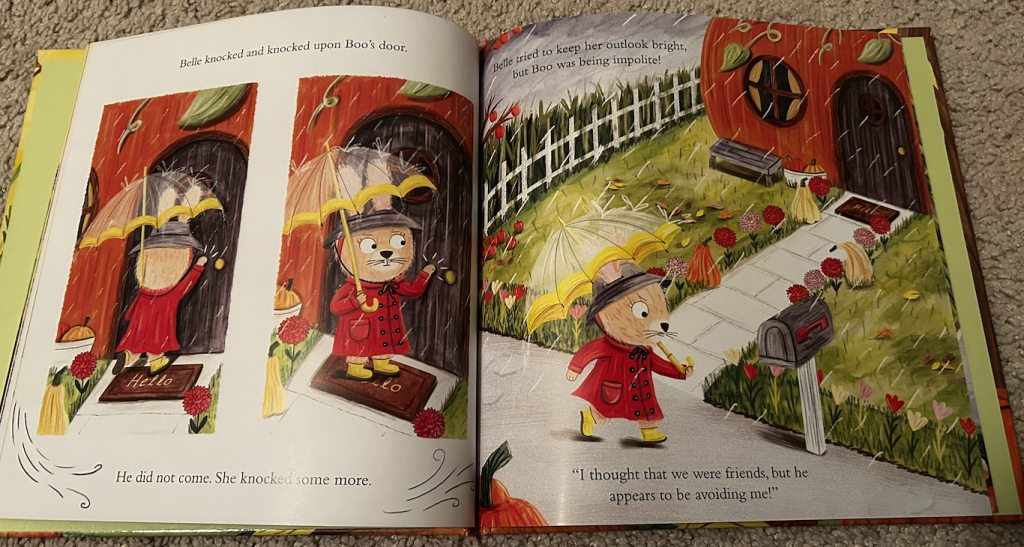
    Here, S is interested in umbrellas and raincoats. (And probably also the bunny.) The movement in the illustrations across multiple images also doesn’t hurt.

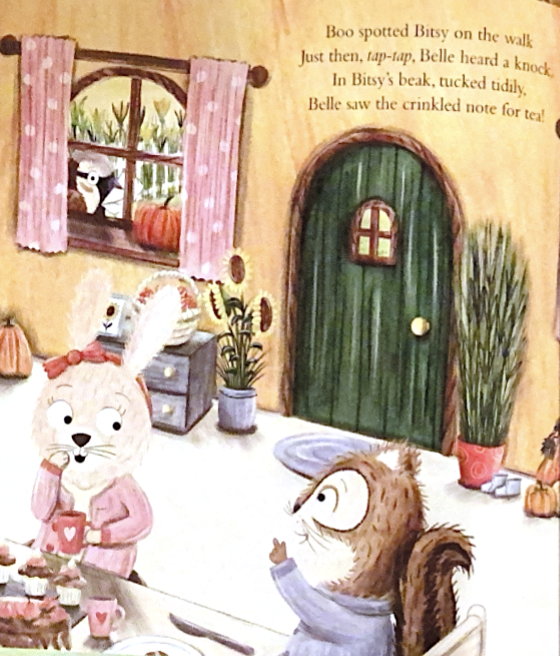
    And here, the big winner is the bird essentially playing hide and seek in the window. (And probably also the bunny.)

    TL;DR: Having lots of things to point out in the background adds to the number of possible toddler hooks and helps build vocabulary. It turns an already-fun book into an outright winner. Also, one can never go wrong with bunnies.

    Pumpkin Day for Boo and Belle By the Numbers

    Pages: 30 pages of what I would consider the “main” book

    Word Count: 561

    Words Per Illustration: 18.1

    Words Per Sentence: 5.39*

    *Since the book rhymes, it creates natural pauses that make it easier for S to pay attention to longer sentences. I therefore counted clauses as full sentences where they conveyed a full idea that S could understand (i.e., where they would likely have ended with a period rather than a comma if the book were written in prose). That occurred in about half of the rhyming sentences.

  • Toddler Teaches…NOT-A-BOX CITY

    Toddler Teaches…NOT-A-BOX CITY

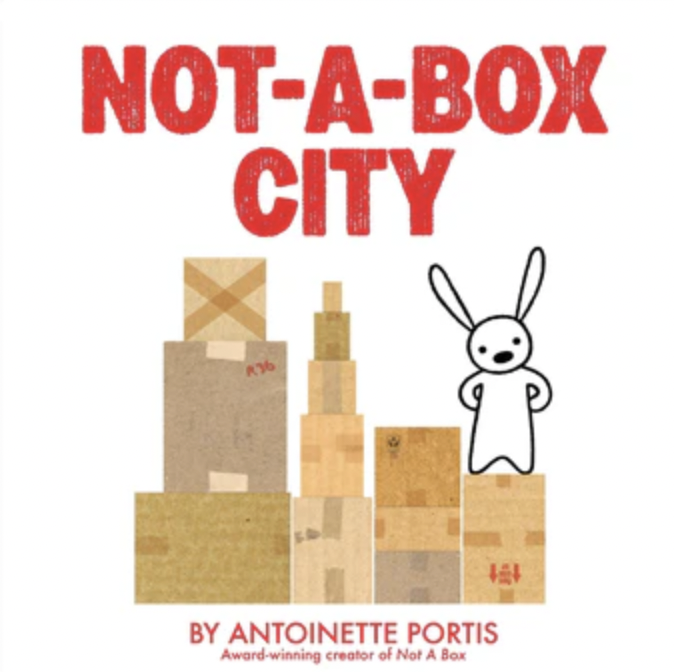
    Antoinette Portis’s Not-A-Box City has been a huge hit for months. It’s easy to see why — it’s got short, snappy sentences that are easy for a 2-year old to follow; animals; construction; and lots of fun things going on in the illustrations.

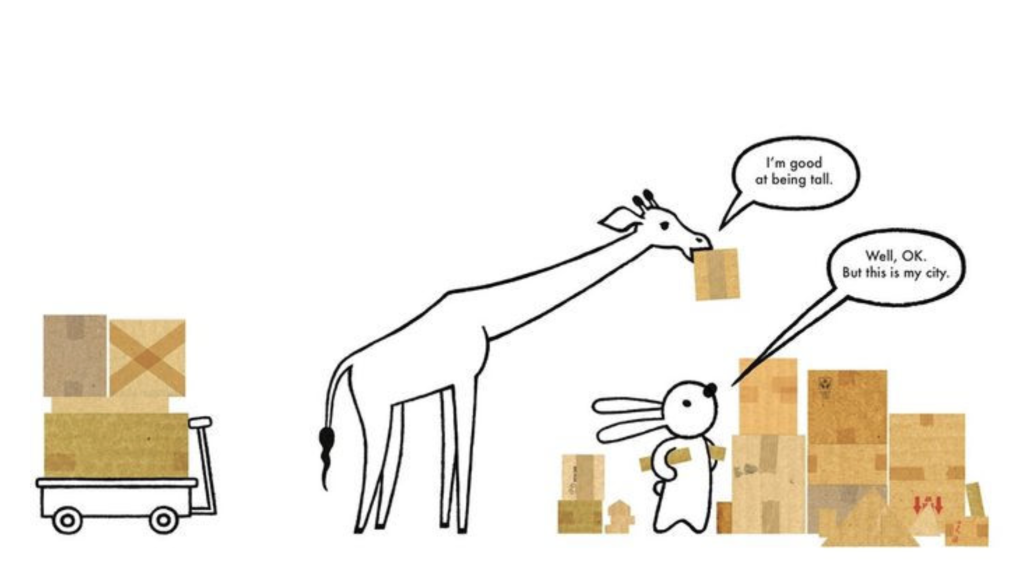
    Let’s start with the animals. We’ve got a bunny main character, and some unique animal friends — a giraffe, ants, and an iguana/chameleon/lizard (you can tell me which in the comments).

    Bunny and giraffe building a box city
    Bunny agrees to let Giraffe help build his city, but with conditions.

    Animals are always a big draw for S, but bunnies have become especially so. At this point, they can almost carry a book on their own. (Side note: If you want to occupy a toddler for however long you can tolerate listening to the same thing on loop, play this interactive bunny song. You’ll thank or curse me later).

    Then we’ve got the main plot. Bunny is building a city out of cardboard boxes. This itself is a major hook — S loves building things, and the steps necessary to make the city (cutting, stacking, painting, etc.) are all activities that feature prominently in preschool.

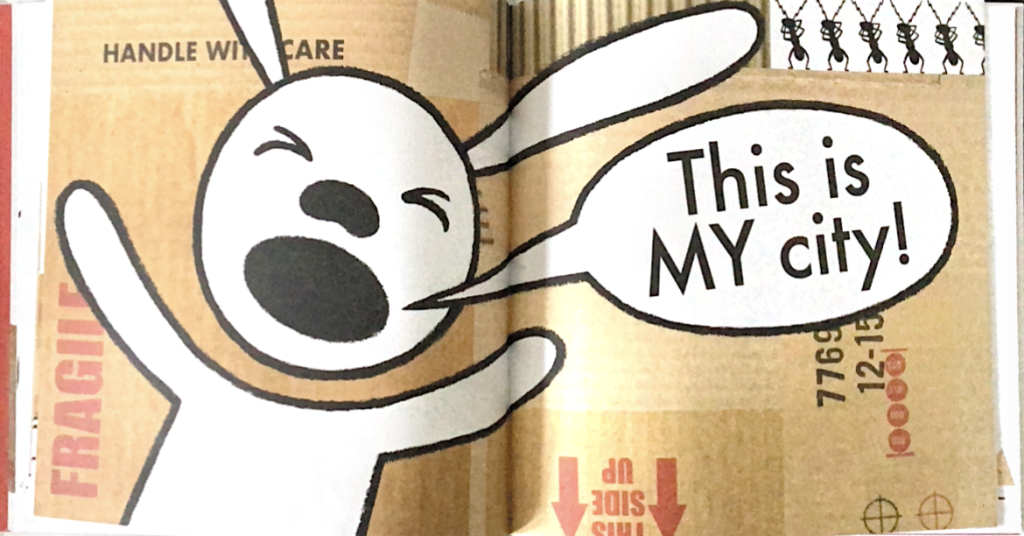
    The story also deals with huge emotions, which is another prime preschool topic. Bunny initially wants to do it all by himself, before agreeing to let Giraffe and some ants help. But when Iguana/Chameleon/Lizard starts painting without permission, Bunny loses it.

    This is one of S’s favorite spreads. Like Perry and Augie’s fight over the ball in Two Dogs, S seems to really identify with Bunny getting upset and territorial after the other animals start taking over the project. S loves to shout “This is MY city!” along with Bunny. I thought it was a bit of an anomaly when we read Two Dogs, but something about characters shouting “this is mine!” seems to be very appealing to toddlers.

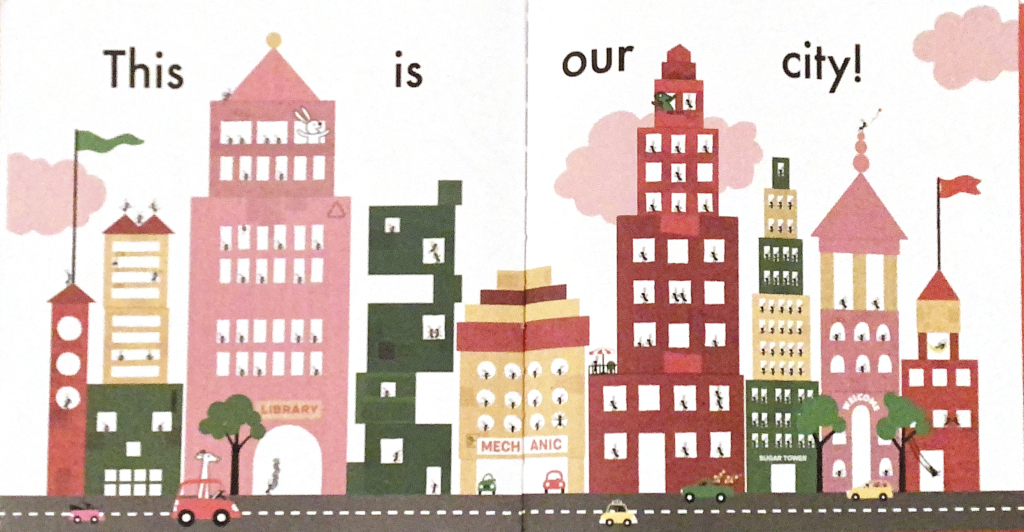
    Of course Bunny realizes he’d prefer having his friends around, and the story ends with the animals working together and cheering “This is our city!”

    The illustrations complete the package. Especially toward the end of the story, they are bright, with lots of engaging colors to point out. In the multiple spreads where the animals are painting the city, S likes to talk about the colors each animal is painting with, which reinforces key toddler vocabulary.

    The illustrations in the final spread keep S returning over and over. On the last spread, the animals’ city is complete, cheerful, and filled with action. The cars at the bottom add in a transportation hook, but perhaps most importantly from S’s perspective, the final spread features Bunny triumphantly sitting at the top of the Box City Library. S loves to point out Bunny’s location — the library is one of S’s favorite places, and its appearance in the city is yet another small detail that gets a lot of mileage with us.

    Neither here nor there from S’s perspective, but just a note for those who are writing stories with speech bubbles — being preliterate and stuck with a parent reader who can’t do voices to save her life, S can’t figure out who is saying what in the spreads unless I tack on something like “said Bunny” or “said Giraffe” as I read each speech bubble. I don’t think it changes much if anything about the way a speech bubble based story would be written, but noting it here in case it affects the way anyone thinks about them.

    Not-A-Box City By the Numbers

    Pages: 36 pages of what I would consider the “main” book

    Word Count: 96

    Words Per Illustration: 5.33

    Words Per Sentence: 3.56