Jennifer Tarr

Writing picture books for kids and their grown ups.

Category: Reading

  • Toddler Teaches…Favorite Picture Books of 2025 (12 to 24 Months)

    Toddler Teaches…Favorite Picture Books of 2025 (12 to 24 Months)

    As we head into a new year, I thought I’d take a moment to highlight some of S’s favorite picture books of 2025 that did not get individual posts. Without further ado, the unsung picture book heroes of the 12-24 month age range:

    Favorite Picture Books of 2025: The Classics

    Book cover for Goodnight Moon by Margaret Wise Brown and Clement Hurd, a favorite picture book of 2025

    Goodnight Moon (Margaret Wise Brown / Clement Hurd)

    The Runaway Bunny (Margaret Wise Brown / Clement Hurd)

    Chicka Chicka Boom Boom (Bill Martin Jr. and John Archambault / Lois Ehlert)

    Brown Bear, Brown Bear, What Do You See? (Bill Martin Jr. / Eric Carle)

    The Very Hungry Caterpillar (Eric Carle)

    Madeline (Ludwig Bemelmans)

    Where’s Spot? (Eric Hill)

    Favorite Picture Books of 2025: The Vehicles Set

    Book Cover for Yellow Copter by Kersten Hamilton and Valeria Petrone, a favorite picture book of 2025

    Yellow Copter (Kersten Hamilton / Valeria Petrone)

    Little Excavator (Anna Dewdney)

    Goodnight, Goodnight, Construction Site (Sherry Duskey Rinker / Tom Lichtenheld)

    Favorite Picture Books of 2025: The Animals Set

    Book cover for Ursula Upside Down by Corey R. Tabor, a favorite picture book of 2025

    Ursula Upside Down (Corey R. Tabor)

    Little Red Hen (Lyn Calder) (specifically this Golden Books edition from 1990)

    The Sky is Falling! (Mark Teague)

    Apples for Little Fox (Ekaterina Trukhan)

    Click, Clack, Moo: Cows That Type (Doreen Cronin / Betsy Lewin)

    Dear Zoo (Rod Campbell)

    Favorite Board Books of 2025

    I Love My Tutu Too! (Ross Burach) (Scholastic, Inc., 2020)

    Rosh Hashanah: New Year, Gather Near (Leah Weber / Taryn Johnson)

    Absolutely anything by Sandra Boynton, with a special shout-out to Silly Lullaby and Moo, Baa, La La La!

    P is for Pastrami (Alan Silberberg)

    Little Blue Truck Feeling Happy (Alice Schertle / Jill McElmurry)

    ***

    And a few closing thoughts on S’s preferences this year:

    • Short, punchy sentences are key. I can get away with reading significantly more text per page if each sentence is around 5-7 words. If a page has 30 words on it, breaking those 30 words into 5-6 sentences is far preferable to 2 sentences.
    • Refrains are toddler gold.
    • S was not nearly as into rhyme as I would have expected. Of all the books on this list, only 5 of them are rhyming, and the rhyme is not the reason S likes the book. Punchy, repetitive sentences that S can anticipate and participate in (a la “Click, clack, moo!”) are far more important for getting S engaged in the text than rhyming is.
    • Subject matter is key, but idiosyncratic. Even having the subject of interest in a background image will often suffice to have S ask to read the book. Combining multiple kid-friendly topics optimizes chances of hitting on a preferred topic at any given time.
    • Flaps, cutouts, and other forms of physical interactivity got high marks this year. This ran the gamut from the holes in The Very Hungry Caterpillar to textures in Little Blue Truck Feeling Happy (which quickly surpassed its namesake because it had feathers and wool and a shiny blue truck to touch).

    Hope you all have a great new year — see you in 2026!
  • Toddler Teaches…HOW TO DRAW A HAPPY CAT

    Toddler Teaches…HOW TO DRAW A HAPPY CAT

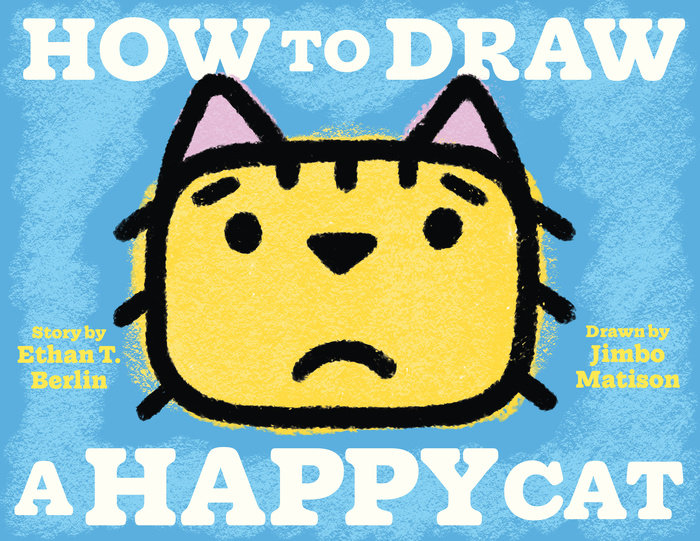
    I first came across How to Draw a Happy Cat when our local children’s librarian suggested it for my own writing research. (Side note: Librarians are awesome. Ideas to support your local library here.)

    As a more advanced picture book (SLJ suggests it for grades K-2), I did not expect it to immediately enter S’s favorite book rotation. I should have. Here’s why:

    1. It combines multiple kid-favorite topics.
    2. The language is declarative and snappy.
    3. The book invites the reader to participate in the action.
    4. The illustrations are active and colorful.

    As pretty much all my previous posts have established, S’s current favorite book subjects are animals and transportation. If your book has animals and/or transportation vehicles, S will probably at least give it a spin. If your book combines animals and transportation vehicles, you have dramatically upped your odds that S will want to read your book, and likely more than once. (Exhibit A: Animals Go Vroom!, an all-time S favorite.)

    How to Draw a Happy Cat does one better, and introduces not only animals and airplanes, but also one of S’s favorite foods: pizza.

    This may be one of S’s favorite images in any picture book we’ve read. It’s got a cat eating pizza being flung from a catapult, all while hanging onto an airplane. Pretty much toddler heaven.

    It’s like Ethan Berlin was handed a list of S’s interests and told to craft a story around them. Even without a great story, S would be predisposed to flip through the story over and over again, just to look at pictures of cats, airplanes, pizza, and cats eating pizza on airplanes.

    But the story works. It’s a hysterical, modern, interactive version of If You Give a Mouse a Cookie. And while the story is complex, the way it’s written and illustrated extends the age range downward.

    The story starts by inviting the reader to participate in the action — drawing our main character.

    Learning how to draw a happy cat may be fun and easy, but no one said anything about keeping that cat happy…

    It goes on from there in the same vein – each time we think the cat is finally happy, something happens, and we have to draw/solve her next problem.

    The sentences are often short and limited to one or two per page, conveying complicated problems and emotions with clean, simple language that is easy for S to understand. (How is the cat going to get the pizza? We have to turn the page to find out!)

    The cadence is great for listening, and the interactive language choices also keep S engaged – S is getting all the credit for helping out our new friend Cat. (“Great! She’s so happy! Good job!”)

    The sentences are also frequently accompanied by an illustration per idea. This decision is genius from a craft perspective, because it gives the reader the impression that they are impacting the story by “drawing” new things as the narrator directs them to do so.

    It also has a possibly-unintended benefit from a toddler attention-span perspective. As with Itty-Bitty Kitty-Corn, the sentence-per-illustration model of picture book creation is crucial to keeping S’s attention in longer books because each sentence gives S a new thing to look at (and the new illustration reinforces S’s ability to understand what the text is saying).

    So while Ethan Berlin and Jimbo Matison probably almost certainly didn’t set out to create this book for an under two year old, a few simple choices turned this book into an unexpected repeat pick.

    How to Draw a Happy Cat By the Numbers:

    Pages: 40

    Word Count: 311

    Words Per Illustration: 7.78

    Words Per Sentence: 5.65

  • Toddler Teaches…HUG

    Toddler Teaches…HUG

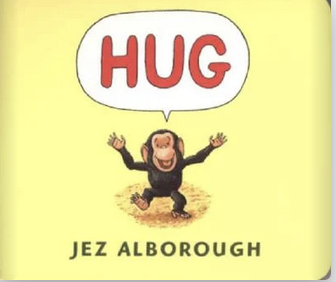
    Jez Alborough’s Hug is a delight. S asked for it daily at 19-20 months old, and still enjoys reading it several months later.

    Why Hug?

    As with many of S’s favorites, Hug has bright, active illustrations; lovable animal characters; and invites engagement with the text. It also starts quickly, introducing you to the main character and problem right away.

    The first spread immediately sets out the subject and tone of the book. Our monkey protagonist (who we later learn is named Bobo) notices two elephants hugging. Alborough does an incredible job conveying the warmth of the hug in the illustration. The page just FEELS cozy, which S picks up on.

    Having set up our world, the second page moves quickly to reinforce it and introduce our problem. Bobo happily spots other animals hugging until…hmmm? Where’s Bobo’s hug?

    S loves to look at all the different animals hugging, loves the warmth of their hugs, and loves saying “hug” along with Bobo. S is also interested in Bobo’s emotional journey, conveyed beautifully and simply through illustrations and the word “hug” — repeated 25 times in various intonations as Bobo gets increasingly distraught over his lack of hug.

    Bobo’s distress culminates in S’s absolute favorite part of the story — Bobo is reunited with his mommy in a sweeping multi-page arc:

    Their excitement to see each other is palpable, the illustrations are active, and Bobo’s problem is resolved with (you guessed it) a hug.

    S loves to repeat the text on these pages: “Bobo!” “Mommy!”

    It is the only time in the entire story that a word appears that is not “hug.”

    S’s love of these two pages highlights the importance of naming picture book characters in ways I was not expecting. I distinctly recall having a conversation with the friend who got S the book about whether the book would be stronger if “hug” was the only word in the book. More artistic? Possibly. But after reading Hug to S over 50 times, I can confidently answer that question “no.”

    Why is it so important that Bobo have a name?

    First, having a name helps S identify with Bobo. He’s not just “the monkey.” He’s a monkey with a personality, a family, and problems.

    Second, Bobo having a name gives us a way to talk about Bobo throughout the book. He’s not just “Bobo” in the one scene where his mommy calls out to him; he’s Bobo in every scene in all subsequent re-reads.

    Third, the simplicity of Mommy and Bobo calling out each other’s names while running towards each other adds a joy to the book that S can understand and participate in. Their reunion would not be nearly as powerful if I narrated a wordless spread of them finding each other, running, and hugging.

    Fourth, Bobo is a perfectly chosen name. It’s fun, easy for S to say, and thus easy for S to remember.

    While S definitely has favorite books and characters without human names, I have found in reading Hug and other SEL books that S identifies better with the character when they are named. (See also: Milo the penguin — S identifying with “Milo” in particular as opposed to any old penguin goes a long way toward S’s caring about his dilemma).

    Some quick stats on Hug:

    Page count: 28 pages of what I would consider the “main” book

    Word count: 27 (25 of which are “Hug”)

    Average word count per illustration: 1.5

  • Toddler Teaches…THE PENGUIN WHO WAS COLD

    Toddler Teaches…THE PENGUIN WHO WAS COLD

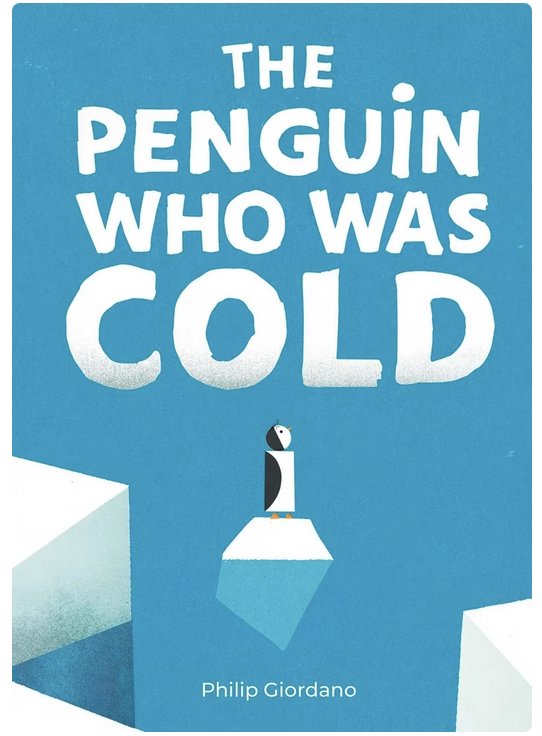
    If Itty-Bitty Kitty-Corn is the rare picture book that captures my under 2 year old’s attention cover-to-cover, Philip Giordano’s The Penguin Who Was Cold is rare in a different way — it’s a book geared toward older picture book readers that S largely flips through, yet excitedly requests again and again (and again).

    A standard read of The Penguin Who Was Cold consists of enthusiastically saying the title (“The Penguin Who Was…” “COLD!”), reading the first 3 spreads aloud, then flipping through the next 20 or so pages to briefly look at whatever catches S’s eye. No matter what else happens, we always stop to look at this gorgeous, colorful spread in the middle of the book:

    At which point S promptly flips to the end pages and declares the book over (“The End!”).

    So how does a book that we barely make a dent in make the “best seller” list?

    First, and probably most important, the book hooks S immediately. The first page quickly introduces our adorable main character and an easy to understand problem: Milo is cold.

    The next couple of pages are equally clear and concise and move the story forward. (“But Mom and Dad weren’t cold.” “And none of the other penguins were cold.”).

    In just 8 words and a beautiful image, we can see just how much of a problem this is for Milo — alone in a sea of sameness.

    The book also makes highly effective use of onomatopoeia right at the outset. “Brrr! Brrr!” is a fun, evocative sound that S understands and repeats, getting involved in the story (and Milo’s problem) right away.

    By the time the book gets into more complicated language and concepts (and a significantly greater number of words per spread), S is already fully invested in Milo and wants to see him over and over.

    Second, the book’s characters are animals, which is a prime subject matter interest for S right now. That they are beautifully rendered certainly does not hurt.

    Third, the art is incredible — brightly colored and richly done. I thought I understood how important art was to a picture book before reading to S, but watching just how much S interacts with it has been eye opening.

    ***

    Of potential interest for writers, once the book gets too complex for S, we stop reading text entirely, even in spreads that would otherwise have been S-appropriate in terms of sentence length and word choice. If we stop on those pages, it is just to look at the illustrations.

    We rarely read this page aloud, even though it is short and easy to understand. By the time we reach it, S is in “flipping-pages mode” and is no longer as invested in the story proper.

    The moral of the story seems to be that for any writers looking to hook a younger toddler (or at least my younger toddler) in a book that is primarily geared for the 3-7 range, putting your most straightforward, engaging material up front is a huge plus.

    Do you have any book suggestions that might seem too old at first glance, but which we should check out now? Drop them in the comments!

    The Penguin Who Was Cold By the Numbers

    Page count: 40 pages plus backmatter

    Word count: 532 (not including backmatter)

    Average word count per illustration on pages we read aloud: 7.67

    Average word count per illustration on pages we do not read aloud: 29.9

  • Toddler Teaches…ITTY-BITTY KITTY-CORN

    Toddler Teaches…ITTY-BITTY KITTY-CORN

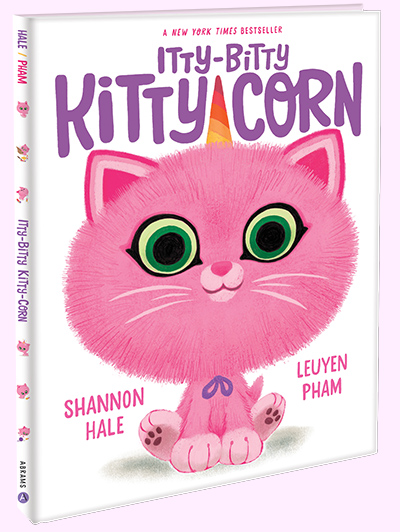
    Shannon Hale and LeUyen Pham’s Itty-Bitty Kitty-Corn is — pardon the pun — a unicorn: a 40-page, 413-word picture book that my toddler will not only sit through cover-to-cover but request again and again. That’s because it ticks off every box for S’s favorite books:

    1. A cute, cuddly main character
    2. A subject S loves (here, animals)
    3. Onomatopoeia
    4. Active, colorful illustrations
    5. Active, short, punchy sentences
    6. Repetition and word choices that invite interaction from the listener

    I’ll take them in turn, though many of these points can easily be combined differently under multiple topic headers. (In short, the reasons this is S’s co-favorite book are self-reinforcing.)

    1. A cute, cuddly main character

    This one’s pretty self-explanatory. Just look at Kitty:

    Book Cover for Itty Bitty Kitty Corn

    She’s adorable. And she prances and preens and trots and gambols all the way through the book:

    S LOVES these end pages, which open the book showing Kitty’s desire to be a unicorn, and the creation of her iconic horn.

    Even when (spoiler alert) Kitty gets sad, she remains utterly adorable. You just want to give her a big hug. S loves to look at all the pictures of Kitty throughout the book, helping to hold S’s attention through the text.

    2. Animals

    This one’s also pretty self-explanatory. S loves animals, and this is a book with animal characters. I will note that the type of animals in the book was not a selling point; just the mere fact of animal characters was what did it. Prior to reading this book, S was not into kitties, unicorns, geckos, or parakeets, but S left the book a fan of kitties, unicorns, and kitty-corns.

    3. Onomatopoeia

    Itty-Bitty Kitty-Corn uses well-placed, fun onomatopoeia. Kitty “neighs” (a favorite animal sound that immediately endeared the book to S). Her tail goes “poof.” The unicorn goes “clop clop.”

    The onomatopoeia is not over the top, but sprinkled in only where it makes sense to move the story along. And S loves to chime in with it.

    4. Active, Colorful Illustrations

    You can get a sense of this from some of the pictures above, but Kitty is constantly moving. Her expressions and actions change across and down the page.

    The fact that the illustrations frequently feature Kitty doing multiple different things on a given page help hold S’s attention — there are lots of varied illustrations that S can look at while I read the corresponding sentences, which makes it much easier to get through longer text blocks (and presumably make it easier for S to understand what the text is conveying when it uses new words).

    5. Active, Short, Punchy Sentences

    Itty-Bitty Kitty Corn may be on the absolute high end of word count for books S and I read together, but it does not feel long in the slightest. Shannon Hale’s text is phenomenally tight. Sentences are short, punchy, and active (and often tied to individualized illustrations per sentence). There are frequently no more than 2-3 sentences on a page. Those sentences are often no more than 5 words, making them easier for a young reader to follow (and adding to the rhythm of the story). Dramatic pauses are built into the writing, and also to the text layout:

    6. Repetition and Interactive Sentences

    Itty-Bitty Kitty-Corn makes great use of repetition and near repetition, as well as interactive sentences that let S anticipate and join in with me. S especially loves the onomatopoeia and saying “up up up” along with me.

    ***

    TL;DR – this book is adorable, and does so many things right for appealing to multiple age groups. I can easily see it remaining a favorite for a long time.

    Some quick stats on Itty-Bitty Kitty-Corn:

    Page count: 40 pages of what I would consider the “main” book

    Word count: 413

    Average word count per illustration: 10.86 (or 10.33 if you count standalone pages of text with pretty font as their own illustration)

    Average sentence length: 5.9 words per sentence (or 6.16 if you include semicolons and sentences that were broken over multiple pages and illustrations as single sentences)

  • Toddler Teaches…ANIMALS GO VROOM!

    Toddler Teaches…ANIMALS GO VROOM!

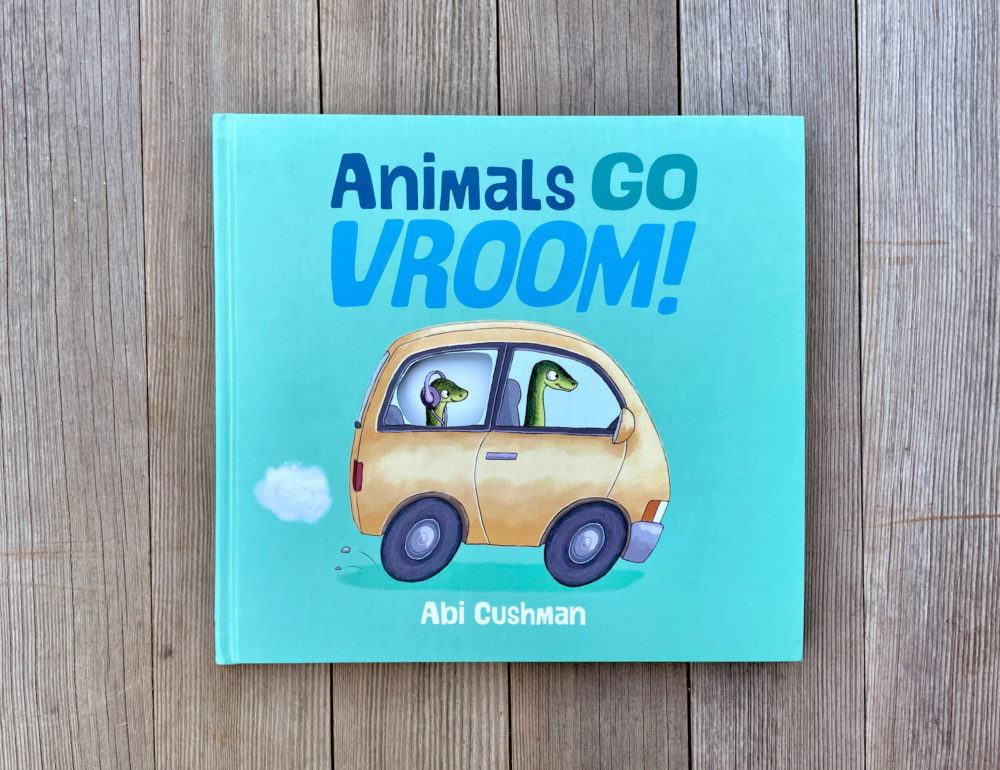
    It is only fitting that the first deep dive into my toddler’s favorite books is the brilliant Animals Go Vroom! by Abi Cushman. Animals Go Vroom! has been in a two-way tie for S’s favorite book for months, right from the moment S pulled it off a library shelf and was so transfixed we had to make it S’s first library book. Here’s why:

    1. Surprising, Interactive Page Turns that Follow a Pattern
    2. Active, Interactive Illustrations
    3. Combining Two Favorite Subjects (Animals and Transportation)
    4. Fun Animal and Transportation Sounds
    5. Evocative Word Choices in Short Sentences

    Each spread in the book follows the same interactive pattern. The left side of the book contains an animal sound seemingly related to an animal visible through a cut out on the right side of the book. The text invites the reader to guess what is making the sound, and to turn the page to finish the sentence.

    A huge thank you to Abi Cushman for providing the high quality book images for use in this blog!

    And when you turn the page …

    You see that the animal sound wasn’t an animal sound at all, but a transportation sound!

    S LOVES this. S loves saying “roar” and all the other fun sounds in the book (“hiss” and “awoooooooooo” are particular favorites). S loves the surprise page turns, and the fact that they follow a predictable pattern, which heightens the suspense and excitement of each page turn. S also loves turning the pages by jamming one hand into the cutouts (a fun textural element!) while I hold my breath and silently thank the publisher for using sturdy paper.

    Animals Go Vroom! is also a favorite because it does a lot to keep S’s attention.

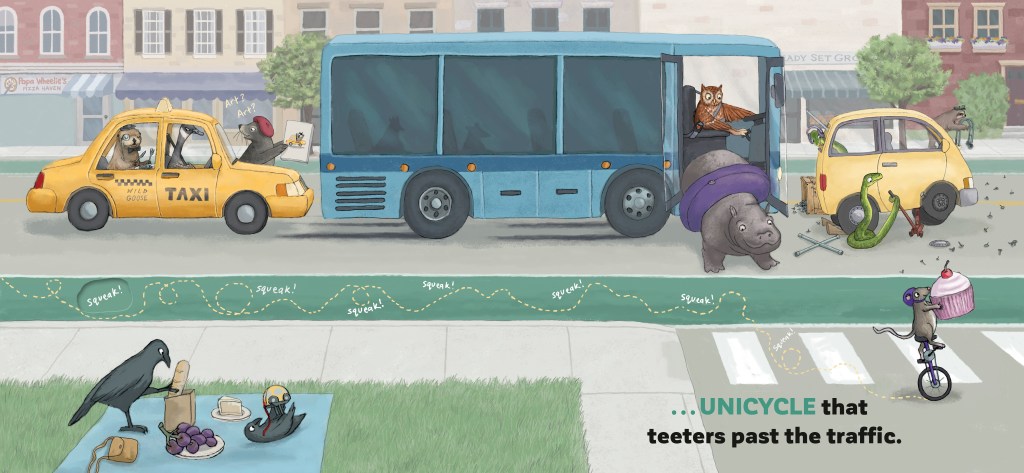
    Sentences are short, punchy, and active, with juicy word choices and alliteration. The truck doesn’t drive up the road – it rumbles. The unicycle doesn’t roll past the traffic – it teeters. The words aren’t just fun to say – they also sound like their meanings, which combined with the illustrations have added to S’s vocabulary.

    Complementing the text, the illustrations are active, bright, and colorful. They also include a lot of background details for us to sink our teeth into and engage with as we read.

    S loves to point out the hat on the tiger in both the “hidden” and fully revealed spreads above. In the spread below, S likes to point out the hippo (a favorite animal) and the picnic, bread, and cheese.

    The images in the story also build off each other, with whole stories happening in the illustrations. It’s both world building and word building. On each page, S and I can discuss everything that is going on beyond the text on the page. The detail in the illustrations also offers a lot of new, easy, and exciting words to learn and/or practice. In the unicycle spread alone, we have a mouse in a helmet riding with a cupcake; the baby crow has a toy; the mommy crow has bread, grapes, cheese, and a bag; there are hippos and snakes and owls; the painter is in a hat….

    These details not only make the story more interactive, but S’s interest in pointing them out builds vocabulary that S enjoys utilizing the next time we read the book.

    Put simply, there’s a reason why S requests this book multiple times a week. Check it out – I hope you love it as much as we do!

    Some quick stats on Animals Go Vroom!:

    Page count: 30 pages of what I would consider the “main” book

    Word count: 70

    Average word count per illustration: 4.67 (I have a hunch that word count per illustration is going to be lowest in the books we read the most, so I’ll be tracking that over time. Check back to see how that hypothesis holds up….)

  • Welcome to Toddler Teaches Writing!

    Hi everyone – thanks for checking out my blog, Toddler Teaches Writing! With a toddler at home, I read a lot of books. We are mostly still in the board book phase, but every so often a picture book becomes such a runaway winner that I can’t help but take note. This blog is about the ways that reading to my kiddo “Sam” is informing the ways I think about my own writing. I hope it helps you too!

    I will eventually do deep dives on Sam’s favorite picture books and what makes them winners, but for my inaugural post, I thought I’d go overarching and write about some of the commonalities in Sam’s favorites. So, without further ado, how to appeal to my under 2 year old:

    1. Pick a topic S knows (and loves)

    The most surefire way to get a repeat reading request is to pick a subject S knows and loves. Examples include: animals (any kind, but especially dogs and horses), vehicles (buses, airplanes, bulldozers, and excavators preferred), and food.

    Chana Stiefel’s Bravo, Avocado! is a winner because it features one of S’s favorite foods as the main character (and because of the gorgeous, active illustrations)

    Sam is constantly learning new things, and is also delighted by book subjects that enable showing off those new skills. This runs the gamut from alphabet books (ex: Chicka Chicka, Boom Boom) to pretty much anything else you can think of – if S has recently learned about it, S is excited to see it in print.

    A recent winner in this regard is Andrew Larsen’s The Bagel King, which I took out of the library for my own research days after Sam tried a bagel for the first time. S was ecstatic to read about bagels, and loved pointing out the bagels in the book.

    The Bagel King

    2. Have bright, active illustrations with relatable extras/background

    At this stage, while the text matters, the illustrations are pretty much make or break for S’s willingness to sit through a 32 page book. Illustrations engage S best when they are bright, active, and keep it moving (ex: multiple panels on a spread or lots of action and background to engage with), and when they have “cute” main characters.

    Shannon Hale and LeUyen Pham’s Itty-Bitty Kitty Corn is the paradigmatic example of hitting every note here – a fluffy, adorable main character, lots of action and motion, and many active images on a single page.

    Lots of our “winner” books also include additional things in the illustrations that S likes and can point out, even when not directly related to the words on the page. The Bagel King contains a full two page spread that has a dog and a bicycle, neither of which are directly related to the action, but which S loves to point out. Same goes for hats on characters and other things that enable S to use new vocabulary words to engage with the book as I’m reading it.

    I have also been surprised by how much S loves end pages. They tend to have lots of different kinds of pictures, and encapsulate the main thrust of the book in one easily accessible spot, making them particularly fun places to turn to and point out main characters or key objects.

    The vibrant end pages in Little Dumplings by Susan Rich Brooke and Bonnie Pang are a big hit.

    3. Use refrains

    Refrains are a great way to encourage interaction and feed into the general toddler love of repetition. When we get to a refrain, I can pause and S can “read” the story. Fun, easy to say words also fit this bill – S knows when they are coming and can interject those too, or have fun repeating them after I read them.

    “Chicka Chicka”
    “Boom Boom!”

    4. Use onomatopoeia

    Onomatopoeia is a value add to many of our repeat books, though not as broadly as I expected. If it’s an animal sound (“neigh,” “hiss,” “buzz”) it’s almost guaranteed to get interaction and a re-read request. But if it’s a somewhat random sound, the sound of something S isn’t familiar with (like a typewriter), or a “splat” type sound, it is less appealing right now.

    5. Keep it short

    The best books for us at this stage are ones that keep it short and active. 1-2 short, punchy sentences per page is ideal. (Really 1 sentence if you can swing it.) Anything longer and S winds up turning the page on me, or I have to make up something about the illustration rather than reading the actual text.

    ***

    I’d love to hear about the books that make the grade with the young readers in your lives. Drop them in the comments (depending on how you got here, you may need to click on the link in the post title to see the comment section), and they may make a separate blog post some day!

en_USEnglish
Powered by TranslatePress