Jennifer Tarr

Writing picture books for kids and their grown ups.

Category: Kittens

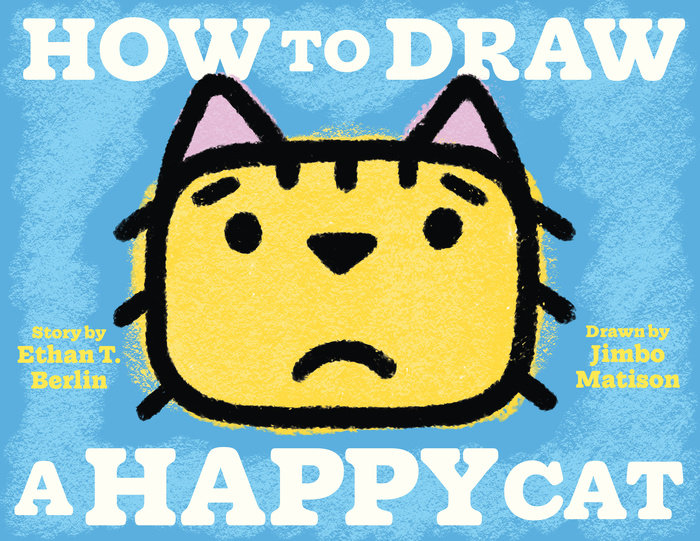
  • Toddler Teaches…HOW TO DRAW A HAPPY CAT

    Toddler Teaches…HOW TO DRAW A HAPPY CAT

    I first came across How to Draw a Happy Cat when our local children’s librarian suggested it for my own writing research. (Side note: Librarians are awesome. Ideas to support your local library here.)

    As a more advanced picture book (SLJ suggests it for grades K-2), I did not expect it to immediately enter S’s favorite book rotation. I should have. Here’s why:

    1. It combines multiple kid-favorite topics.
    2. The language is declarative and snappy.
    3. The book invites the reader to participate in the action.
    4. The illustrations are active and colorful.

    As pretty much all my previous posts have established, S’s current favorite book subjects are animals and transportation. If your book has animals and/or transportation vehicles, S will probably at least give it a spin. If your book combines animals and transportation vehicles, you have dramatically upped your odds that S will want to read your book, and likely more than once. (Exhibit A: Animals Go Vroom!, an all-time S favorite.)

    How to Draw a Happy Cat does one better, and introduces not only animals and airplanes, but also one of S’s favorite foods: pizza.

    This may be one of S’s favorite images in any picture book we’ve read. It’s got a cat eating pizza being flung from a catapult, all while hanging onto an airplane. Pretty much toddler heaven.

    It’s like Ethan Berlin was handed a list of S’s interests and told to craft a story around them. Even without a great story, S would be predisposed to flip through the story over and over again, just to look at pictures of cats, airplanes, pizza, and cats eating pizza on airplanes.

    But the story works. It’s a hysterical, modern, interactive version of If You Give a Mouse a Cookie. And while the story is complex, the way it’s written and illustrated extends the age range downward.

    The story starts by inviting the reader to participate in the action — drawing our main character.

    Learning how to draw a happy cat may be fun and easy, but no one said anything about keeping that cat happy…

    It goes on from there in the same vein – each time we think the cat is finally happy, something happens, and we have to draw/solve her next problem.

    The sentences are often short and limited to one or two per page, conveying complicated problems and emotions with clean, simple language that is easy for S to understand. (How is the cat going to get the pizza? We have to turn the page to find out!)

    The cadence is great for listening, and the interactive language choices also keep S engaged – S is getting all the credit for helping out our new friend Cat. (“Great! She’s so happy! Good job!”)

    The sentences are also frequently accompanied by an illustration per idea. This decision is genius from a craft perspective, because it gives the reader the impression that they are impacting the story by “drawing” new things as the narrator directs them to do so.

    It also has a possibly-unintended benefit from a toddler attention-span perspective. As with Itty-Bitty Kitty-Corn, the sentence-per-illustration model of picture book creation is crucial to keeping S’s attention in longer books because each sentence gives S a new thing to look at (and the new illustration reinforces S’s ability to understand what the text is saying).

    So while Ethan Berlin and Jimbo Matison probably almost certainly didn’t set out to create this book for an under two year old, a few simple choices turned this book into an unexpected repeat pick.

    How to Draw a Happy Cat By the Numbers:

    Pages: 40

    Word Count: 311

    Words Per Illustration: 7.78

    Words Per Sentence: 5.65
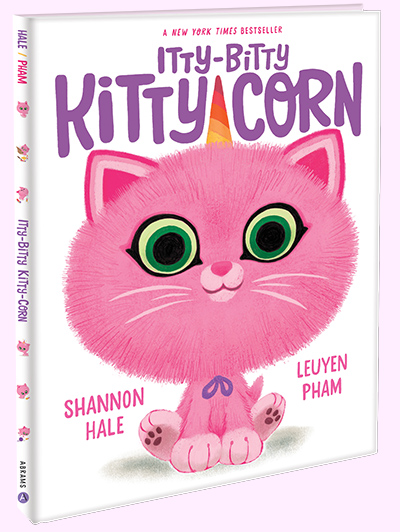
  • Toddler Teaches…ITTY-BITTY KITTY-CORN

    Toddler Teaches…ITTY-BITTY KITTY-CORN

    Shannon Hale and LeUyen Pham’s Itty-Bitty Kitty-Corn is — pardon the pun — a unicorn: a 40-page, 413-word picture book that my toddler will not only sit through cover-to-cover but request again and again. That’s because it ticks off every box for S’s favorite books:

    1. A cute, cuddly main character
    2. A subject S loves (here, animals)
    3. Onomatopoeia
    4. Active, colorful illustrations
    5. Active, short, punchy sentences
    6. Repetition and word choices that invite interaction from the listener

    I’ll take them in turn, though many of these points can easily be combined differently under multiple topic headers. (In short, the reasons this is S’s co-favorite book are self-reinforcing.)

    1. A cute, cuddly main character

    This one’s pretty self-explanatory. Just look at Kitty:

    Book Cover for Itty Bitty Kitty Corn

    She’s adorable. And she prances and preens and trots and gambols all the way through the book:

    S LOVES these end pages, which open the book showing Kitty’s desire to be a unicorn, and the creation of her iconic horn.

    Even when (spoiler alert) Kitty gets sad, she remains utterly adorable. You just want to give her a big hug. S loves to look at all the pictures of Kitty throughout the book, helping to hold S’s attention through the text.

    2. Animals

    This one’s also pretty self-explanatory. S loves animals, and this is a book with animal characters. I will note that the type of animals in the book was not a selling point; just the mere fact of animal characters was what did it. Prior to reading this book, S was not into kitties, unicorns, geckos, or parakeets, but S left the book a fan of kitties, unicorns, and kitty-corns.

    3. Onomatopoeia

    Itty-Bitty Kitty-Corn uses well-placed, fun onomatopoeia. Kitty “neighs” (a favorite animal sound that immediately endeared the book to S). Her tail goes “poof.” The unicorn goes “clop clop.”

    The onomatopoeia is not over the top, but sprinkled in only where it makes sense to move the story along. And S loves to chime in with it.

    4. Active, Colorful Illustrations

    You can get a sense of this from some of the pictures above, but Kitty is constantly moving. Her expressions and actions change across and down the page.

    The fact that the illustrations frequently feature Kitty doing multiple different things on a given page help hold S’s attention — there are lots of varied illustrations that S can look at while I read the corresponding sentences, which makes it much easier to get through longer text blocks (and presumably make it easier for S to understand what the text is conveying when it uses new words).

    5. Active, Short, Punchy Sentences

    Itty-Bitty Kitty Corn may be on the absolute high end of word count for books S and I read together, but it does not feel long in the slightest. Shannon Hale’s text is phenomenally tight. Sentences are short, punchy, and active (and often tied to individualized illustrations per sentence). There are frequently no more than 2-3 sentences on a page. Those sentences are often no more than 5 words, making them easier for a young reader to follow (and adding to the rhythm of the story). Dramatic pauses are built into the writing, and also to the text layout:

    6. Repetition and Interactive Sentences

    Itty-Bitty Kitty-Corn makes great use of repetition and near repetition, as well as interactive sentences that let S anticipate and join in with me. S especially loves the onomatopoeia and saying “up up up” along with me.

    ***

    TL;DR – this book is adorable, and does so many things right for appealing to multiple age groups. I can easily see it remaining a favorite for a long time.

    Some quick stats on Itty-Bitty Kitty-Corn:

    Page count: 40 pages of what I would consider the “main” book

    Word count: 413

    Average word count per illustration: 10.86 (or 10.33 if you count standalone pages of text with pretty font as their own illustration)

    Average sentence length: 5.9 words per sentence (or 6.16 if you include semicolons and sentences that were broken over multiple pages and illustrations as single sentences)

en_USEnglish
Powered by TranslatePress